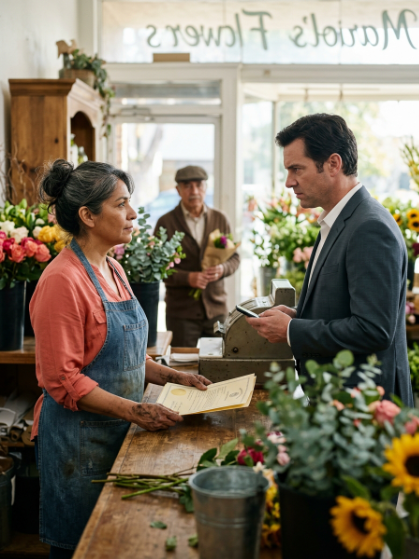
I pulled the fireproof box out from under the counter and set it on the wood between us.
Brandt actually smiled. “What is that, your recipe for potpourri?”
I opened it and took out the lease. One page, typed, signed by Mr. Okafor and my mother, and stamped and signed by a notary public on K Street, dated nineteen years ago.
“It’s the agreement,” I said, “that fixes the rent on this unit for as long as a Delgado operates a florist here. Signed. Witnessed. Notarized. It runs with the building, Mr. Coyle. Which means it runs with you.”
He took it. His smile got smaller as he read. Men like Brandt can read a document fast when there’s money in it.
“This wouldn’t hold up,” he said, but his voice had changed. “Handshake deals, side letters — there are ways around these.”
That’s when Mr. Alvarez stepped in from the doorway and set his little bouquet down on the counter.
“There aren’t, actually,” he said. “Not around a properly notarized lease covenant that’s been honored for nineteen years and runs with the land. I’d know.”
Brandt turned. “And who are you?”
“Hector Alvarez.” He took off his flat cap. “Retired. I spent thirty-one years as a real estate attorney in this county before I started buying flowers for my wife every Tuesday from this shop.” He nodded at the page in Brandt’s hand. “That’s enforceable. The notary stamp alone gets it past your first three arguments. And if you try to force her out anyway — change the locks, cut the water, the little tricks I’m sure you’re already thinking about — that’s not a rent dispute anymore. That’s harassment and constructive eviction, and I will personally walk Rosa into court and enjoy every minute of it.”
I have known Mr. Alvarez for six years. I knew his coffee order. I knew his late wife’s favorite was yellow freesia. I did not know, until that morning, that the quiet man who came in every Tuesday had spent three decades doing exactly the kind of law that could end Brandt Coyle’s whole strategy in a sentence.
That’s the thing about a flower shop. Everyone passes through it. Weddings, funerals, apologies, anniversaries. You learn a town one bouquet at a time. And the town, it turns out, learns you back.
Brandt tried for another minute. He always would. Then he set the lease down on the counter, very gently, like it had gotten hot.
“I’ll have my office review it,” he said.
“You do that,” Mr. Alvarez said pleasantly. “Have them call me. They’ll have my number by lunch.”
He left without buying the building’s way out of anything.
His office did call. Mr. Alvarez did answer. And the review came back exactly the way a nineteen-year-old notarized covenant comes back: airtight. My rent stayed fixed. The shop stayed mine.
But that’s not the part of the morning I think about.
The part I think about is why my mother did it in the first place.
She came to this country with even less than I have now. She cleaned houses and saved for eleven years to open Marisol’s Flowers. And when Mr. Okafor, God rest him, shook her hand and promised her a fair rent forever, she thanked him — and then she insisted they write it down and drive it to a notary that same afternoon.
He laughed at her. Told her his word was good. She told him she didn’t doubt his word; she doubted the world that would come after him. Landlords die. Buildings sell. New men in gray suits show up with calculators where their hearts should be.
“Mija,” she told me when I was a girl, watching her file that paper into the box, “kindness is a gift, but you put the important promises in writing. You protect the people who come after you. That is also love. The boring kind. The kind that holds.”
She died behind that counter at sixty-three, arranging an order for a wedding she didn’t live to see delivered.
For nineteen years I kept her boring, holding kind of love in a fireproof box and never needed it.
Then a man in a gray suit slid a notice across her counter, and my mother reached out from the past and stopped him cold.
The story got around the neighborhood the way stories do. People started coming in just to buy a single stem and shake my hand. The taquería owner Brandt had pushed out came by; I gave him flowers for his new place across town and we cried a little in the cooler.
Brandt sold the building within the year. The new owner is a young woman who grew up two blocks over. She came in, introduced herself, bought a bouquet for her grandmother, and told me, “Marisol’s isn’t going anywhere on my watch. My abuela bought flowers from your mom.”
A town learns you one bouquet at a time.
I framed my mother’s lease. It hangs by the register now, next to her photo, where Brandt’s notice never managed to land.
Some days I catch a customer reading it, puzzled, wondering why a flower shop frames a legal document.
I always tell them the same thing.
“That’s my mother,” I say. “That’s her telling me she had my back. She just wrote it down nineteen years early.”