Sofia answered on the second ring, like she’d been holding the phone.
“It’s you,” she said. “It’s really you.”
Neither of us knew how to start. So we just breathed at each other across two states for a few seconds, two strangers who’d shared a father and never a room.
Then she told me the thing she said couldn’t go in a message.
Our father had known about all of us.
That was the part that rearranged everything a second time. I’d spent the first hour after the results imagining a man with a secret double life, slipping between two families who didn’t know the other existed. A liar in plaid shirts.
The truth was stranger and, somehow, both better and worse.
Twenty-some years ago, before he ever met my mother, our father had a first marriage in Arizona. Three kids: Sofia, then her brother Marcus, then the youngest, Dani. When that marriage detonated — and from what Sofia described, it detonated badly — there was a custody war so ugly that the court, and her mother, cut him out almost entirely. New last names. A restraining order built on accusations Sofia, as an adult, had come to doubt. A clean, brutal erasure.
He moved across the country to start over. He met my mother. He had me.
And he made a choice I’m still turning over in my hands: he never told my mother or me about the first three, because the terms of that erasure were vicious and he’d been warned that any contact would be used against him. He believed staying away was the one gift he could still give those kids — to not drag them back into a war.
So he carried two griefs his whole life. The three children he wasn’t allowed to raise. And the daughter he was raising, who’d have been devastated to learn her gentle, honest dad had a hole in him that size.
“He found me when I turned eighteen,” Sofia said. “The order expired and he wrote me a letter the same week. We had six years before he passed. He told me about you, Allie. He showed me your picture. He said, ‘She doesn’t know yet. When I’m gone, if she ever does a test, she’ll find you. Don’t let her think I was a liar. Tell her I ran out of courage, not love.'”
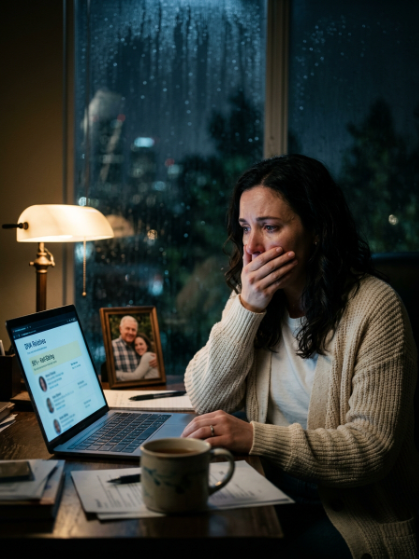
I sat in my little office with the rain coming down and I cried for a father I thought I’d finished grieving eight months ago.
Because here’s the cruelty of the timing. He died before I tested. He’d been ready for this conversation for years. He’d rehearsed it through Sofia. He just couldn’t be the one to have it, because he couldn’t bear to watch my face change.
So he left the truth where he knew it would eventually find me, and he left a sister to catch me when it did.
“There’s a box,” Sofia said. “He mailed it to me a year before he died. He said it was yours. He made me promise not to open it — that it was for the day you called.”
I flew to Phoenix three weeks later.
I’d love to tell you it was easy. It wasn’t, at first. Marcus, the middle brother, was angry — not at me, but at the whole shape of it, at a father who’d chosen distance and called it protection. Dani, the youngest, barely remembered him and didn’t know what she was supposed to feel. We were four adults trying to assemble a family from a man’s regrets.
But Sofia met me at the airport holding a sign with my name on it and our father’s same crinkled smile, and when she hugged me it didn’t feel like meeting a stranger. It felt like the back half of a sentence I’d been saying my whole life.
The box was full of him.
Photographs of all four of us he’d kept in the same album, side by side, like he’d been quietly raising us together in the only place he was allowed to — a shoebox. Birthday cards he’d written to Sofia, Marcus, and Dani every year and never been able to send, dated and sealed. A letter to me on top, in his handwriting.
I won’t share all of what it said. Some of it is just mine.
But the line I keep is this: “You were never my second family, and they were never my first. You were all just mine, kept in different rooms because I wasn’t brave enough or free enough to open the doors between them. I’m sorry I left you the key instead of the house. Use it.”
We use it.
Sofia and I talk every week now. Marcus came around — grief and anger are cousins, and they made their peace. Dani came to stay with me in Portland last summer and we drove the coast with the windows down.
Four people who grew up as only-children and half-stories are learning, late and clumsy and real, how to be siblings.
People hear this story and ask if I’m angry at him. For the secret. For the twenty years. For not being brave enough to just tell us.
I used to think I would be.
But I look at the album he kept — all four faces in one book, the doors he couldn’t open in life pressed together between cardboard covers — and I don’t feel cheated.
I feel found.
He ran out of courage, my sister told me he said. Not love.
I believe that now.
He just left the bravery to us.
And on a rainy night in Portland, with a spit tube and a discount code, I finally took the key out of the envelope.