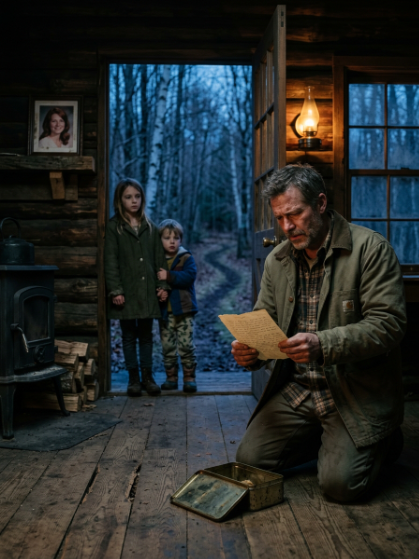
I got the children inside first. That part wasn’t a decision. It was just cold, and they were small.
I lit the woodstove and the kerosene lamp and gave them the only food I had — crackers, a can of soup, some cocoa I found in the back of a cabinet that Nora must have bought.
The girl, Sophie, watched me the whole time, the way you watch a stranger you’ve been promised is safe but don’t quite believe in yet. The little one, Toby, ate three crackers and fell asleep sitting up.
“Sophie,” I said gently, “I need you to tell me where you came from. Down the trail?”
She nodded.
“And your mom is down there?”
Another nod. “She’s too tired to walk up. She said if you were here, you’d come down. She said Nora promised.”
Nora promised.
My wife had been dead for two years, and a nine-year-old in my kitchen was repeating a promise I’d never heard her make.
I read the journal page again. Follow the trail at dusk. I should have told you. I’m sorry I ran out of time.
So at dusk, with a flashlight and a girl who knew the way better than I did, I followed Nora’s trail into the birch trees.
It led to the old hunting cabin a half-mile back, the one we’d never used, the one I’d assumed was empty and falling in.
There was a lamp on inside.
And a woman on the cot, too weak to stand, who looked up at me with my wife’s eyes set in a thinner, harder-lived face.
“You’re Mark,” she said. “God. You look just like the picture she sent.” She started to cry. “I’m Cara. I’m Nora’s sister.”
Nora didn’t have a sister.
That’s what I’d believed for the eleven years I loved her. An only child, she’d said, from a family she didn’t talk about.
It wasn’t true. It was a wound she’d dressed up as a fact.
Cara told me the rest in pieces, over the next hour, while the kids slept up the trail.
There had been a sister. Younger. Years ago Cara had fallen into addiction, and the family — strict, proud, unforgiving — had drawn a line and made Nora choose. Choose the family or choose the sister who kept relapsing and breaking their hearts.
Nora chose the family, on the outside. She stopped speaking Cara’s name at dinners. She let them believe the sister was gone.
But she never actually let go.
For years she sent money to a P.O. box. Letters. A standing promise: when you’re ready, when you’re really ready and you’ve got nothing left and nowhere to go, there’s a cabin in Vermont, and a good man, and a door that opens.
Cara got clean. Two years clean now, she told me, with the fierce pride of someone who counts the days. She’d finally gotten ready.
And by the time she came looking, Nora was already gone.
“I didn’t know she died,” Cara whispered. “I came up the road and the house was dark and I thought — I thought she changed her mind about me. I’ve been in that cold cabin three days trying to decide if I had the right to knock on a dead woman’s husband’s door with two kids and no explanation.”
That’s the part that breaks me, still.
Nora ran out of time. She’d built the whole plan — the trail, the note under the floorboard, the promise — and she meant to tell me. She must have meant to tell me a hundred times. And then a Tuesday came that none of us expected, and the telling never happened, and her last act of love sat sealed in a rusted tin under our floor for two years while her sister sat three days away in the cold, afraid to knock.
We didn’t get the reunion Nora wanted. She didn’t get to open the door herself. She didn’t get to hug the sister she’d protected in secret or meet the niece and nephew she was clearly saving that cabin for.
That grief is real and I won’t pretend it away.
But here is what I could do.
I could keep the promise she ran out of time to keep.
I helped Cara up the trail that night, slow, one arm around her, the flashlight shaking in the cold. I put her by the woodstove. I gave the kids my bed. I called a doctor friend in the morning, and then a clinic, because Cara was sicker than just tired — the years had cost her body something, the way they do.
She’s better now. Not perfect. Better. She and the kids took the small cabin, fixed up and warm, and I’m two hundred yards up the trail, which turns out to be exactly close enough to be family.
Sophie calls me Uncle Mark. Toby just calls me Mark and falls asleep on me anyway.
I never did sell the place.
The man who couldn’t let go — that’s what they called me. Turns out the thing I couldn’t let go of was the one thing that needed me to stay.
Some nights I walk Nora’s trail at dusk, the way her note said.
I used to walk it looking for a ghost.
Now I walk it to check on her sister’s porch light, to make sure it’s on.
It always is.
I think that’s what she was really asking me to find.