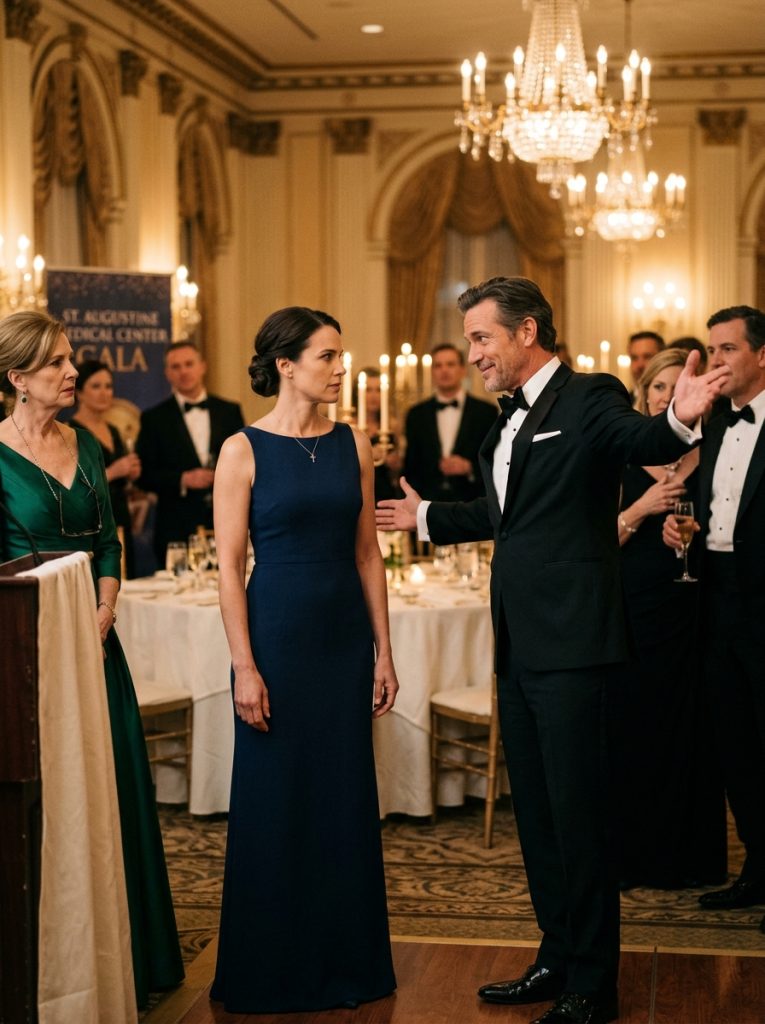
I climbed the three steps to the stage while two hundred people held their breath.
Diane handed me the microphone and squeezed my arm. “Whenever you’re ready, Grace.”
Behind me, I heard Preston Vance finally find his seat. Hard. Like his legs had stopped agreeing with him.
I didn’t gloat. Twenty-two years in an ICU teaches you that the loudest person in any room is almost never the strongest one in it.
“Good evening,” I said. “For those of you I haven’t met — my name is Grace Bellamy. I’ve been a nurse at St. Augustine for twenty-two years. And since last spring, I am the chair of this hospital’s board of directors.”
I let that land.
I watched it travel from table to table. I watched it reach Preston and go off like a flashbulb behind his eyes.
“Some of you already know why we’re really gathered tonight,” I went on. “There is a proposal before the board to close our medical ICU and move that funding into a new surgical pavilion. A pavilion that would carry one surgeon’s name.”
A few heads turned toward Preston. He had gone the gray of old newspaper.
“The board votes on that proposal in eleven days,” I said. “Before anyone asks you to put your name on a wall, I wanted you — the people who fund this place — to know exactly what your money already buys.”
So I told them.
I told them about the man in Bed 4 who flatlined twice on a Tuesday and walked out of our doors a week later on his daughter’s arm. I told them about nurses working double shifts because we run short every night, who hadn’t seen a raise in three years while the surgical budget tripled. I told them about a memo, which I had read with my own eyes, that called my unit “a drain on margins.”
I never raised my voice.
I didn’t have to.
When I finished, the room stood up. Not for the surgeon with the silver cufflinks. For the floor he had tried to erase.
Preston caught me afterward by the coat check, and the charm was gone. What sat underneath it was not pretty.
“You ambushed me,” he hissed. “You let me stand there and—”
“You told me to refill the coffee,” I said.
“Do you have any idea how many donors I bring to this hospital?”
“I do,” I said. “I also know how many patients you quietly transferred off our floor the week before every quarter closed, so the deaths wouldn’t show up in your numbers. I have the transfer logs, Preston. I’ve had them for months.”
His mouth opened. Then closed.
For once in his life, the man had nothing to say.
Eleven days later, we sat in the boardroom on the fourteenth floor, the Charles River gray through the windows.
Preston walked in confident again. He’d spent those eleven days making calls, leaning on the two board members he golfed with on Saturdays.
He had miscounted.
He presented his proposal with a glossy deck. Growth. Prestige. Donor appeal. He smiled at me like the gala had never happened.
Then I asked our controller to put up the second set of numbers. The real ones. Staffing ratios. Readmission rates. The human cost, measured in actual people, of closing the unit that caught the very patients his pavilion would create.
And then I told them the part Preston never bothered to learn.
“Forty-one years ago,” I said, “this hospital almost closed its charity ward. A nurse on this floor left her entire estate to keep it open. It became our medical ICU. Her name was Eleanor Bellamy.”
I let them look at me.
“She was my mother. I started here as a candy striper at sixteen, in the unit she saved. I have spent my whole life paying back a debt this hospital didn’t even know it was owed. So no — we are not closing it to build a monument.”
The vote wasn’t close.
The proposal died seven to two. The two were Preston’s golf partners, and they couldn’t meet my eyes when they raised their hands.
His contract came up for renewal that same quarter. The board declined to renew it. The pavilion idea died with it. He landed somewhere in Phoenix within the year, smaller title, no wall with his name on it.
The ICU stayed open. We hired six nurses. The staffing ratios on my floor are now written into policy — a policy the board named, over my objection, the Bellamy Standard.
I still work the floor three nights a week. I still flush the lines and learn the families’ names and sit in the hard chair at three in the morning when someone is afraid to be alone.
The chair of the board, in scrubs, holding a stranger’s hand in the dark.
My mother would have liked that part best.