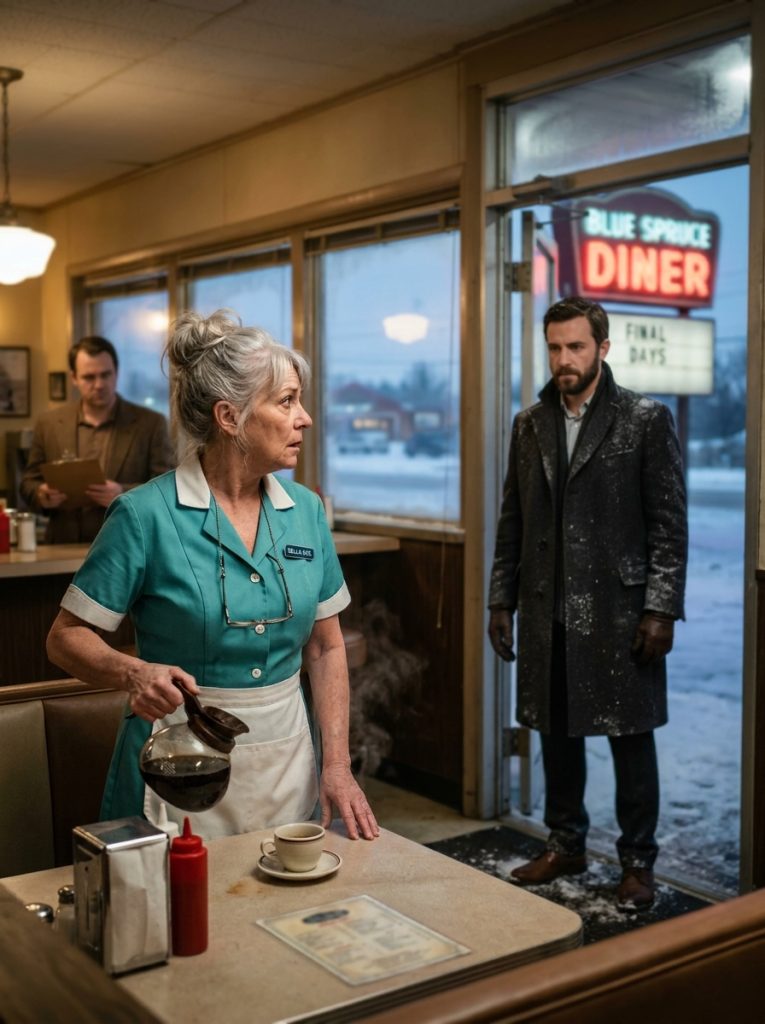
“You gave this place away one slice of pie at a time, Della. That’s why we’re closing.”
The owner’s son said it loud, in front of the whole diner, on our second-to-last week open.
I just kept pouring coffee. I didn’t tell him about the booth in the corner. Or the blizzard. Or the boy.
My name is Della Mae Foster, and I’ve worked at the Blue Spruce off Exit 9 on I-80 for thirty-one years.
The new owner is a decent man who inherited the place along with a stack of debt he didn’t ask for. His son Wes is another story. Wes carries a clipboard and a chip on his shoulder, and he’d decided the reason the diner was failing was me. Too many free refills. Too much pie “for the regulars.” Too soft to run a business.
“FINAL DAYS,” said the plastic letters out on the marquee. Wes put them up himself, a little too cheerfully, snapping each letter into the board like he was proving a point.
So that snowy Tuesday at dusk, with the parking lot going blue under the falling snow, I started cleaning out the corner window booth. The one I never let the busboys touch. Wes watched me wipe it down and rolled his eyes. “Sentimental over a booth. No wonder we’re broke.”
He didn’t know what that booth was.
Ten years ago, on the worst blizzard this stretch of interstate had seen in a decade, a young man walked in off the highway half-frozen. No real coat. No money. Just a backpack and lips gone blue and a look in his eyes I’d seen before in people who’d run out of options.
The truckers had all pulled off. The state had closed the road. And this kid — couldn’t have been twenty-three — asked, real quiet, if he could just sit a while and warm up, because the bus station was locked and he had nowhere to go.
The old owner would’ve said no. Rules are rules, liability, all that.
But it was me on the night shift. So I poured him coffee he couldn’t pay for, made him a grilled cheese and a bowl of chili, and when he tried to head back out into the whiteout at midnight, I told him absolutely not. I sat him down in that corner booth, gave him a stack of clean dish towels for a pillow, and let him sleep there until the plows came through at first light.
In the morning I pressed two twenties into his hand for a bus ticket and a hot breakfast. He cried. A grown young man, crying into a paper napkin. He said, “I’m going to remember this, ma’am. I promise you I will.” And he walked out into the cold and I never saw him again.
I never even knew his name. I sure never expected to.
I’d just finished wiping down that same booth, ten years later, when the bell over the door rang.
A man stepped in out of the snow. Long charcoal overcoat that cost more than my car. Leather gloves. A neat beard now, and calm, steady eyes.
He didn’t glance at the menu board. He didn’t ask for a table. He looked straight at the corner booth, walked over, slid into the exact same seat, and said:
“I’ll have the blizzard special. Grilled cheese and a bowl of chili. Like last time.”
My coffee pot nearly slipped out of my hand.
“Last time,” I said.
“Ten years ago. February. You wouldn’t let me leave.” He smiled, and there it was — the kid under the man. “You gave me forty dollars and your dish towels. I told you I’d remember.”
His name was Sam. That freezing night he’d been twenty-three, running from a foster placement that had aged out and left him with nothing, headed west on a rumor of work. The forty dollars got him to Denver. The work became a trade, the trade a company, the kind of success that lets a man walk into any room he wants.
He’d been looking for the Blue Spruce for two years — couldn’t remember the town, just “Exit 9” and a waitress with silver hair and a diner that smelled like coffee and pie. He’d passed three wrong exits before he saw our sign.
“I almost didn’t make it in time,” he said, and nodded at the marquee glowing FINAL DAYS through the frosted glass. “Heard you were closing. From the woman at the gas station down the road.”
Wes was hovering by the register, suspicious, ready to tell the fancy stranger we were closing and to make it quick.
Sam reached into his coat. Wes tensed. And what Sam pulled out wasn’t a wallet for the chili.
It was a folder.
“I had my lawyer draw these up before I drove out,” he said, sliding it across the Formica. “I’d like to buy the Blue Spruce. The building, the debt, the land. All of it. At a price that lets the owner walk away clean instead of bankrupt.”
Wes made a sound like a startled goose.
Sam went on, looking at me the whole time. “On two conditions. One — the marquee comes down tonight. We’re not closing. Two —” and here his voice caught a little “— Della Mae runs the place. Title of her choosing. Because the only reason there’s anything here worth buying is that ten years ago somebody on the night shift decided a frozen kid was worth a grilled cheese.”
I had to sit down. I sat right there in the corner booth across from him, in my teal uniform, fifty-eight years old, and cried into a napkin the way he once had.
He bought it. All cash, fast, no drama. The owner got out from under the debt and sends Sam a Christmas card every year. Wes learned that the lady giving away pie had been the diner’s best advertising all along; Sam kept him on, but under me, and the clipboard’s a lot quieter now.
We took the FINAL DAYS letters down that same night. Sam climbed the ladder himself, in his thousand-dollar coat, snow in his beard, and pulled them off one by one.
There’s a small brass plate on the corner booth now. It doesn’t have my name on it, though Sam wanted it to. It just says: “Reserved for anyone who needs a warm place to sit. On the house.”
I think about how close I came to wiping that booth down for the last time and locking the door forever — how a kindness I’d half forgotten was out there the whole time, finding its way back through a snowstorm.
You never know which cup of coffee comes back around.
Comment “BLUE SPRUCE” if kindness always finds its way home. ☕