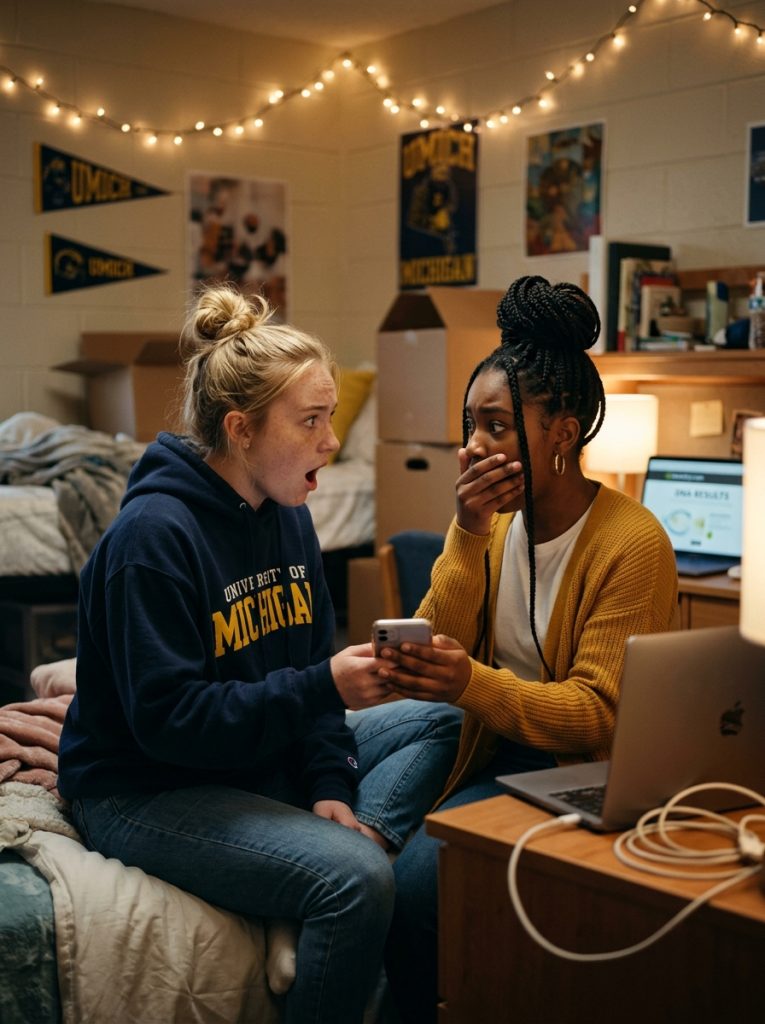
The app said “processing” for three days. When it finally loaded, there was a number on the screen that neither of us could explain. And once you see a number like that, you can’t unsee it.
We only took the test because it was a dorm thing. Half our freshman floor did it — spit in a tube, mail it off, compare whose ancestry was more interesting. Imani and I got randomly assigned as roommates in August by a housing algorithm at a university in Ann Arbor. By October we were doing each other’s laundry and finishing each other’s sentences. People kept stopping us in the dining hall to ask if we were sisters, because we have the exact same weird straight nose and the same eyebrows.
“Imagine,” we’d say, and laugh.
So we opened our results side by side on my twin bed, fully expecting to find out she was 3% Viking and I had a cousin in Ohio.
Both our phones buzzed at the same second. Same notification.
“You have a close family match.”
Then a name. Each other. Shared DNA: 25%.
I laughed, because obviously it was a glitch. Then Imani went quiet. She’s pre-med. She knew before I did exactly what 25 percent means.
Not cousins. Not a fluke. Half-sisters.
We sat there on the bed doing the math out loud, our voices getting smaller. Her dad “wasn’t in the picture.” My dad traveled constantly for work when I was little — gone Monday, back Friday, for years. Two different cities. Two different last names. And one number on a screen insisting that somewhere, somehow, we shared a parent.
I called my mom. She went silent for ten full seconds — I counted — and then she said, in a voice I’d never heard her use, “Sophie. Who told you to take that test?” Imani called her own house and her mother hung up on her.
Neither of them would say the one thing we were begging them to say.
So at 11 p.m. we got in my car and drove ninety minutes to the only person Imani thought might actually tell us the truth: her grandmother, in a little house outside Toledo, who Imani said had “never been good at secrets.”
Her grandmother opened the door in her robe, looked at the two of us standing on her porch with our matching noses and our phones in our hands, and she didn’t even ask why we’d come. She just sighed, this deep, old sigh, and said, “You found each other. Lord. I always thought you might.”
She made us tea. And she told us.
Twenty years ago, before either of us was born, my father — David — and Imani’s mother were together. Young, serious, the real thing. When she got pregnant, David panicked. His own family leaned on him hard; there was money involved, expectations, another relationship already starting. He left. He set up quiet payments through a lawyer on the condition that no one ever speak his name. Imani’s mom, proud and hurt, agreed, and told her daughter only that her father “wasn’t around.” A year later David married my mother and never told her any of it. Imani was the secret he buried so he could start clean.
“He paid,” her grandmother said, “but he never came. And your mother,” she nodded at Imani, “decided you didn’t need a man who’d only send checks. So she let it die. I think she hoped it would stay dead.”
It didn’t. A housing algorithm and a $79 spit kit dug it right back up.
Here is the part the parents didn’t plan for.
Imani and I drove home at 2 a.m., wrung out, furious at people we loved, grieving a story we’d been handed without our consent. And somewhere on I-75 in the dark, Imani said, “They spent twenty years keeping us apart for their reasons.” And I said, “Yeah.” And she said, “I don’t have to keep doing that. For their reasons.”
We confronted my dad that weekend. He cried. He admitted all of it — the panic, the lawyer, the cowardice. It’s not fixed; some things between him and me may never be fully fixed, and Imani is still deciding what, if anything, she wants from him. That’s hers to decide.
But here’s what we decided together, the two of us. We requested to stay roommates next year. We’re getting an apartment junior year. She came to my house for Thanksgiving and I’m going to hers for spring break. My little brother has a new big sister and he is thrilled about it.
Our parents made a choice twenty years ago to pretend we didn’t exist to each other.
We made a different choice. We were assigned as strangers in room 214. We walked out of that DNA result as sisters — and that part, finally, nobody got to decide for us but us.