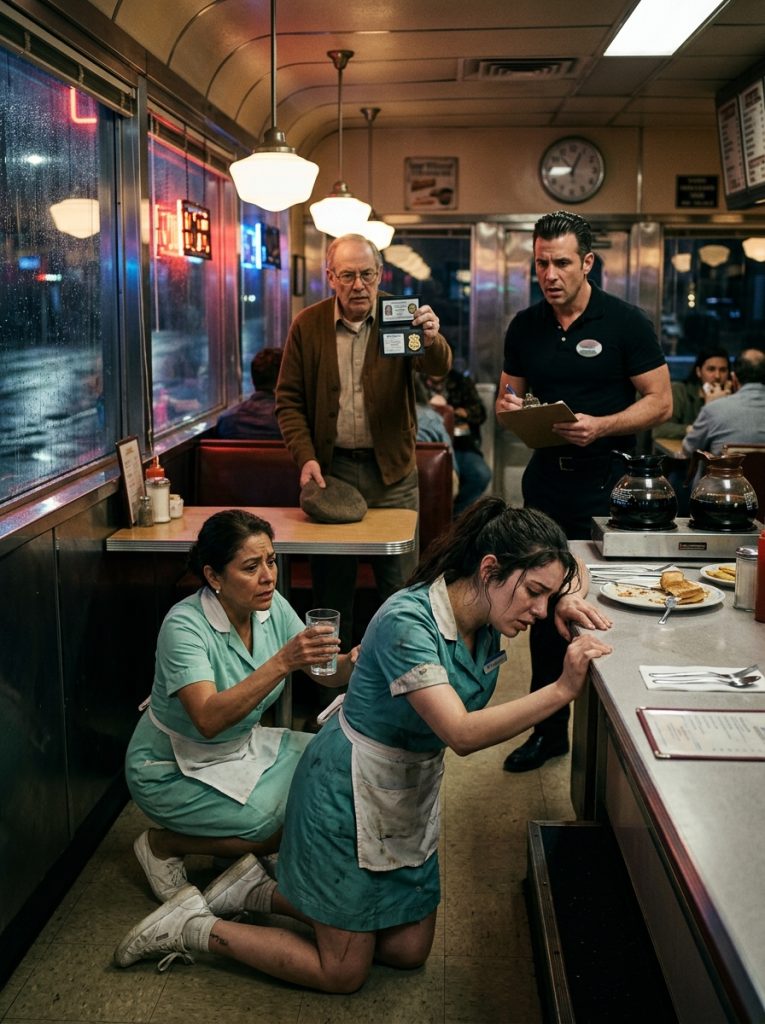
I was on the floor behind the counter when the quietest man in the whole diner stood up and held something in the air I never thought I’d see in real life.
Third double in a row. Let me say that again, because management liked to pretend it wasn’t happening: my third sixteen-hour shift in three days at a 24-hour diner in Pittsburgh. Chad, the shift manager, scheduled me a double, then “asked” me to cover the overnight when Becca called out. When I said I hadn’t slept, he gave me his favorite line: “There’s plenty of girls who’d want these hours.”
So I stayed. Rent was due. Tips are decent at 2 a.m. when the bars let out.
We didn’t get real breaks. Chad would clock us out for a thirty-minute lunch we never actually took, then pocket the overtime difference on the books. Everybody knew. Nobody said it out loud, because when you’re living check to check you need the job a lot more than you need to be right.
There was a regular in booth six. Older man, brown cardigan, flat cap, wire glasses. Three nights a week. Patty melt, coffee, exact change, barely a word. I figured he was lonely. I always made sure his coffee was hot anyway, because my grandmother raised me that way.
Somewhere past midnight on that third shift, the floor tilted. I remember reaching for the counter. I remember Marisol’s voice coming from very far away, saying my name. Then I was down on one knee, the pendant lights were too bright, and my legs just would not answer.
And through all of it, I heard a chair scrape.
The man from booth six crouched down next to me first. Calm. “Easy. Don’t try to get up. Head between your knees, that’s it. When did you last eat?” I couldn’t remember. He nodded like that confirmed something he already suspected.
Then he stood, took out a worn leather wallet, and flipped it open. A state seal caught the light.
“Ma’am, stay down a moment,” he said gently to me. Then he turned to Chad, and his voice changed entirely. “I’m an investigator with the state labor board. My name’s Alan Whitcomb. I’ve been eating in this diner for six weeks.”
Chad’s clipboard hit the floor.
“I have six weeks of your posted schedules,” Alan said, nodding toward the wall. “I have photos of that time clock at open and close. I have receipts time-stamping when these employees were supposedly clocked out for lunch and were, in fact, serving me coffee. And I have three signed statements.” He looked at Chad over his glasses. “Including tonight. You just pressured a visibly ill employee into a sixteen-hour shift with no break, in front of a state official. I’d stop talking now, if I were you.”
The whole diner went silent except for the coffee machine gurgling.
It turned out somebody had tipped the labor board months ago — I still don’t know who, one of the cooks maybe — and they don’t announce themselves. They send someone in to order a patty melt three nights a week and watch.
What happened after happened fast.
The investigation went up the chain past Chad to the owner. They pulled the payroll records, and the “missing” lunch breaks added up to real money — months of unpaid wages and overtime stolen off the top, from people who counted every dollar. Every server and cook on those schedules got back pay. Mine was almost three thousand dollars. I cried in my car when the check came, the good kind of crying.
Chad was fired. So was the district manager who’d approved his schedules. The owner, facing a fine that could have closed the place, decided he’d rather not, and brought in someone new to run the floor.
That someone, it turned out, was supposed to be hired from outside. But Alan Whitcomb wrote a line in his report I didn’t find out about until later: that during six weeks of observation, the most senior person actually holding the floor together, training new hires, and covering for management’s failures was a server named Rosie Delgado.
They offered me shift lead. Real salary. Real breaks — mandatory ones, posted on the wall, the law in a frame. The first thing I did was build a schedule where nobody works a third double in a row, because I remember exactly what that floor feels like from one knee.
Mr. Whitcomb still comes in. Booth six. Patty melt, coffee, exact change. He talks a little more now. Last week he left his usual exact change and, under the saucer, a note in careful handwriting: “Hot coffee even when you were running on empty. That’s how I knew which one of you to look out for.”
I keep it in my apron pocket.
Funny thing about being underestimated. The people who treat you like you’re invisible never notice the quiet man in the corner who’s watching how you treat everybody else.