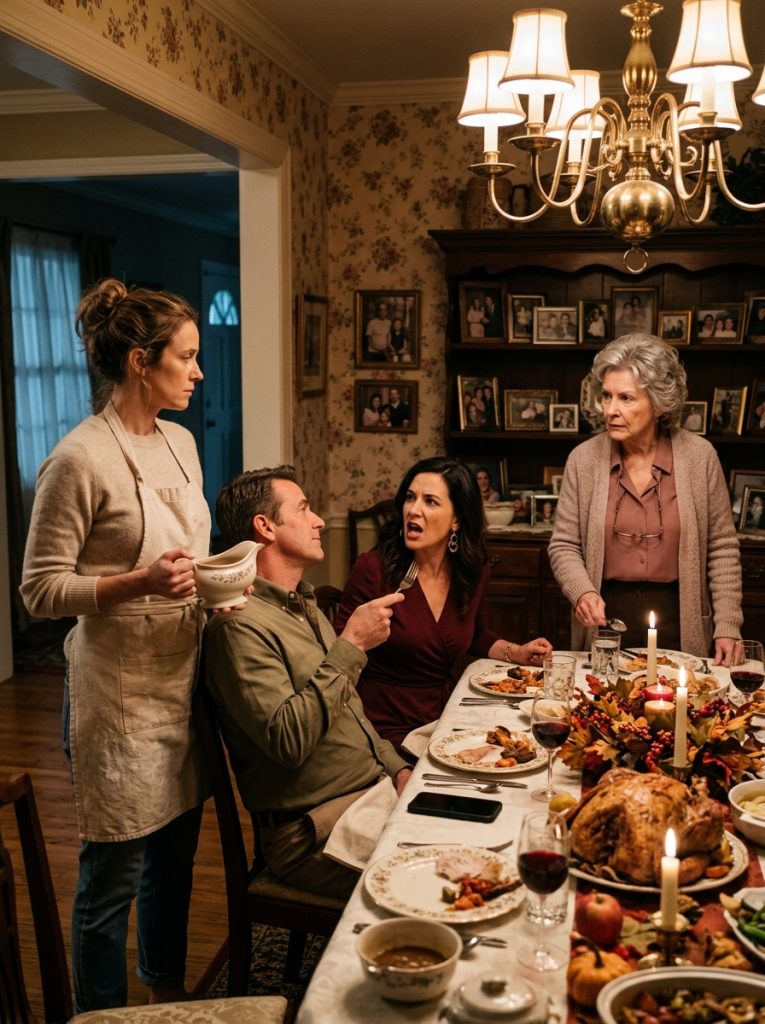
My brother waited until the turkey was carved to call me a freeloader in front of the whole family. I didn’t argue. I just kept passing the gravy. My mother had taught me that the people who talk the most at the table usually did the least to set it.
For three years I’ve lived in my mother’s house in Columbus. To Greg and Tara, that single fact is a crime they bring up at every holiday like a tradition. “Hannah lives off Mom.” “Hannah doesn’t even pay rent.” “Must be nice.”
What they leave out is everything else.
I moved in the week Mom left a burner on for the third time and didn’t notice. I do her insulin at 6 a.m. and again at night. I drive her to dialysis three times a week and sit in the waiting room with the same four hours of my life I’ll never get back, every week, for three years. I sleep with my door open so I can hear if she falls. I quit a job I liked because she needed someone who could be there at 2 p.m. on a Tuesday, and “there” doesn’t pay.
Greg flew in from Denver that morning. Tara drove over an hour before dinner. They visit twice a year and post “miss you Mom, my hero 💕” the other 363 days.
So at Thanksgiving, Greg leaned back, pointed his fork at me across the candles, and announced it to the table: “Must be nice, though, right? No rent, no job, just living off our mother in the house we all grew up in.”
Tara jumped in like they’d rehearsed it. “We really should talk about the house. While Mom’s here to weigh in. Split three ways, fair and square.”
I felt my face go hot. I set down the gravy boat. I opened my mouth.
And then my mother — Eleanor Boyd, seventy-four years old and all of five feet of her — stood up.
It takes her a minute now. She braced her small hands on the table and tapped her water glass with a spoon until the room went quiet, and when she spoke it was in the clear, certain voice I hadn’t heard since before she got sick.
“I’ve decided what happens to this house,” she said. “And it’s simple. It goes to whoever actually showed up for me this year. So let’s go around the table. Tell me what you did for me since last Thanksgiving. Greg — you start.”
Greg’s smile fell off his face.
The silence stretched so long I heard the furnace kick on in the basement.
“I — I called,” Greg said finally. “We talk.”
“You called on my birthday,” Mom said. “For four minutes. I timed it, because it was the only call I got that day that wasn’t a pharmacy reminder.” She turned. “Tara?”
Tara stared at her plate. “I’ve been really busy with the kids—”
“I know,” Mom said, not unkindly. “Everyone’s busy. Busy is the most popular reason in this family.” She looked around the table, slow, at all of them. “Now. Who took me to dialysis on Christmas Eve? Who learned to give me my shots so I didn’t have to move into a facility? Who sleeps with her door open every night so I’m not alone if I fall?”
Nobody said it. So Mom did.
“Hannah.” She reached into the pocket of her cardigan and pulled out a folded envelope with my name on it, and set it on the table in front of me. “I had Mr. Delaney draw it up in September. The house is already in Hannah’s name. Not in my will — done. Finished. While I’m still here to defend it, so nobody can stand over my grave and call my daughter a thief.”
I couldn’t move. Greg’s mouth opened and closed like a fish.
“That’s not fair,” Tara said, her voice climbing. “We’re your children too—”
“You are,” Mom said. “And you’ll always be my children, and you’ll always have a place at this table. But the house goes to the one who lived in it with me. That’s not a reward, Tara. That’s just the truth, written down.” She sat back down, a little out of breath, and patted my hand. “I’m tired of pretending the dishes wash themselves.”
I opened the envelope later, alone, after they’d gone. Inside was the deed, my name on it. And tucked behind it, a second sheet in my mother’s shaky handwriting — a list. Three years of dates. Every dialysis run. Every 2 a.m. Every shot. She’d kept a record of all of it, quietly, the whole time. At the bottom she’d written: “So you’ll know I saw you. Even when no one else did. — Mom.”
Greg and Tara don’t call much now. Maybe that’ll change; maybe it won’t. I’ve stopped organizing my heart around their schedule.
What I know is this. The house was never really the point. The point was a woman who couldn’t move fast anymore, but who stood up at her own Thanksgiving table, tapped a glass, and made absolutely sure that the daughter who showed up got told so out loud — by the one person whose word could never be argued with.
I keep her list in the kitchen drawer. On the hard days, I read it.