I Shared My Only Meal With a Mute Boy and Saved a Broken Family
PART 3 (FULL STORY)
The parking lot of the grocery store fell completely silent, save for the low, rhythmic idle of the three armored SUVs and the harsh whistle of the December wind through the light poles. Vincent Moretti stood frozen in the headlights, his broad chest rising and falling as his gaze dropped from his lieutenant’s raised weapon to his seven-year-old son. Noah stood planted between us on the icy curb, his small hands curled into tight fists, his chin raised in fierce, unyielding defiance.
“Stand down,” Vincent commanded, his voice dropping into a register that made every bodyguard instantly holster their firearms. “Lower the guns. Step back to the perimeter.”
The lieutenant, Marco, blinked in disbelief. “Boss, we don’t know who she is. Protocol dictates—”
“I said step back, Marco,” Vincent cut him off with razor-sharp finality.
He didn’t spare another glance for his men. Instead, the man who controlled half the commercial docks and private finances in the tri-state area slowly sank to one knee on the salt-stained pavement directly in front of me. He looked at my cracked boots, the frayed hem of my thin canvas coat, and the violent shivering I could no longer suppress. His dark eyes, which had looked so terrifying moments before, were flooded with an emotion that was raw, humble, and completely disarmed.
“Ma’am,” Vincent spoke softly, his deep voice trembling with reverence. “My name is Vincent Moretti. What you just gave my son is something all the money in this city could never buy.”
Without another word, Vincent slipped off his heavy, fur-lined cashmere overcoat and stepped forward, draping it gently around my trembling shoulders. The radiant warmth trapped in the wool hit me like a rush of life, thawing the bitter numbness that had settled into my collarbones.
“Noah has not spoken a single syllable in seven hundred and thirty days,” Vincent whispered, looking at his son with tears glistening against his dark eyelashes. “Not to me. Not to his doctors. Not to anyone. And you fed him while your own stomach was empty.”
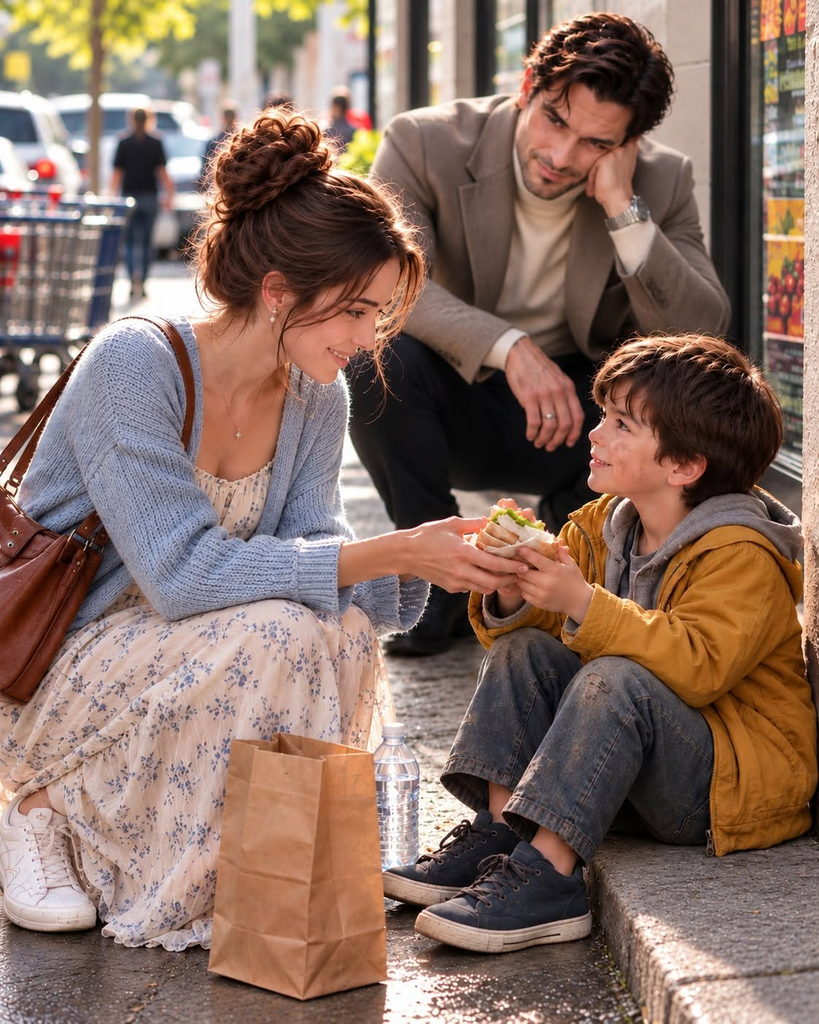
Noah reached up, taking his father’s gloved hand with one small palm while keeping his other hand locked around the cuff of my borrowed coat. “She was hungry, Daddy,” the boy said again, his voice gaining strength with every word. “Her hands were shaking from the cold, but she gave me her sandwich anyway. She said she wouldn’t leave me alone. Can we take her home?”
Vincent closed his eyes for a long second, letting out a ragged breath that billowed like white smoke in the freezing air. When he opened them, he met my eyes with an intensity that held no threat, only an unbreakable vow.
“Marco,” Vincent ordered, rising smoothly to his feet and lifting Noah into the crook of his arm. “Take her tote bag. Open the center vehicle. We’re going home.”
The ride across the city was unlike anything I had ever experienced. The executive SUV glided silently over the snow-slicked avenues, the interior smelling of polished leather, cedarwood, and heated upholstery. Noah sat firmly between Vincent and me, his little fingers laced through mine as if terrified that letting go would make the miracle vanish.
In slow, hesitant sentences, the truth of Noah’s disappearance emerged.
That morning had marked the second anniversary of his mother Elena’s death. Two years earlier, an ambush intended for Vincent’s convoy had caught Elena’s town car outside their home. Noah had been in the backseat; he had survived without a physical scratch, but the psychological trauma of seeing his mother perish had shattered his world. He had closed his lips that rainy afternoon and never opened them again.
Earlier that afternoon, his strict private tutor at the preparatory academy had confiscated the photograph of Elena, harshly telling the boy to move on from ghosts. Overwhelmed by grief, Noah had slipped through a broken latch in the school garden during recess, determined to walk across the city to the cemetery where his mother was buried. But the cold and the unfamiliar streets had disoriented him, leaving him shivering, hungry, and terrified beneath the supermarket awning.
“The therapists told me he had psychogenic selective mutism,” Vincent said quietly, staring out the tinted window as the city lights blurred past. “They said he felt completely unsafe in the world. I thought I could fix it by building higher walls, hiring more guards, and hunting down anyone who ever threatened my name. I turned my home into a fortress, thinking steel and concrete could protect him.”
He turned to look at me, his gaze solemn and aching. “I gave him an army, but you gave him kindness. You didn’t demand anything from him. You just sat in the cold and shared what little you had.”
I looked down at Noah, who was leaning his tired head against my arm, his breathing slowing as exhaustion took over. “Children don’t need fortresses, Mr. Moretti,” I said softly. “They just need to know that someone is willing to stay when things get dark.”
Half an hour later, the SUVs passed through towering wrought-iron gates into a vast private estate nestled in the forested hills outside the city. The manor was immense, constructed of dark stone and slate, but inside, a welcoming warmth filled every corridor.
Vincent did not treat me like a stray or a charity case. He immediately instructed the estate staff to prepare the master guest suite on the second floor, complete with a private bathroom, fresh wool clothing, and a blazing hearth. A physician examined my frostbitten fingers and treated the scrapes on my feet, while the head chef brought a tray of roasted chicken, herb potatoes, and fresh sourdough bread directly to the library.
Noah refused to eat his dinner in the formal dining room. Instead, he carried his plate upstairs to the library, pulling a wooden chair up beside mine, watching me with wide, watchful eyes until I took my first warm bite.
For the first time in eighteen months, I slept in a bed with clean linen sheets, beneath heavy down duffels, while the winter wind howled harmlessly against double-paned glass.
The following morning, I woke to the scent of brewing coffee and fresh pastries. Downstairs in Vincent’s sunlit study, the mafia boss was waiting behind a massive mahogany desk, dressed in a simple charcoal sweater instead of his tailored armor.
“I had my people run a background check on you last night, Maya,” Vincent said, placing a folder on the desk.
I tensed, the old street instincts flaring up. “I haven’t committed any crimes, Mr. Moretti.”
“I know,” he replied gently. “Three years ago, you were a beloved elementary school art teacher. When your father was diagnosed with pancreatic cancer, you spent every dollar of your savings and took out predatory medical loans to pay for his experimental treatments. When he died, the bank foreclosed on your home, your credit collapsed, and you ended up on the pavement because this city has no mercy for honest grief.”
He stood up, walking around the desk to stand before me.
“I cannot change the cruelty you survived, Maya,” Vincent said, his voice deep and resolute. “But I can ensure you never face it again. Noah woke up an hour ago and asked for you. He asked if you were going to paint with him today. I am offering you the position of Noah’s primary caregiver and resident educator. You will have full legal autonomy, a private apartment on the east wing, and a permanent salary that ensures you will never depend on anyone’s charity again. If you choose to leave, I will buy you a home and fund your account for life. The choice is yours.”
Tears blurred my vision, warm and cleansing. I looked toward the study doorway, where Noah stood peeking around the jamb in his woolen socks, clutching a set of colored pencils and a sketchbook.
“I’d like to stay,” I whispered. “If Noah wants me here.”
The boy broke into a radiant grin, racing across the oriental rug and throwing his arms around my waist.
Over the next twelve months, the cold, paranoid atmosphere of the Moretti estate melted away.
Noah blossomed into a vibrant, inquisitive child who chattered endlessly about dinosaurs, stars, and watercolors. He returned to school with bright confidence, his laughter echoing through the once-silent marble hallways.
And seeing his son heal worked a quiet miracle on Vincent Moretti himself. The kingpin began systematically dismantling his illicit operations, cutting ties with criminal cartels and transferring his vast fortune into legitimate maritime shipping, clean green logistics, and educational endowments. He refused to let his son inherit an empire soaked in the blood that had taken Elena.
One year later, on a crisp, golden October afternoon, the estate gardens were alive with color.
Noah was running across the manicured lawn with a golden retriever puppy, shouting with joyful abandon as they chased falling maple leaves toward the pond.
On the terrace, I stood before an easel, adding the finishing strokes of watercolor to a landscape of the forested hills. Vincent walked out from the French doors, carrying two warm ceramic mugs of spiced cider. He handed me a cup, his fingers lightly brushing mine, his dark eyes warm and serene in the autumn light.
“Look at him,” Vincent said softly, his voice full of quiet pride. “He never stops talking now.”
“He has two years of lost stories to tell,” I smiled, leaning back against the terrace railing.
Vincent reached into his vest pocket and placed a small, silver-framed object on the edge of the easel. It was the greasy paper wrapper from that fifty-cent supermarket sandwich, carefully smoothed out, preserved, and framed behind museum glass.
“A reminder,” Vincent murmured, looking from the frame to his laughing son, “that the greatest power in this world isn’t fear. It’s the willingness to sit in the cold with someone who needs you.”
I smiled, taking a sip of the sweet, warm cider, the scent of burning woodsmoke and damp earth filling the breeze, knowing that from a single act of mercy in the snow, an entire family had been born anew.