The Cracked Phone My Daughter Refused to Let Her Father Take
PART 3 (FULL STORY)
The doctor read the preview again, then turned the phone so the screen faced away from Michael.
“What blue bag?” he asked.
Emily swallowed hard. “The one in the garage.”
Michael stepped forward. “She doesn’t know what she’s talking about.”
The doctor raised one hand. “Stay where you are.”
A security officer had appeared near the reception desk, drawn by the raised voices. The clerk was already on the phone, speaking quietly to someone in the back office.
I moved closer to Emily’s bed.
She reached for my hand but did not let go of the blanket with the other.
“Mom,” she whispered, “I tried to tell you.”
“I know.”
“No. You don’t.”
There was no accusation in her voice.
That somehow made it worse.
She looked at the doctor. “Can you save the phone?”
“Yes.”
“Before he takes it?”
“Yes.”
Michael laughed once, sharply. “This is ridiculous. She’s fifteen. She has been vomiting for days. She’s scared. She’s confused. You’re all listening to a sick child accuse her father of something because her mother has decided I’m the villain.”
I looked at him.
For years, that kind of sentence would have worked on me.
Not because I believed every word.
Because I knew what happened after I disagreed with him.
He would become cold.
Then angry.
Then he would stop speaking to me.
Then he would make every ordinary thing difficult until I apologized just to make the house quiet again.
But there was something different about hearing him do it beside a hospital bed while our daughter was waiting for surgery.
The fear I had spent years calling caution finally looked like what it had always been.
Fear.
The doctor asked Emily whether she wanted a social worker present before they continued.
She nodded.
Michael shook his head. “You’re seriously doing this?”
“Yes,” the doctor said.
The answer was so calm that Michael seemed to understand, perhaps for the first time, that the room no longer belonged to him.
A nurse came in to prepare Emily for surgery.
As they began wheeling her toward the operating area, she tightened her fingers around mine.
“Mom?”
“I’m here.”
“Don’t let him get the phone.”
“I won’t.”
Michael followed us until the security officer stopped him.
“You can wait in the lobby.”
“I’m her father.”
“And she asked that you not enter.”
He looked at me.
“Tell them.”
I did not look away.
“Stay here.”
The doors closed behind Emily.
For the first time in years, Michael and I were standing on opposite sides of a boundary I had not created.
He sat down.
I stayed standing.
The doctor’s assistant took the phone to a secure station and made a forensic copy of its contents before anyone opened the messages.
That detail mattered.
Because when the screen was finally unlocked, there were hundreds of messages.
Most were ordinary.
Homework.
Reminders.
Friends asking about lunch.
Then there were the messages from Michael.
Some were short.
Some were deleted.
Some had been saved in screenshots.
Emily had hidden them inside a folder disguised as a calculator app.
She had also recorded audio.
The social worker listened first.
Then she asked me to sit down.
I listened to the beginning of one recording.
Michael’s voice came through the tiny speaker.
“Stop making things difficult.”
Emily’s voice was quieter.
“I said it hurts.”
“You’re fine.”
Then the recording ended.
Another began.
This time Emily was crying.
Michael was speaking.
The words were not dramatic.
That was what made them difficult to hear.
He was telling her that if she told anyone what happened at home, people would separate the family and everyone would blame her.
He told her nobody would believe a teenager over her father.
He told her that the bruises were her fault because she had tried to pull away.
Then came the sentence I could not forget.
“If you want this family to stay together, you learn when to keep quiet.”
I covered my mouth.
The social worker did not touch me.
She simply let me listen.
There was more.
Not a confession to one single act.
A pattern.
Arguments.
Threats.
Descriptions of injuries.
Messages telling Emily not to photograph certain bruises.
Warnings about the garage.
And references to the blue bag.
The social worker asked whether I knew what was in it.
I shook my head.
“No.”
An officer arrived while Emily was still in surgery.
He asked me whether there was anything in the house that could explain the injuries.
I thought about the garage.
Then I remembered something I had dismissed months earlier.
Michael had started keeping one area locked.
He said it was for tools.
He had always been protective of that lock.
I had never questioned it.
Not seriously.
That was one of the things I hated most about myself.
I had noticed the details.
I just had not allowed myself to connect them.
The officer asked whether I could identify the blue bag.
“Yes.”
He asked whether I could tell him where it was.
I gave him the address.
He left with another officer.
Michael remained in the hospital lobby under supervision.
When he saw me return, he stood.
“What did you tell them?”
“The truth.”
His face tightened.
“You don’t know what you’re doing.”
“I know Emily is having surgery.”
“She needs her father.”
“She asked you not to go into her room.”
“You’re destroying this family.”
I looked at him for several seconds.
“No,” I said. “I think you did that when you taught our daughter to be afraid of you.”
He stared at me.
I expected anger.
Instead, he sat down.
That frightened me more.
Hours later, the surgeon came out.
Emily was stable.
The infection had been severe, but they had treated it.
He explained that the appendix had ruptured and that the inflammation had spread, which was why the pain had become so intense.
I thanked him.
Then I asked when I could see her.
“Soon.”
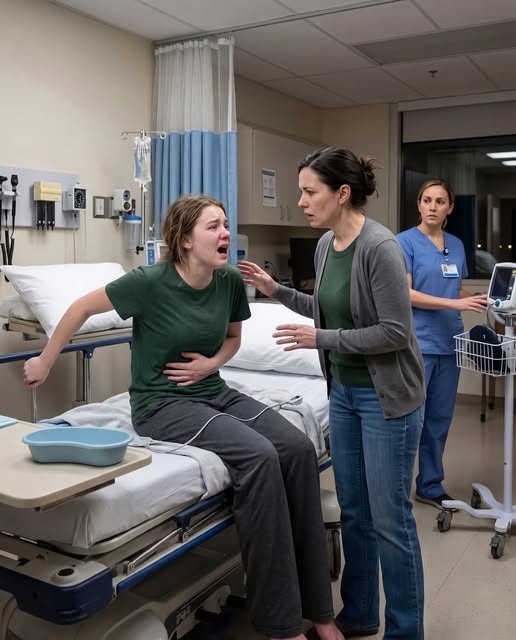
I sat beside her bed when she woke.
Her eyes opened slowly.
“Mom?”
“I’m here.”
“Is Dad there?”
“No.”
She closed her eyes again.
A tear slipped toward her ear.
“Okay.”
That was all she said.
The next morning, investigators returned with an update.
They had searched the garage.
The blue bag contained several items that were now part of their investigation, including clothing Emily had been wearing on earlier occasions, photographs, and a notebook with dates written beside short descriptions.
None of it was a single dramatic secret.
Together, it showed something much harder to dismiss.
A history.
A record Emily had created because she believed she might eventually need proof.
The cracked phone had not been a weapon.
It had been a witness.
Emily stayed in the hospital for several more days.
A social worker met with her privately.
Then with me.
They asked why I had not known.
I answered honestly.
“I thought I was protecting her from him.”
The social worker shook her head gently.
“You were surviving him too.”
I did not like hearing that.
But I did not argue.
When Emily was strong enough to walk, she asked me to help her sit by the window.
Outside, the parking lot was wet from overnight rain.
She watched cars come and go.
“I thought you wouldn’t believe me,” she said.
“I should have.”
“You didn’t.”
“No.”
She looked at me.
“I’m sorry.”
“You don’t have to apologize.”
“I kept thinking if I got sick enough, you’d have to see it.”
That sentence stayed with me long after she stopped talking.
Michael was not allowed back into the house while the investigation continued.
The legal process moved slowly.
There were interviews.
Statements.
Medical records.
Photographs.
Phone data.
Questions I wished I had never needed to answer.
There were also moments when people tried to turn everything into a simple story.
Some relatives said Michael had always been a strict father.
Some said Emily was troubled.
One person told me privately that perhaps we should handle it as a family.
I asked her what she meant.
She said, “You know. Keep it private.”
I looked at her and remembered Emily on the bathroom floor.
“Private is what almost got her killed,” I said.
After that, I stopped explaining myself.
Weeks passed.
Emily came home to a different house.
Not because the walls had changed.
Because the rules had.
She had her own room.
Her own key.
Her own phone.
She knew exactly who she could call.
I changed the locks.
I opened the curtains in the kitchen.
I stopped lowering my voice whenever I heard footsteps.
The first night she slept at home, I woke around 3:18 a.m.
For a moment I did not know why.
Then I remembered.
That had been the time Michael told me not to take our daughter to the ER.
I walked down the hallway.
The bathroom light was on.
Emily was standing at the sink, brushing her teeth.
She looked at me through the mirror.
“You okay?”
“Yes.”
She rinsed her mouth.
“You?”
She thought about it.
“Better.”
I looked at the counter.
The same cheap bulb still flickered above us.
I had planned to replace it for months.
I finally did.
The next morning, sunlight filled the bathroom instead of that weak yellow glow.
Emily kept the cracked phone.
The screen still had a thin white line across one corner.
I offered to buy her a new one.
She shook her head.
“Not yet.”
I understood.
It was not because she wanted to remember the fear.
It was because, for three terrible days, that phone had been the one thing she knew she could hold onto.
The object Michael had dismissed had become the thing that helped other people hear her.
Months later, when the house was quiet in a different way, Emily placed the phone in a small box in her desk drawer.
She did not throw it away.
She did not need to carry it everywhere anymore.
Before closing the drawer, she touched the cracked screen once.
Then she shut it.
Downstairs, I heard the new kitchen light click on.
For the first time, neither of us lowered our voice.