The Wedding Toast That Forced a Father to Choose His Daughter
PART 3 (FULL STORY)
Emmett stared at the envelope as though it had suddenly become something dangerous.
I could see the question forming on his face before he asked it.
“Where did you get this?”
“Your house,” I said. “The old cedar box in Phoebe’s closet. I found it months ago when I was helping Margot look for one of her mother’s photographs.”
Claire looked from the envelope to me.
“What does it say?”
I didn’t answer her.
Emmett turned the envelope over in his hands.
Phoebe’s handwriting was unmistakable.
He had seen it thousands of times.
The rounded letters.
The slight slant.
The little heart she always drew over the “i” in Margot’s name.
His thumb moved across the writing without opening it.
“Why didn’t you give this to me?”
“Because it wasn’t addressed to you.”
The answer landed harder than I intended.
Emmett looked at Margot.
She was still sitting beside me, small hands folded in her lap, watching the adults around her with the careful silence children use when they know something is wrong.
He swallowed.
“Can I read it?”
I nodded.
He opened the envelope.
Inside was a single folded sheet of paper.
He unfolded it slowly.
For several seconds, he didn’t move.
Then his eyes began traveling across the page.
I didn’t need to read it.
I had already read it once.
Phoebe had written it shortly before the accident.
She had apparently been sorting through old photographs and memories for Margot, knowing her daughter was still too young to understand them.
The letter wasn’t dramatic.
That was what made it hurt.
Phoebe had written about ordinary things.
How Margot laughed when someone sneezed.
How she hated having her hair brushed.
How she liked to fall asleep holding one finger of her mother’s hand.
Then Phoebe had written something else.
She said that if Margot ever had to grow up without her, she hoped the people around her would never make her feel as though loving someone new meant losing the people she had already lost.
Emmett stopped reading.
His hand trembled.
Claire reached toward him.
“Emmett—”
He pulled the letter against his chest.
“Don’t.”
One word.
Quiet.
But final.
Claire lowered her hand.
The room had become uncomfortable in a way no wedding reception was supposed to be.
Guests who had been laughing minutes earlier were suddenly staring at their plates.
A few people whispered.
Others looked toward Margot.
I wasn’t interested in embarrassing Claire.
That had never been the point.
I wanted Emmett to see what I had seen.
His daughter had spent the entire day believing she was part of her father’s new beginning.
Someone had taken that joy away from her.
And for what?
A photograph?
A place beside her father?
A few minutes of attention?
Emmett folded the letter carefully.
Then he looked at Claire.
“Did you tell her she wasn’t important to me anymore?”
Claire’s eyes filled.
“I was trying to establish boundaries.”
“With a five-year-old?”
“She needs to understand that things have changed.”
“They have,” Emmett said. “But not like that.”
Claire glanced around the room.
“You’re making this into something it isn’t.”
“No,” he said. “I’m finally seeing it for what it is.”
She shook her head.
“I never said I didn’t love her.”
“You didn’t have to.”
His voice cracked slightly.
“You told my daughter she wasn’t important anymore.”
Claire crossed her arms.
“I was talking about family pictures.”
“No.”
Emmett looked at Margot.
“You were talking about her place in my life.”
Claire didn’t answer.
That silence said more than an argument could have.
The photographer, who had been standing several feet away, quietly stepped forward.
“I can take another family picture,” he said.
Nobody moved.
Emmett looked at Margot.
Then he walked toward her.
He crouched until they were eye to eye.
“Sweetheart.”
Margot looked at him but didn’t speak.
“I’m sorry.”
Her lower lip trembled.
“For what?”
“For letting anyone make you think you aren’t important to me.”
Margot stared at him.
“Am I still your girl?”
Emmett’s face broke.
“You will always be my girl.”
She looked toward Claire.
Then back at her father.
“Even when you have a wife?”
“Yes.”
“Even in the pictures?”
He nodded.
“Especially in the pictures.”
Margot finally moved.
She wrapped both arms around his neck.
Emmett held her tightly.
For the first time that day, she looked like the child who had arrived that morning in her pink dress.
Not because everything was fixed.
Because she finally knew where she stood.
Claire remained several feet away.
Nobody applauded.
Nobody cheered.
This wasn’t that kind of moment.
It was too private for that.
Instead, people slowly began looking away.
One of Emmett’s brothers cleared his throat and walked toward the bar.
Someone else picked up an empty glass.
The wedding continued, but the celebration had changed.
Emmett eventually stood and looked at me.
“I need to ask you something.”
“What?”
“Did Phoebe ever say anything about Claire?”
I took a breath.
“No.”
He nodded.
That seemed to matter.
I wasn’t going to invent warnings that had never existed.
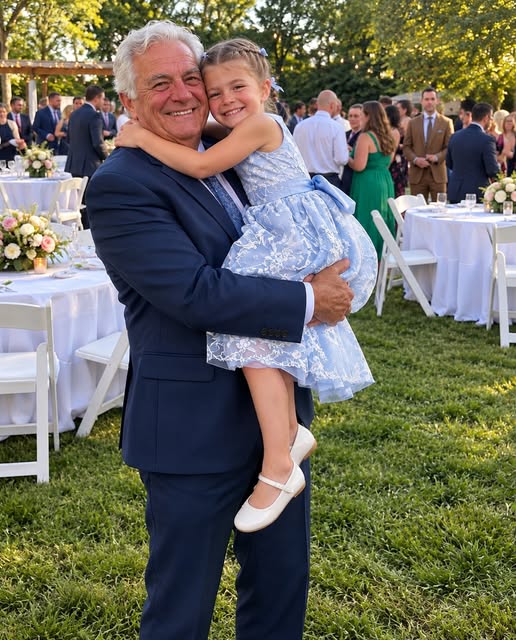
Phoebe had never met Claire.
She couldn’t have known what would happen.
All she had done was leave behind a mother’s hope for her daughter.
That was enough.
The next morning, Emmett called me.
His voice sounded exhausted.
“Dad?”
He hadn’t called me that in months.
Maybe years.
“I’m here.”
“I sent Claire to her sister’s last night.”
I didn’t ask why.
“I told her we were going to have a conversation when we were both calm.”
“That sounds reasonable.”
There was a long pause.
“I don’t know what happens now.”
“You don’t have to decide everything today.”
“I know.”
Another pause.
“But I do know one thing.”
“What?”
“I won’t let Margot feel like she has to compete for her father’s love.”
I closed my eyes.
“That girl has already lost enough.”
“I know.”
We hung up.
For the next few weeks, Emmett and Claire lived separately.
There was no dramatic public divorce.
No revenge.
No screaming matches in front of family.
There were conversations.
There were difficult questions.
And there were consequences.
Claire eventually admitted that she had been jealous.
She had convinced herself that Margot occupied a place in Emmett’s life that should belong to her.
She said she thought removing Margot from the photographs would make the wedding feel like the beginning of a new family.
But a family doesn’t begin by erasing someone.
That was the part she hadn’t understood.
Emmett didn’t tell me whether he would ever forgive her.
That was his decision.
What I knew was that he started taking Margot to counseling with him.
Not because there was something wrong with her.
Because he wanted to make sure the damage didn’t become something she carried into adulthood.
He also began doing something small that mattered more than any speech.
He started keeping photographs everywhere.
On the refrigerator.
In the hallway.
On his desk.
In the living room.
Some were pictures of him and Margot.
Some were pictures of Phoebe.
Some were pictures of all three of them from years ago.
And one day, he brought me a framed photograph.
It was the family picture that had never been taken at the wedding.
Except this time, nobody was standing where they didn’t belong.
Margot stood in the middle.
Emmett was beside her.
I stood on the other side.
The picture wasn’t perfect.
Margot’s dress was slightly wrinkled.
My tie was crooked.
Emmett’s hair was a mess.
Margot was laughing instead of looking at the camera.
But I loved it.
Months later, I asked Margot if she remembered the wedding.
She thought for a moment.
“I remember my pink dress.”
“You liked that dress.”
“I still do.”
Then she looked at me.
“I remember being sad too.”
I didn’t tell her to forget it.
I didn’t tell her it hadn’t mattered.
Children know when adults lie to make them feel better.
Instead, I said, “I’m sorry you had to feel that way.”
She leaned against me.
Then she asked the question I had been afraid she might someday ask.
“Did Mommy know Daddy would marry someone else?”
“No.”
“Would she be mad?”
I looked at the photograph of Phoebe on the shelf.
“No.”
“How do you know?”
“Because your mother loved your father.”
Margot thought about that.
“And she loved me.”
“More than anything.”
She smiled.
Then she pointed at the framed wedding photograph.
“Grandpa?”
“Yes?”
“You’re crooked.”
I laughed.
“So I am.”
“You need to fix your tie.”
“I’ll work on it.”
She climbed onto the couch beside me.
For a while, we sat there without saying anything.
There were still things none of us could fix.
Phoebe was still gone.
My wife was still gone.
Margot would still grow up with memories that should have been ordinary and weren’t.
But she would not grow up wondering whether she belonged.
That mattered.
A year after the wedding, Emmett married again.
Not Claire.
Someone else.
But he didn’t rush.
He introduced the woman to Margot slowly.
He made sure his daughter understood that meeting someone new didn’t erase anyone who came before.
And when they eventually took family pictures, Margot stood in the center again.
This time, she knew exactly why.
Afterward, Emmett sent me one of the photographs.
I put it beside Phoebe’s old picture.
The two frames sat next to each other on my shelf.
One showed the daughter I had lost.
The other showed the family she had left behind.
That evening, Margot came over and climbed onto the chair beside me.
She studied the two photographs.
“Mommy is watching us,” she said.
I smiled.
“I think so.”
She touched the corner of Phoebe’s frame.
Then she reached over and straightened my tie.
“You’re crooked again.”
I looked down.
She was right.
I laughed.
She laughed too.
And when she leaned against my shoulder, I looked at the two photographs one more time.
For a long time, I had thought family was something grief could destroy.
I was wrong.
Sometimes family is the people who remain.
Sometimes it is the people who arrive later.
And sometimes it is simply the promise that no child will ever have to wonder whether she still belongs.
On my shelf, Phoebe’s photograph stood beside the new family picture.
And beneath them, almost hidden by the frame, was the envelope in her handwriting.
For Margot, when she is old enough.
I kept it there.
Not as a warning.
As a reminder.