My mother read every page twice before she said a word.
I sat beside her on the couch — the one where she reads her historical fiction every night — and I watched her face while she went through the GPS logs and the calendar screenshots and the map of the apartment building on Elm Park Drive.
She didn’t cry. That surprised me. I’d expected crying.
Instead she got very still. The kind of still that’s louder than any noise.
“How long have you known?” she asked.
“One week. I found it Thursday. I needed to be sure before I — I didn’t want to be wrong.”
She nodded slowly. She squared the papers into a neat stack on the coffee table, aligning the edges with both hands.
“You weren’t wrong,” she said. “I’ve known something was off for three months. I just didn’t know what.”
That was the moment I understood that my mother is much stronger than I ever realized.
She didn’t fall apart. She didn’t scream. She didn’t call my dad in a rage. She picked up her phone, opened a notes app, and started writing down dates. Building her own record. The way I’d built mine.
“Sophie,” she said. “I need you to do something for me. I need you to not say anything to your father. Not a word. Not a look. Can you do that?”
I could.
It was the hardest week of my life. Sitting across from my dad at breakfast. Watching him put on his running jacket. Watching him say “client dinner tonight” on a Tuesday and kiss the top of my head on his way out the door.
I said nothing.
My mother said nothing.
But my mother was busy.
She called a lawyer. She pulled three years of bank statements. She found the lease — in my dad’s name, a second residence he’d been paying for since the spring, the apartment on Elm Park Drive, Unit 4B. She found the furniture charges. The grocery deliveries to an address that wasn’t ours.
She built a file that made my screenshots look like a doodle.
And then, on a Sunday — my dad at the gym, my brother at a friend’s house — she sat my father down when he came home, still in his running jacket, and she put the file on the table.
I was upstairs. I wasn’t supposed to hear.
I heard everything.
I heard my dad start with the lie. The “it’s not what it looks like.” The “I can explain.” The “you don’t understand the context.”
And I heard my mother say, in a voice I’d never heard her use — calm, flat, final — “I have the lease, David. I have the bank statements. I have three years. There’s no context that explains a second apartment and a name on a grocery account that isn’t mine.”
Silence.
Then my dad’s voice, smaller: “How did you find all this?”
And my mother said: “Our daughter found the first thread. I pulled the rest.”
I sat at the top of the stairs with my hood pulled tight and I felt something I didn’t have a word for. Guilt, maybe. Pride, maybe. The strange grief of being the one who started the unraveling of your own family.
I heard my dad ask if they could go to counseling. I heard my mother say it was too late for that. I heard him ask about the house, about my brother, about me.
And I heard my mother say the thing that told me she’d already decided everything: “The kids stay with me. You’ll see them on a schedule. My lawyer will send it Monday.”
My lawyer. She’d already hired one. During the week I stayed silent, my mother had quietly assembled an entire legal strategy. She’d been three steps ahead the whole time, the same way I’d been careful to be sure before I told her.
I realized then where I got it from. The patience. The carefulness. The instinct to be sure before you act. My mother had it in spades, and she’d passed it to me without either of us ever saying a word about it.
My dad moved out two weeks later.
The divorce was not pretty, but it was fast, because my mother had documentation for everything and my father had no defense for any of it. The apartment on Elm Park Drive turned out to have a tenant my father had been supporting for over a year. I never met her. I never wanted to.
My brother took it hard. He’s younger. He didn’t understand why Dad was gone. My mother told him the truth in the gentlest version a kid could hold: that Dad had broken a promise, and that sometimes when grown-ups break big promises, families have to change shape.
She never told him I was the one who found the calendar.
She protected me from that. The way I’d tried to protect her by being sure before I spoke.
Here’s the thing I’ve thought about most, in the months since.
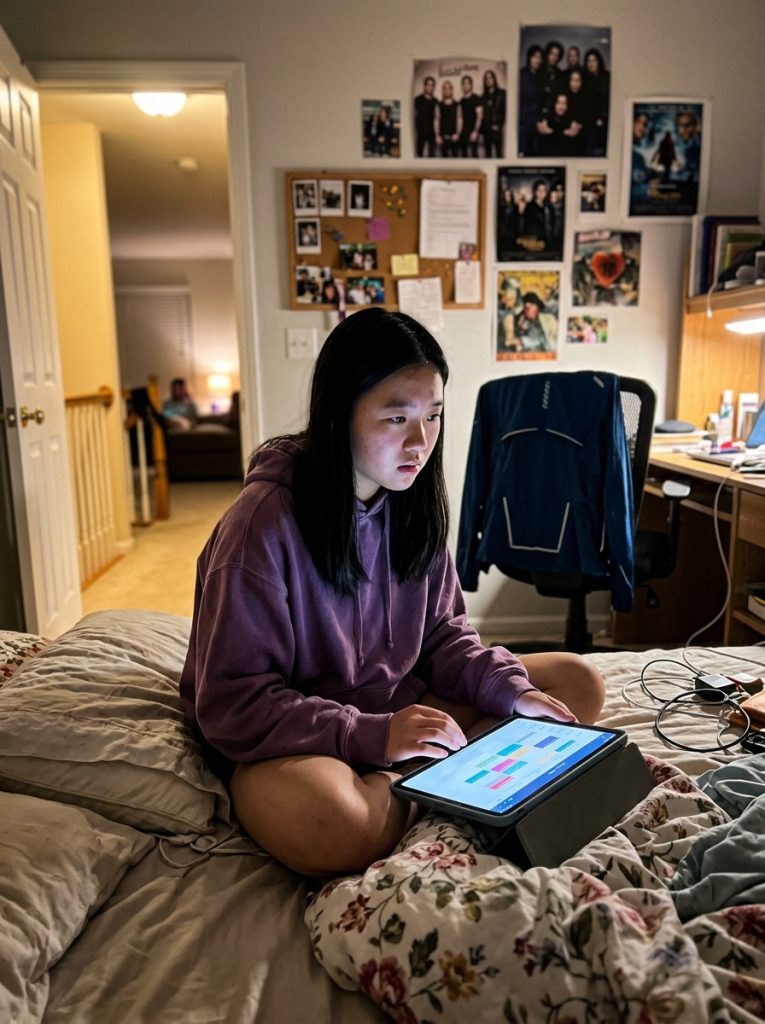
I almost didn’t tap that calendar event. I almost just added my orchestra concert and closed the tablet and gone to sleep. The blue blocks were right there for three months and nobody looked because nobody had a reason to.
I had a reason. A school concert. The most innocent thing in the world.
And it cracked open the biggest lie in our house.
My mother and I are closer now than we’ve ever been. She told me, a few weeks after my dad left, that she was sorry I’d had to carry that for a week alone. That no sixteen-year-old should have to find what I found.
But she also said something I’ll keep forever.
“You didn’t break this family, Sophie. Your father did. You just turned on the light.”
I think about that when the guilt comes back. Which it still does, sometimes, late at night.
I didn’t break anything.
I just turned on the light.
And what was in the dark was always there — whether I looked or not.
My grades dropped for a quarter. My counselor noticed before my mom did and pulled me aside. I ended up telling her the whole thing — the calendar, the GPS logs, the week of silence. She connected me with a therapist who specialized in teens going through family changes.
I didn’t want to go at first. I thought therapy was for people who couldn’t handle things. But the therapist — her name was Dr. Okonkwo — said something in our second session that unlocked me.
“You did an adult’s job,” she said. “You found evidence, you verified it, you brought it to the right person at the right time. That’s remarkable. And it also means you skipped being a kid for that week. We’re going to make space for the kid part now.”
So we did.
I cried in her office for the first time about three sessions in. Not about my dad, exactly. About the breakfast. About sitting across from him for a week, knowing, and saying nothing, and watching him kiss the top of my head like everything was normal.
That was the part that haunted me. The pretending.
Dr. Okonkwo helped me see that the pretending was a gift I gave my mother — the time she needed to build her case and protect herself and my brother. It wasn’t deceit. It was loyalty.
My dad and I talk now. Sometimes. It’s awkward and careful and slowly getting less awkward. He apologized — a real one, eventually, not the “I can explain” kind. He told me he was sorry I was the one who found it. I told him I was sorry too, but not for finding it. For him making it something I could find.
He didn’t have an answer for that.
My orchestra concert was three weeks after my dad moved out. My mom came. She sat in the third row and clapped louder than anyone.
I’d added it to the calendar after all.
In purple.
Just mine.