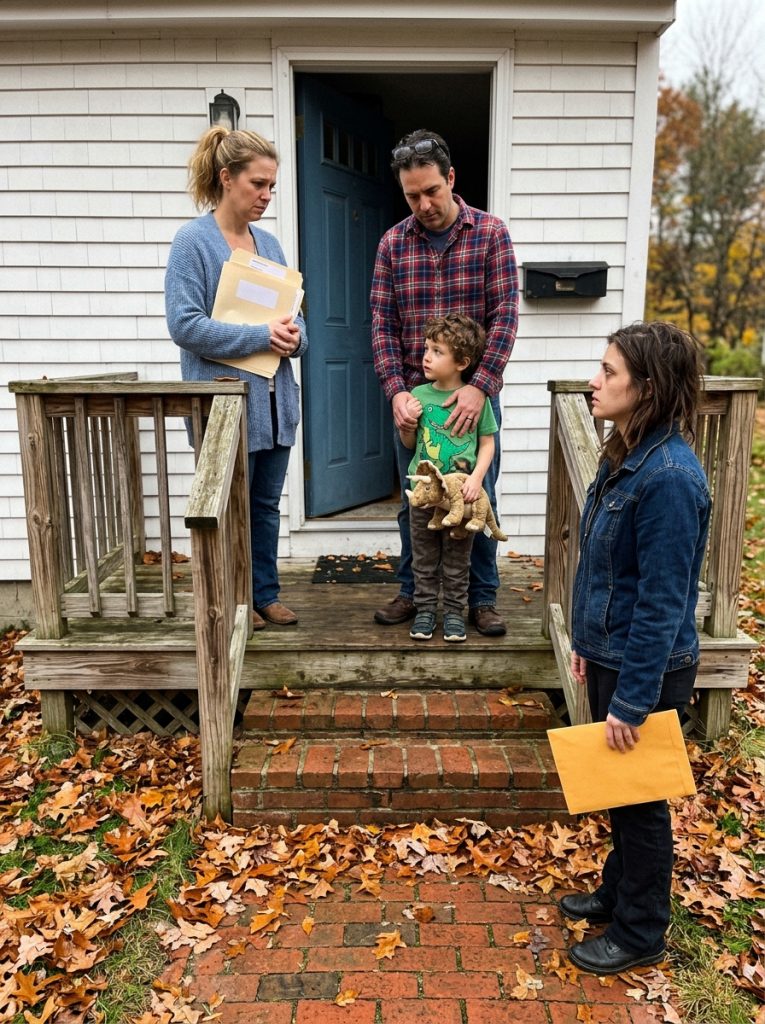
Tanya Brooks did not come inside.
I want to be clear about that, because it matters. She stood at the base of our porch steps in her denim jacket with the manila envelope in her hand, and she did not take a single step up. Not because she couldn’t. Because she wouldn’t. Because she understood something about that doorway that I was only beginning to understand myself.
“Can I read it?” I asked. My voice didn’t sound like mine.
She held the envelope up. I came down two steps and took it. David stayed in the doorway with Marcus, his arm a steel band around our son’s shoulders.
I read the court order standing on my own porch in the flat gray October light.
It was real. Signed by Judge Harmon. A stay of adoption finalization pending a reunification review hearing scheduled for the following month. The legal language was cold and precise, but the meaning was simple: the adoption that was supposed to happen in twenty minutes was not going to happen today. Maybe not ever.
“They told us your rights were terminated,” I said. “Two years ago. The agency said it was final.”
“It was,” Tanya said. “And then I appealed. And then I did everything they asked.” Her voice cracked but she held it together. “Eighteen months sober. Parenting classes. A job at the hospital laundry. An apartment with a second bedroom. I painted it blue because the file said he likes dinosaurs and I thought — I thought maybe—”
She stopped.
She looked at Marcus.
Marcus looked back at her, clutching his triceratops, and said the thing that broke all three adults at once:
“Are you the lady from the pictures?”
Tanya’s hand went to her mouth.
I learned later what he meant. The agency, during the early foster placement, had given us a small album — photos of Marcus’s biological family, to be shared “if and when appropriate.” We’d kept it in a drawer. Marcus had found it once, two years ago, and asked who the people were. We’d told him the truth as gently as a four-year-old could hold it: that he had another mom who loved him but couldn’t take care of him right then.
He remembered.
Seven years old, and he remembered the lady from the pictures.
“Yes,” Tanya whispered. “I’m the lady from the pictures.”
What followed was the hardest month of my life.
I won’t pretend I was noble about it at first. I called our adoption attorney that same morning, hands shaking, and asked her to fight. To find a way to block the review. To argue abandonment, to argue best interest, to argue anything.
She listened. Then she told me the truth, which is what good attorneys do even when you don’t want to hear it.
“Rachel,” she said. “She completed every requirement the court set. She has been sober for eighteen months. She has stable housing and employment. She did not abandon him — she lost him to addiction and then fought the system to get him back, which the system explicitly allows. If we fight this, we will spend forty thousand dollars and eight months, we will put Marcus through evaluations and interviews and a custody battle, and we will very likely lose. And he will be the one who pays for it.”
I sat with that.
I sat with it for days.
Because here is the thing nobody tells you about loving a foster child: you sign up knowing it might end. They tell you at the very first training. “Reunification is the goal.” You nod. You think you understand. You don’t. You can’t. Not until you’re standing on your own porch holding a court order with a seven-year-old’s triceratops three feet away.
I loved Marcus like he came from my own body.
And Tanya loved him like he came from hers.
Because he did.
The reunification hearing happened a month later. I went. David went. We didn’t fight it — but we asked to be heard, and the judge allowed it.
I told the court the truth. That Marcus was thriving. That he had friends and a soccer team and a reading level above his grade. That we loved him.
And then I said the thing that cost me everything to say:
“But I’ve watched Ms. Brooks at the supervised visits this month. I’ve watched my son run to her. I’ve watched her braid the patience of eighteen hard months into the way she talks to him. She is not a stranger. She is his mother. And she fought her way back to him. I will not be the person who stands between a child and a mother who did the impossible to come home.”
Tanya was crying. The judge was quiet for a long time.
The judge spoke carefully. She praised us — said Marcus was lucky to have been loved so well, that our care during his most vulnerable years had given him a foundation that would last his whole life. She said the system worked precisely because families like ours existed.
And then she ruled for Tanya.
I had known it was coming. I had even, in some buried place, decided it was right. But knowing and hearing are different things. When the gavel came down, David reached for my hand and I gripped it so hard my knuckles went white.
Tanya turned around in her seat and looked at me.
She didn’t smile. She didn’t celebrate. She mouthed two words: “Thank you.”
The transition was gradual. The court ordered it that way — weeks of increasing visits, overnights, a slow handoff designed to protect Marcus from the whiplash of sudden change.
We did it right. David and I agreed on that. Whatever we felt, we would not let Marcus feel torn. We would not make him choose. We would not turn the handoff into a tug-of-war with a child as the rope.
So we packed his things slowly. We told him stories about how brave his birth mom was. We let him decorate a photo book of his three years with us so he’d have something to take.
The last night he slept in our house, I sat on the edge of his bed while he held his triceratops and asked me if I was still going to be his mom.
I told him I would always love him. That he could have more than one mom. That love doesn’t divide — it multiplies.
I don’t know if a seven-year-old can hold that. But he nodded, and he fell asleep holding my hand.
The morning he left, Tanya stood at the base of our porch steps again. Same denim jacket. No envelope this time. Just her hands, open.
Marcus walked down the steps with his triceratops and his pink-and-blue backpack, and he stopped halfway, and he ran back up and hugged me so hard I felt it in my ribs.
Then he walked down to his mother.
And she took his hand.
And they walked to her car together, and I stood in the doorway where I’d stood the month before, and David’s arm came around my shoulders the way it had come around Marcus’s, and we watched our son drive away to the home he came from.
We get letters now. Tanya sends them. Photos. Marcus in the blue bedroom. Marcus at his new school. Marcus holding the triceratops, a little more worn each season.
She didn’t have to do that. The court didn’t order it.
She does it because she understands what I understand now: that Marcus has more than one mother, and love doesn’t divide.
It multiplies.
Some things you save too late.
And some things — some people — you have to love enough to let go.