My Fiancé Married My Best Friend Before Begging Me To Save His Father
PART 3 (FULL STORY)
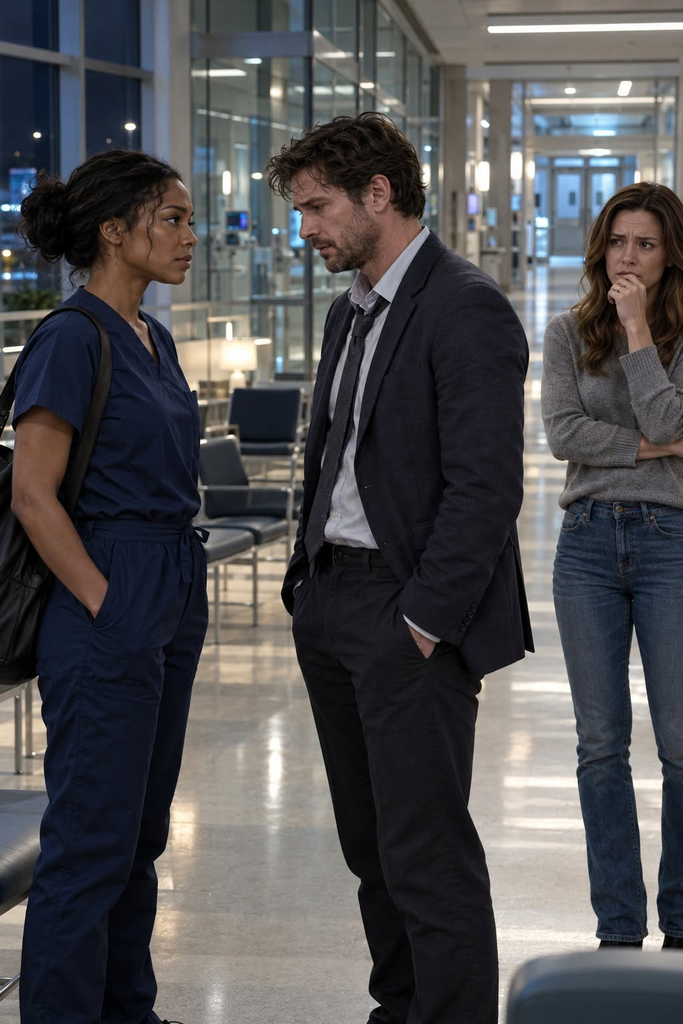
Preston stood frozen in the harsh fluorescent glare of the surgical hallway, staring down at the platinum and diamond engagement ring resting in his open palm like a burning coal. Beside him, Cecily shrank back against the wall, her knuckles white as she clutched her designer handbag, her eyes darting frantically toward the double doors of the recovery suite. Behind them, Dr. Marcus Keller and two senior hospital trustees watched in unyielding, judgmental silence. The relief that had washed over Preston’s face just moments earlier had completely curdled into sheer, suffocating terror.
I pulled off my surgical scrub cap, running a tired hand through my hair as the adrenaline of a nine-hour open-heart operation slowly ebbed from my veins. My scrubs were damp beneath my surgical gown, and my shoulders ached from standing over the bypass field, meticulously reconstructing the delicate, paper-thin layers of Richard Sterling’s torn ascending aorta under deep hypothermic circulatory arrest. But my mind was crystalline. In the operating room, every stitch had been placed with flawless surgical precision—not for Preston, and certainly not for Cecily, but for the sacred oath I had taken to preserve life.
“Althia, please,” Preston stammered, stepping forward with his hand outstretched. “You don’t understand what happened. It was a mistake. Cecily and I… we were under so much pressure with Dad’s declining health.” I didn’t flinch. I looked at the man I had loved for three years, the man whose soft promises had filled my apartment only six days earlier while I was across the ocean in France. “You didn’t make a mistake, Preston,” I said softly, my voice carrying cleanly down the corridor. “A mistake is dropping a glass. You drove to Greenwich Town Hall, signed a legal contract, placed a ring on my best friend’s finger, and then called me in Paris to pretend we were choosing wedding flowers. You made a series of calculated choices, and now you have to live with them.”
Before Preston could speak another word, the oak doors of the recovery suite swung open, and Richard Sterling’s personal estate attorney, Arthur Vance, stepped into the hallway. Arthur adjusted his spectacles, his expression carved from gray granite. “Mr. Sterling is fully conscious, extubated, and has requested the presence of his son and his new daughter-in-law,” Arthur said, the biting emphasis on the final word leaving no doubt that the truth was already laid bare.
We walked into the private corner suite, where Richard lay propped up in his hospital bed. Though pale and surrounded by the steady, rhythmic beeping of telemetry monitors, the sixty-eight-year-old hospital founder possessed the same formidable presence that had built Sterling Memorial into a world-class institution. His clear blue eyes moved from the surgical dressing across his chest to where I stood beside Marcus Keller. When he looked at me, a profound warmth touched his weathered face. “Thank you, Althia,” Richard whispered, his voice rough from the endotracheal tube. “You gave me my life back.”
“You fought hard in there, Richard,” I replied, stepping to his bedside to check his peripheral pulses and chest tube drainage. “Your heart is beating with full sinus rhythm. The graft is holding beautifully.”
Richard nodded once, then turned his gaze toward the foot of the bed, where Preston and Cecily stood trembling side by side. The warmth in the patriarch’s eyes vanished instantly, replaced by a cold, devastating disappointment that made Preston visibly wilt. On the bedside tray beside Richard’s heart monitors lay a certified copy of the Greenwich marriage license and a printout of the photograph outside the town hall, retrieved hours earlier by Arthur Vance’s investigative team.
“You thought you were clever, didn’t you, Preston?” Richard said, each word measured and heavy. For over a year, Richard had made it abundantly clear that the family estate and the controlling chairmanship of the twenty-five-million-dollar Sterling Medical Foundation would pass only to an heir whose personal integrity and dedication reflected the values of the institution. Cecily, who had worked as an independent public relations contractor for the hospital’s foundation, had discovered the exact wording of the trust covenants while drafting promotional materials for our planned October gala.
Realizing that Richard’s cardiovascular symptoms were worsening and fearing that Preston might never commit to marriage in time, Cecily had orchestrated the private elopement. She had convinced Preston that securing the marriage license would lock in his executive appointment before Richard could alter the trust, while persuading him to keep the union hidden from Althia so our planned society wedding wouldn’t trigger awkward questions before the probate transfers were formalized. They had treated my life, my reputation, and my heart as disposable collateral in their desperate scramble for wealth.
“You underestimated your father, and you disgracefully underestimated the woman who just saved my life,” Richard said, motioning toward Arthur Vance. Arthur produced a leather-bound folio containing an emergency codicil to the Sterling Family Trust. “As of six o’clock this morning, Preston, you have been permanently removed as a trustee, disinherited from the liquid estate, and terminated from your position as Vice President of Hospital Development. The board of directors has already ratified the decision.”
Preston’s knees buckled. “Dad, no! You can’t do this! Cecily and I love each other—we were trying to protect the family!” But the illusion of unity shattered in real time. Cecily turned toward Preston, her face contorting with sudden, vicious rage. “You told me your father would never cut you off!” she screamed, completely abandoning her performative grief in front of the assembled physicians and attorneys. “You promised me that once we were married, the trust was guaranteed! You dragged me into this mess, and now you have nothing!”
The ugly shouting match between them spilled out of the room and echoed down the hospital corridor as hospital security firmly escorted both of them off the premises. Watching them tear each other apart over the ashes of an unearned fortune, I felt no vindication, only a clean, liberating sense of closure. The man I had grieved over the Atlantic was nothing more than an empty shell, and the best friend I had trusted was merely an opportunist who had finally trapped herself in her own cage.
Richard looked up at me from his bed, his eyes filled with quiet admiration. “Althia, this hospital was built on excellence and unwavering honor. We need leaders who embody both.” With the unanimous backing of the board of trustees, Richard formally offered me the position of Chief of Cardiothoracic Surgery and Chair of the Sterling Heart and Vascular Institute, accompanied by an unrestricted ten-million-dollar research endowment to expand our clinical trials. I accepted the role on my own terms, not as a consolation for a broken engagement, but as the natural summit of fifteen years of relentless sacrifice and surgical devotion.
Over the subsequent year, my life transformed into a masterpiece of professional triumph and personal serenity. Under my leadership, the Heart and Vascular Institute performed over three hundred complex aortic and valve reconstructions, achieving the lowest mortality rate in the state. I purchased a sunlit, high-ceilinged brownstone overlooking the leafy canopy of Central Park, filling the rooms with fresh flowers, classical music, and rare medical texts. Preston and Cecily’s hasty marriage collapsed into a bitter, penniless divorce within six months, their names fading into distant footnotes among the city’s social registers.
On a golden afternoon in early October, exactly twelve months after that fateful night, I finished a successful four-hour valve sparing aortic root replacement. I stepped into the surgeons’ scrub lounge, pulled off my latex gloves, and turned on the brass faucet. As the warm water flowed over my hands, I looked at my fingers in the mirror. They were steady, strong, and unburdened.
I walked out of Sterling Memorial into the crisp autumn breeze, feeling the gentle warmth of the late-day sun against my face. The diamond ring was long gone, but in its place was something infinitely more enduring: the profound, unbreakable peace of a woman who had crossed an ocean to honor her calling, conquered the storm, and reclaimed her destiny entirely on her own terms.