The Homeless Woman at My Gate Knew the Truth About My Silent Daughter
PART 3 (FULL STORY)
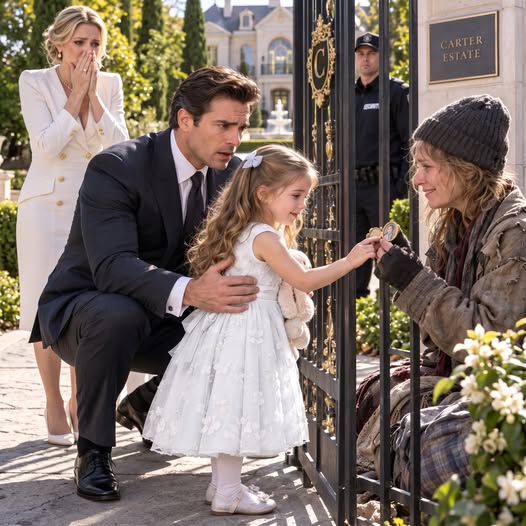
It was a small silver locket, scratched almost white with age.
I stared at it through the iron bars, trying to understand why a piece of tarnished metal had brought my wife to the edge of panic.
I had seen that locket before.
Not recently.
Not in our house.
But three years earlier, in a photograph taken at St. Mary’s Children’s Hospital.
I remembered the picture because Emily had been only two years old then, and I had carried her out of the hospital myself.
Victoria had told me the locket belonged to an old nurse who had given it to Emily as a comfort.
I had never questioned that explanation.
Now the woman standing outside my gate was holding the same locket.
“Where did you get that?” I asked.
My voice sounded different even to me.
The woman looked at me, then at Victoria.
“I didn’t come here for money.”
Her voice was tired, but steady.
“I know men like you usually think that’s why people like me come to your gate.”
My security guard shifted closer.
I raised a hand.
“Nobody touches her.”
The woman nodded once.
Then she looked at Emily.
“She deserves to know the truth.”
Victoria whispered my name.
“Jonathan, don’t listen to her.”
I turned toward my wife.
She was crying now.
Not the quiet tears she had shed during doctor’s appointments.
These were different.
She looked frightened.
“What truth?” I asked.
The woman reached through the bars and held out the locket.
“Ask your wife what happened at St. Mary’s Children’s Hospital three years ago.”
Victoria took a step backward.
I felt something cold settle in my stomach.
“Victoria?”
She didn’t answer.
Emily pressed both hands against the iron bars.
She was still crying.
Then she whispered a word I had not heard from her in nearly two years.
“Mommy.”
Victoria froze.
I looked at my daughter.
Emily was staring directly at her mother.
Not confused.
Not frightened.
Waiting.
The homeless woman opened the locket.
Inside was a tiny photograph.
Even from several feet away, I could see the edge of a hospital blanket.
And underneath it was a handwritten date.
October 14.
My wedding anniversary.
I looked at Victoria.
She covered her mouth.
“What is that?” I asked.
She shook her head.
“I don’t know.”
The woman laughed once.
There was no humor in it.
“You know exactly what it is.”
My security guard glanced at me.
I could see he was beginning to understand that this was no ordinary confrontation.
I unlocked the gate myself.
Victoria grabbed my wrist.
“Jonathan, please.”
I pulled free.
The woman didn’t move.
She simply waited.
“Come inside,” I told her.
She looked down at her torn coat and old shopping cart.
“I don’t belong inside.”
“Today, you do.”
She hesitated before stepping through the gate.
Emily immediately ran to her.
The woman dropped to her knees and opened her arms.
Emily buried her face against the woman’s coat.
I had watched my daughter avoid strangers her entire life.
She had hidden behind me when relatives hugged her.
She had refused to speak to therapists.
She had never shown this kind of trust toward anyone outside our immediate family.
Yet she clung to this woman as if she had been waiting for her.
Victoria turned away.
I noticed her hands trembling.
“Who are you?” I asked.
The woman slowly stood.
“My name is Sarah Bennett.”
She looked at Emily.
“I was a nurse at St. Mary’s.”
I felt the pieces begin to move.
“You’re the nurse from the photograph?”
She nodded.
“I was there the night Emily was born.”
I stared at her.
“Emily wasn’t born at St. Mary’s.”
Victoria closed her eyes.
Sarah looked at her.
“That’s what you were told.”
The words landed harder than they should have.
I turned to my wife.
“Victoria.”
She finally looked at me.
There was something in her face I had never seen before.
Not anger.
Not sadness.
Guilt.
“Tell him,” Sarah said.
Victoria whispered, “I was going to.”
“When?”
“I don’t know.”
“Before or after you let him spend two years blaming himself?”
Victoria began crying.
I stepped toward her.
“What are you talking about?”
She wiped her face.
“When Emily stopped speaking, I thought it was because of what happened at the hospital.”
“What happened?”
Victoria sat down on the stone bench beside the driveway.
I had never seen her look so small.
“Three years ago, when Emily was admitted for the fever, she wasn’t alone.”
My heart tightened.
“What does that mean?”
“Another little girl was there.”
Sarah answered for her.
“Her name was Lily.”
I looked between them.
“Lily?”
Sarah nodded.
“She was five years old.”
My daughter’s age now.
“She had been in foster care,” Sarah continued. “Her mother had died. Her father was in prison. She had nobody.”
I frowned.
“Why are you telling me about another child?”
Sarah opened the locket again.
“Because Emily met her.”
I looked at my daughter.
She was holding the locket in both hands.
“How?”
“They were in neighboring rooms,” Sarah said. “Emily couldn’t sleep. Lily couldn’t either. They used to talk through the space beneath the privacy curtain.”
Victoria covered her face.
“What did they talk about?”
Sarah smiled sadly.
“Anything children talk about. Cartoons. Ice cream. Their favorite colors.”
Then her expression changed.
“But Lily had one thing Emily didn’t understand.”
“What?”
“She was afraid she was going to disappear.”
I felt a chill.
“Why?”
“Because a social worker had told her she was being transferred to another facility.”
Sarah paused.
“That transfer never happened.”
I looked at Victoria.
“Where did Lily go?”
Victoria said nothing.
Sarah answered.
“She died that night.”
The driveway seemed to narrow around us.
I stared at her.
“How?”
“An infection. It spread too quickly.”
“Then why didn’t I hear about her?”
Sarah looked at Victoria.
“Because her records were sealed.”
I turned toward my wife.
“Why would they be sealed?”
Victoria stood.
“Jonathan, I didn’t know she was going to die.”
“That’s not what I asked.”
She swallowed.
“I was there.”
I couldn’t speak.
She continued.
“I went to see Emily after you left to take a call.”
I remembered that night.
I had been in the hospital lobby arguing with one of our lawyers over a business deal.
Victoria had told me she wanted a few minutes alone with Emily.
“I found her talking to Lily,” Victoria said.
Sarah nodded.
“Emily was holding Lily’s hand through the gap between the beds.”
Victoria’s voice broke.
“Then the monitors started beeping.”
She looked at Emily.
“Everything happened so quickly.”
“What did you do?”
“I ran for the nurses.”
Sarah stepped closer.
“And I came in.”
Victoria nodded.
“Sarah tried to help her.”
“She did,” Sarah said.
“But Emily saw everything.”
My daughter was staring at the locket.
I knelt beside her.
“Emily?”
She looked at me.
“What happened next?”
Sarah answered gently.
“Lily gave Emily the locket.”
I looked down.
“Why?”
“She told her to keep it safe.”
I touched the scratched metal.
“Did Emily remember that?”
Sarah nodded.
“She remembered everything.”
I looked at Victoria.
“Then why didn’t she ever tell us?”
Sarah’s eyes softened.
“She tried.”
That sentence hit me harder than anything else.
“What do you mean?”
“After Lily died, Emily stopped talking.”
I remembered the day.
Emily had been three.
She had spoken that morning.
She had asked for cereal.
She had laughed at a cartoon.
By evening, she had gone silent.
Doctors had called it selective mutism.
Specialists had searched for psychological causes.
Nobody had asked the simplest question.
What had she seen?
Sarah looked at me.
“She was trying to protect Lily’s memory.”
I shook my head.
“She’s five.”
“Exactly.”
Emily suddenly tugged at my sleeve.
I looked down.
She pointed at the locket.
Then she pointed toward Victoria.
Her mother began crying again.
“I didn’t know what to do,” Victoria said.
“You knew enough to hide it.”
“I was afraid.”
“Of what?”
She looked at me.
“Of losing you.”
I stared at her.
She continued.
“After Lily died, Emily wouldn’t let go of the locket. I was terrified that if you knew what happened, you’d blame me for leaving her alone.”
“You weren’t alone,” I said.
“You were gone.”
“For twenty minutes.”
“I know.”
Her voice was barely audible.
“But when Emily stopped speaking, I thought if I kept the hospital incident buried, maybe she would eventually recover.”
Sarah shook her head.
“You didn’t bury it.”
Victoria looked at her.
“You buried your daughter with it.”
The words hung between them.
Victoria sank onto the bench.
I wanted to be furious.
Part of me was.
But another part was remembering every therapy session.
Every specialist.
Every night Emily sat silently at the dinner table.
Every time I had begged her to say just one word.
And all those years, she had been carrying something she was too young to explain.
I turned toward Sarah.
“Why did you leave?”
She looked down at her hands.
“I didn’t.”
I frowned.
“I was fired.”
“Why?”
“Because I reported what happened.”
“What did you report?”
Sarah took a breath.
“Lily’s records were changed after her death.”
I stared at her.
“Changed how?”
“Her original file stated that she had no family contact and had been awaiting transfer.”
Sarah’s voice became quieter.
“After she died, someone removed several pages.”
“Who?”
“I never found out.”
“Then why come to me now?”
Sarah looked at Emily.
“Because I found the original notes.”
She reached into the pocket of her coat.
This time, my security guard didn’t move.
She pulled out a folded envelope.
I opened it.
Inside were photocopies of handwritten nursing notes.
One sentence appeared repeatedly.
LILY ASKED FOR EMILY.
Another said:
EMILY REFUSES TO LEAVE LILY’S SIDE.
And beneath that:
PATIENT BECAME NONVERBAL AFTER INCIDENT.
I looked at Sarah.
“You kept these?”
“For three years.”
“Why?”
“Because I knew someday somebody would need to understand why that little girl stopped speaking.”
I looked at Emily.
She had stopped crying.
She was watching me.
“Why didn’t you come sooner?”
Sarah looked embarrassed.
“I tried.”
She pointed toward the gate.
“Your security team wouldn’t let me through.”
I glanced at the guard.
He looked uncomfortable.
“I left messages,” Sarah continued. “Letters. Emails.”
Victoria looked at me.
“I never saw them.”
Sarah gave her a hard look.
“I know.”
The realization came slowly.
Someone had been intercepting the messages.
“Who?” I asked.
Sarah shook her head.
“I don’t know.”
I looked at Victoria.
She shook her head too.
“I swear it wasn’t me.”
I believed her.
But there was still one missing piece.
“Why were you homeless?”
Sarah looked away.
“I lost my job after the hospital investigation.”
She gave a small shrug.
“Then I lost my apartment.”
I felt ashamed of how quickly I had assumed she had come for money.
“Why didn’t you ask me for help?”
She looked directly at me.
“Because I wasn’t trying to sell you the truth.”
That stayed with me.
I turned toward Emily.
She was holding the locket against her chest.
I knelt in front of her.
“You don’t have to talk.”
She watched me.
“But if you want to, I’m listening.”
For several seconds, nothing happened.
Then Emily touched the locket.
She whispered, “Lily.”
Victoria covered her mouth.
I felt tears rise in my eyes.
It was the second word I had heard from my daughter that day.
“Who is Lily?” I asked gently.
Emily pointed toward the locket.
“Friend.”
One word.
Then another.
“She scared.”
I closed my eyes.
Sarah crouched beside her.
“Yes.”
Emily looked at her.
“You came back.”
Sarah nodded.
“I promised I would.”
Emily leaned against her.
I looked at Victoria.
She was crying silently.
For the first time, I understood that Emily’s silence had never been empty.
It had been full.
Full of a memory none of us had known how to reach.
That evening, we sat in Emily’s room.
There were no therapists.
No doctors.
No behavioral charts.
Just the three of us and a little girl holding an old silver locket.
Emily talked for almost ten minutes.
Not continuously.
A word here.
A sentence there.
Sometimes she stopped for several minutes before continuing.
She told us about Lily’s favorite cartoon.
She told us Lily hated peas.
She told us Lily had been afraid of thunderstorms.
And finally she told us what Lily had whispered before she died.
“Don’t let them forget me.”
Victoria broke down.
I held my daughter’s hand.
“We won’t.”
The next morning, I contacted St. Mary’s.
I hired an attorney, but not to threaten anyone.
I wanted the records preserved.
I wanted Lily’s family located.
I wanted to know exactly what had happened.
An internal review found that several pages had indeed been removed from Lily’s original chart.
The hospital could not determine who had removed them.
There was no evidence that Victoria had done it.
There was no secret conspiracy.
There was no hidden fortune.
There was no dramatic villain waiting to be exposed.
There had simply been fear, mistakes, bureaucracy, and one frightened mother who had convinced herself that silence would protect her family.
It hadn’t.
Within months, Lily’s surviving relatives were found.
Emily never met them.
But we sent them copies of every photograph and note Sarah had preserved.
We also paid for Lily’s name to be placed on a small memorial at the hospital.
Sarah came to the dedication.
She wore a new coat.
Victoria bought it for her.
Sarah tried to refuse.
Victoria wouldn’t let her.
“I should have listened sooner,” Victoria told her.
Sarah looked at her for a long moment.
“Then listen now.”
Victoria nodded.
She did.
As for Emily, she never became a child who talked constantly.
She still went quiet when overwhelmed.
She still needed time before speaking to strangers.
But she spoke.
Slowly.
Honestly.
And whenever she struggled, we stopped trying to force the words out of her.
We waited.
We listened.
A year after Sarah first appeared at our gate, Emily and I stood beside the same iron fence.
The grass had grown tall again.
Emily was holding the silver locket.
She opened it and looked at the tiny photograph inside.
“Daddy?”
I looked down.
“Yes?”
“Do you think Lily knows we remembered?”
I squeezed her hand.
“I think so.”
Emily smiled.
Then she closed the locket.
She slipped it into her pocket and ran across the lawn toward her mother.
I watched her go.
The iron gate stood open behind me.
For years, I had believed the gate protected my family from the world.
That afternoon, I understood something different.
Sometimes the thing you spend the most money trying to keep outside is the truth you most need to let in.