The Key My Father Left Behind Before His Death
PART 3 (FULL STORY)
“Because your father wasn’t hiding something from you.”
The groundskeeper’s fingers tightened around my arm.
“He was hiding something from Reagan.”
I stood there beneath the cypress trees, staring at him.
For three years, I had lived with one question.
Who had stolen the money from my father’s company?
The police had found the transaction records under my login.
The security footage showed someone entering the accounting office using my access card.
And money had been transferred into an account bearing my name.
I had told everyone the same thing from the beginning.
I didn’t do it.
Nobody cared.
My father had been the one person who believed me.
At least, I had thought he was.
Then Reagan told me he had died without ever contacting me.
Now an old man was telling me my father had expected me to come looking for him.
I took the letter from my jacket.
“What else did he tell you?”
The groundskeeper looked uncomfortable.
“He said you might hate him for what he had to do.”
“What did he do?”
“He didn’t explain.”
I waited.
The old man shook his head.
“He only said that if you came here after leaving prison, I should give you the envelope and tell you not to return to your house.”
“Why?”
“Because someone might be watching it.”
I looked toward the cemetery entrance again.
Nobody was there.
But for the first time, I noticed the dark sedan parked across the street.
My stomach tightened.
“Was that car there before?”
The groundskeeper followed my gaze.
His face changed.
“Yes.”
“How long?”
“Since yesterday.”
I slipped the key into my pocket.
“Then I’m going to Storage Unit 108.”
He caught my sleeve again.
“Don’t go there from here.”
“Why?”
“Because if someone is watching you, they may follow.”
I nodded slowly.
Then I walked away without saying another word.
I took a bus two stops past the storage facility, got off, crossed the street, and entered a small diner.
From the window, I watched the highway.
Ten minutes passed.
The dark sedan never appeared.
I waited another fifteen.
Still nothing.
Only then did I leave through the back entrance and walk toward the storage facility from the opposite direction.
Storage Unit 108 was in the oldest building on the property.
The metal door was scratched and faded, and a thick padlock hung from it.
I looked at the key.
It fit.
My hand hesitated before I turned it.
The lock clicked.
I pulled up the door.
Inside was a small wooden desk, three cardboard boxes, an old filing cabinet, and a leather suitcase.
Nothing else.
No fortune.
No dramatic secret room.
Just dust and the smell of old paper.
I stepped inside.
On the desk was a photograph.
My father and me.
I was maybe twelve.
He had one hand on my shoulder, and I was holding the baseball glove he had bought me after my mother died.
I hadn’t seen that picture in years.
Beside it was another envelope.
My name was written across the front.
FINNLEY.
I opened it.
“Son,
If you are reading this, then I failed to protect you the easy way.
You need to understand something before you read the rest.
I did not believe you stole from my company.
I never did.
The evidence against you was too convenient.
Your access card.
Your password.
The transfer records.
The timing.
Everything pointed toward you so perfectly that I knew someone wanted the police to stop looking.
I began investigating quietly.
That was when I discovered Reagan had been moving money from the company for more than two years.
Not millions at once.
Small amounts.
Payments hidden inside supplier accounts.
Transfers disguised as consulting fees.
Debts paid through companies that didn’t exist.
I confronted her.
She denied everything.
Then she told me something I will never forget.
She said Carter owed people money.
A lot of money.
And she would do whatever was necessary to protect him.
I should have gone to the police immediately.
I didn’t.
That was my mistake.
I thought I could fix it myself.
I was wrong.”
I stopped reading.
My hands had begun to shake.
I looked toward the filing cabinet.
There were four folders inside.
Each one contained bank statements.
Every statement showed transfers from Dennis Manufacturing to companies I had never heard of.
And every transfer had been approved using an executive authorization code.
My father’s authorization code.
I pulled out the next folder.
Inside was a printed email.
The sender was Reagan.
The recipient was Carter.
The date was two weeks before my arrest.
I read the first line.
“Your father is getting suspicious.”
The next one was worse.
“If Finnley takes the blame, everything will settle down.”
I sat down hard in the chair.
For three years, I had wondered why the prosecution had been so certain.
Why my lawyer had said the evidence was unusually clean.
Why my father had stopped answering my calls two months before my arrest.
Now I knew.
Someone had built the entire case before I ever stepped into that courtroom.
I kept reading.
The messages showed Reagan and Carter discussing the stolen money.
They had been desperate.
Carter had accumulated gambling debts.
Reagan had been using company funds to cover them.
My father had discovered the transfers.
Then Carter had stolen my access card from my office.
Reagan had obtained my password through the company administrator.
They had planned everything.
But there was something I couldn’t understand.
If my father knew, why hadn’t he stopped them?
I searched the remaining folders.
Near the bottom of the cabinet, I found a doctor’s report.
Camden Dennis.
Diagnosis: pancreatic cancer.
My breath caught.
The date was nearly eighteen months before Reagan had claimed he discovered the cancer.
He had known for a long time.
And beneath the report was another document.
A letter from my father’s attorney.
It stated that my father had prepared a new will.
I read it twice.
Then a third time.
Reagan was not the sole owner of the house.
She wasn’t even the primary beneficiary.
My father had left the house, the remaining company shares, and the majority of his personal assets to me.
But there was a condition.
The inheritance could not transfer until I was released from prison and personally presented the original key to Storage Unit 108.
I stared at the page.
The key wasn’t just a way to find evidence.
It was proof that I had come looking.
My father had built a trail for me to follow.
And then I saw the date on the will.
Three days before my arrest.
He had known what was coming.
A sound outside made me freeze.
A car door slammed.
I switched off the small light inside the unit.
Footsteps approached.
Slowly.
I moved behind the filing cabinet and held my breath.
Someone stopped outside.
The storage door rattled.
Then Carter’s voice came through the metal.
“Finnley?”
I closed my eyes.
He knew.
The door lifted halfway.
Carter crouched beneath it.
“Come on, little brother.”
His voice was strangely calm.
“You’ve always been terrible at following instructions.”
I stepped out from behind the cabinet.
Carter looked at me.
For several seconds, neither of us spoke.
Then he saw the papers in my hand.
His expression changed.
“You weren’t supposed to find those.”
“So it’s true.”
He looked away.
“Which part?”
“All of it.”
Carter rubbed his face.
“You don’t understand.”
“I spent three years in prison because of you.”
“I know.”
The words came quietly.
That surprised me more than anything.
“You know?”
He nodded.
“I was there when they sentenced you.”
I stepped closer.
“You watched.”
“I was scared.”
“So was I.”
He swallowed.
“Reagan told me if I confessed, we’d both go to prison.”
“You’re telling me she made you do it?”
“No.”
His eyes met mine.
“I made the first mistake.”
He sat down on the edge of the wooden desk.
“I took money from Dad’s company to pay a gambling debt.”
My jaw tightened.
“She found out.”
He nodded.
“Then she started covering for me.”
“How much?”
“I don’t know anymore.”
“Millions?”
He didn’t answer.
That was answer enough.
I looked at the papers.
“And my father?”
Carter’s face tightened.
“He found out.”
“Did you kill him?”
Carter stood so quickly the chair fell backward.
“No.”
The word came out hard.
“No, Finnley.”
“Then what happened?”
“He was sick.”
“I know he was sick.”
“You don’t know everything.”
Carter looked toward the open door.
“Dad confronted Reagan three weeks before you were arrested.”
“What did she do?”
“She threatened to expose him.”
I frowned.
“Expose him for what?”
“For hiding the financial problems.”
I didn’t understand.
Carter continued.
“Dad had borrowed money to keep the company alive during a bad year. He never told the board. Reagan found the records and used them against him.”
My father had always protected his reputation.
Even from me.
“So she blackmailed him?”
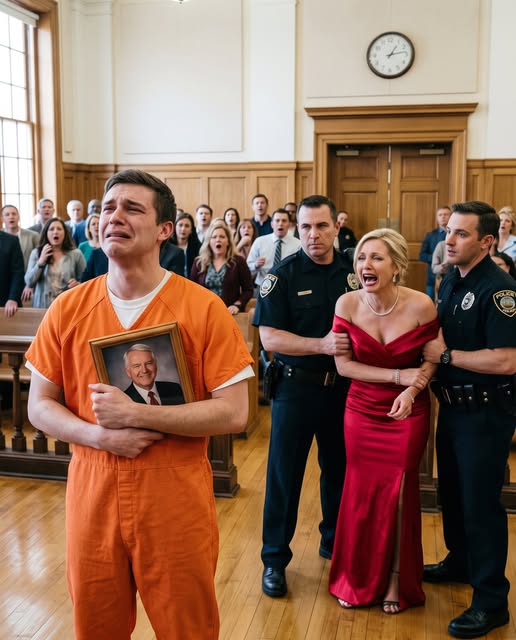
“Yes.”
“Then why did he write the will?”
“Because he finally realized she was going to destroy everything.”
I looked down at the papers.
“And the funeral?”
Carter was silent.
“She told me she would handle it.”
“She lied to me.”
“Yes.”
“Why?”
His voice dropped.
“Because if you knew Dad had changed the will, you would have come home.”
I felt something cold settle inside me.
“And if I came home?”
“She would have had to give you the company.”
“Unless I was still in prison.”
Carter looked at me.
I didn’t need him to answer.
Reagan needed me gone.
Carter needed the money.
My father needed time.
And time was the one thing his illness had not given him.
I picked up the final folder.
Inside was a handwritten page.
My father’s handwriting.
“Finnley,
If Carter is with you when you read this, listen carefully.
Your brother made terrible choices, but he is not beyond saving.
Reagan is different.
She knows exactly what she is doing.
Do not destroy Carter simply because he was afraid.
Make him tell the truth.
And if he refuses, give these documents to the police.”
I looked at Carter.
He was crying silently.
I had not seen my stepbrother cry since we were children.
“I should have stopped her,” he whispered.
“Yes.”
“I should have told the truth.”
“Yes.”
“I was afraid of losing everything.”
“You lost everything anyway.”
He nodded.
“I know.”
For a moment, neither of us moved.
Then Carter reached into his pocket.
He pulled out a phone.
“There is one more thing.”
He unlocked it.
“There are recordings.”
My pulse quickened.
“Of what?”
“My father and Reagan.”
He handed me the phone.
The first recording was dated five days before my arrest.
My father’s voice was weak.
“You cannot keep taking money.”
Reagan answered.
“I can if I need it.”
“You’ve already taken enough.”
“You’re dying, Camden.”
There was a pause.
“You don’t have much time left.”
My father’s voice became colder.
“And that’s why you’re rushing.”
Reagan laughed softly.
“I am protecting this family.”
“You’re protecting yourself.”
The recording ended.
I stared at the phone.
There was another file.
Then another.
Carter looked at me.
“Dad made me record them.”
“Why?”
“Because he knew nobody would believe him once you were arrested.”
I played the next recording.
Reagan’s voice filled the storage unit.
“You’re going to sign the new documents.”
“No.”
“Then Finnley goes to prison.”
My father’s breathing became heavier.
“You can’t threaten my son.”
“I don’t have to.”
There was a long pause.
“You already gave the police everything they need.”
I stopped the recording.
My hands were shaking.
Carter whispered, “There are six more.”
I looked at him.
“Then we’re going to the police.”
He nodded.
But before we could leave, his phone rang.
He looked at the screen.
Reagan.
He didn’t answer.
The phone rang again.
Then a message appeared.
WHERE ARE YOU?
Another message followed.
I KNOW YOU FOUND THE STORAGE UNIT.
Carter stared at me.
A third message arrived.
IF YOU WANT YOUR FATHER’S DEATH TO REMAIN PEACEFUL, COME HOME.
I read it twice.
My father was dead.
There was nothing she could do to him now.
But she could still be hiding something.
We left the storage facility together.
This time, we went straight to the police station.
The detective who reviewed the case was no longer the same detective who had arrested me three years earlier.
He listened.
He examined the documents.
He watched the recordings.
Then he called another investigator into the room.
For nearly four hours, I answered questions.
Carter gave his statement.
The bank records were copied.
The recordings were preserved.
The detective finally looked at me.
“Finnley, I can’t promise what happens next.”
“I don’t need a promise.”
I placed my father’s letter on the table.
“I need the truth.”
The investigation moved quickly after that.
The financial records matched.
The shell companies were real.
The transfers were real.
The recordings were authenticated.
And the old security footage from the company showed Carter using my access card two days before my arrest.
But the final piece came from an account Reagan had forgotten.
A private storage account contained copies of the original financial files.
My father’s attorney had preserved them after receiving instructions from Camden himself.
Reagan’s name appeared throughout the records.
So did Carter’s.
The difference was that Carter had eventually confessed.
Reagan had not.
She was arrested at the house.
When I saw her again, she wasn’t wearing the emerald-green dress.
She wore a plain gray sweater and no pearls.
She looked older.
For a second, I remembered the woman who had once brought me soup when I was sick.
The woman who had stood beside my father at my mother’s funeral.
The woman who had helped raise me.
Then I remembered the front door closing in my face.
“You went to the police,” she said.
“Yes.”
“You don’t understand what your father did.”
“I know enough.”
“He was sick.”
“I know.”
“He was afraid.”
“I know.”
She stared at me.
“He loved you.”
I said nothing.
That seemed to hurt her more than an accusation.
Finally, she whispered, “I loved him too.”
“Maybe.”
She looked down.
“But you still lied about his burial.”
Her eyes filled with tears.
“Because I knew you’d come back.”
“You wanted me to stay in prison.”
She didn’t answer.
“You let me believe my father died without saying goodbye.”
Her voice broke.
“I was trying to save Carter.”
“And my father?”
She closed her eyes.
“I thought I had more time.”
That was the sentence that stayed with me.
Not because it excused her.
It didn’t.
But because it sounded like the closest thing to the truth she had given me.
She had kept making one decision to protect another.
Then another.
Until there was no clean way back.
Carter eventually received a reduced sentence for cooperating and returning what remained of the stolen money.
He lost his share of the inheritance.
He also entered treatment for his gambling addiction.
I never became close to him again.
But I didn’t pretend he was a monster either.
He had done terrible things.
He also finally told the truth.
The house was legally mine.
I could have sold it immediately.
Instead, I stood in the entrance hall one evening and looked at what remained.
Reagan’s expensive furniture was gone.
The artificial air freshener smell had disappeared.
The old family photographs had been recovered from storage.
My mother’s portrait was back on the wall.
My father’s hat sat on the same wooden hook where it had hung for years.
I walked upstairs.
His bedroom had been remodeled, just as Reagan had said.
But beneath the new flooring, the original hardwood remained.
I kept it.
I kept the worn leather chair too.
The one I had imagined him sitting in for 1,095 nights.
A week later, I returned to Pinecrest Cemetery.
The groundskeeper was trimming the cypress trees.
He saw me and smiled.
“You found what you were looking for?”
I thought about the key in my pocket.
“Yes.”
“Your father would be glad.”
I looked across the cemetery.
“Where is he buried?”
The old man hesitated.
Then he pointed toward a small section beneath the trees.
“He changed his instructions near the end.”
I followed him.
There, beside a simple stone, was my father’s name.
Camden Dennis.
No elaborate monument.
No polished marble.
Just his name, two dates, and one sentence beneath them.
He kept his promises.
I stood there for a long time.
I had spent years believing my father had abandoned me.
He hadn’t.
He had been dying while trying to leave me a path back to the truth.
I took the old key from my pocket.
The metal was scratched from the night I had turned it inside Storage Unit 108.
I placed it against the gravestone for a moment.
Then I closed my hand around it.
I didn’t need it anymore.
But I kept it anyway.
Some keys are meant to open doors.
Others remind you that someone, somewhere, believed you would eventually find your way home.