The trail was exactly where Olivia had always walked it.
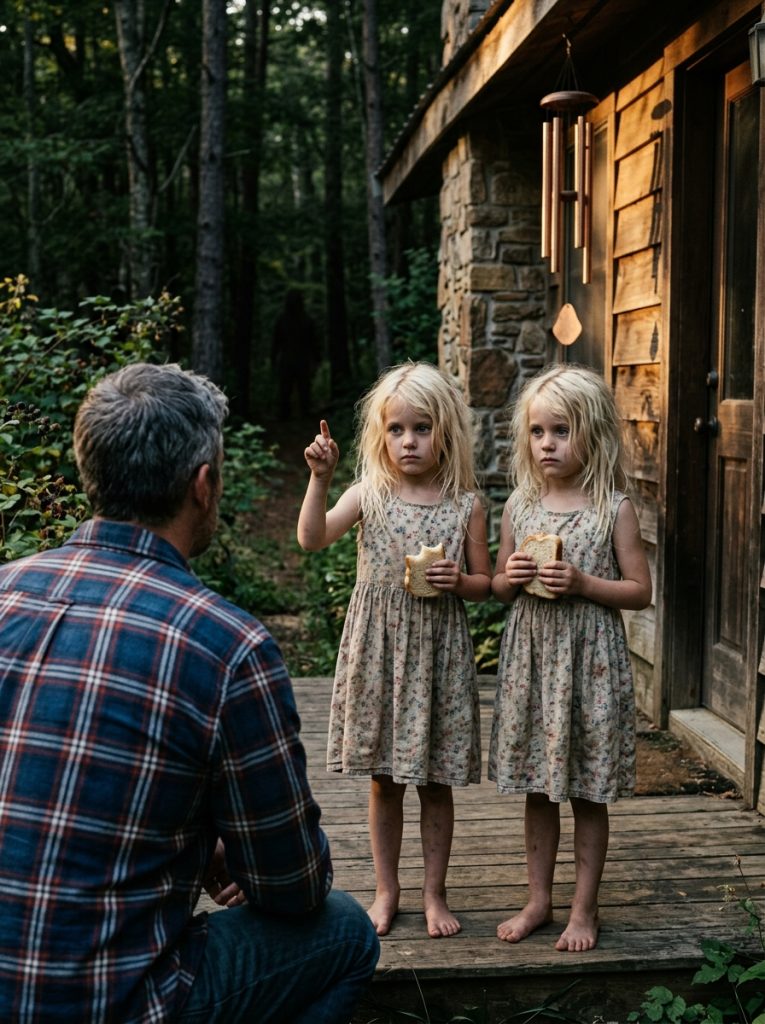
Narrow. Overgrown. Just wide enough for one person to pass between the pine trees without brushing the branches. The golden hour light was fading fast — the Blue Ridge Mountains don’t give you much time between sunset and true darkness. The twin girls, Emma and Ella, walked ahead of me in perfect synchronized steps, their bare feet finding the path as if they’d walked it a hundred times.
Maybe they had.
The silhouette in the trees never came closer — but it never disappeared either. It moved with us, always at the edge of my vision, always between the trunks where the light barely reached. Not quite human. Not quite anything I could name. But there.
“How long have you been here?” I asked the girls.
Emma looked back at me. Her pale blue-gray eyes — Olivia’s eyes — seemed to glow in the dim light. “Since the snow melted.”
“That was months ago.”
“We’ve been waiting.”
“Waiting for what?”
Ella pointed ahead. The trail opened into a small clearing, and there, tucked between two ancient oaks, was a second cabin. Smaller than the main cottage. Built from the same cedar and stone. A thin curl of smoke rose from the chimney.
Someone was inside.
The silhouette at the edge of the trees stopped moving. It stood there — at the boundary of the clearing — and for the first time, I could see it clearly enough to recognize the shape.
A woman. Tall. Dark hair. Wearing one of my old flannel shirts.
“Olivia?”
The word came out before I could stop it. It was impossible. It was insane. Olivia had died three years ago. I had held her hand while she took her last breath. I had watched them lower her into the ground. But the woman standing at the edge of the clearing looked exactly like her.
The twins ran to her. They wrapped their arms around her legs. She rested a hand on each of their heads — the same gesture Olivia used to make when she was thinking.
“You’re not Olivia,” I said.
“No,” the woman said. Her voice was similar — but not the same. A half-step lower. A different cadence. “I’m her sister.”
“Olivia didn’t have a sister.”
“She didn’t know about me. Our mother gave me up for adoption when I was two. I didn’t find out about Olivia until four years ago — right before she got sick.”
The woman stepped into the clearing. The golden light caught her face, and I could see the differences now — the shape of her jaw was slightly different, the set of her eyes, the way she held her shoulders. She was Olivia’s sister. I could see the resemblance and the divergence at the same time.
“My name is Sarah,” she said. “Olivia found me through one of those DNA databases. We met twice before she died. She never told you because she was waiting for the right time. And then…”
“And then there wasn’t a right time,” I finished.
“No.”
I looked at the girls. Emma and Ella — the twins with Olivia’s eyes. “And them?”
“They’re mine,” Sarah said. “But Olivia helped me. When I was pregnant — my husband had left, I had nowhere to go — Olivia brought me here. She said the cottage would always be safe. She taught the girls about the trail. About the wind chime. About you.”
“She told them I’d come.”
“She told them you’d come on a Friday. That you’d be sad. That they should be patient.” Sarah’s voice caught slightly. “She knew you better than anyone, Nathan. She knew it would take you three years to work up the courage to come back. She knew you’d come at golden hour. She even knew you’d kneel on the porch to talk to the girls at their eye level — because that’s the kind of person you are.”
I sat down on a fallen log at the edge of the clearing. My legs wouldn’t hold me anymore.
“Why didn’t you tell me?” I asked. “When I found the girls — why didn’t you just come out and explain?”
Sarah sat beside me. “Because I was scared. I’ve been hiding here for months, Nathan. I don’t have anywhere else to go. I didn’t know if you’d call the police. I didn’t know if you’d try to take the girls. Olivia told me you were a good man, but… good men can still do terrible things when they’re grieving.”
I looked at the girls — Emma and Ella, barefoot in the clearing, finally eating the stale bread they’d been clutching all day. Their faces were thin but not starving. Their clothes were dirty but not destroyed. Sarah had been caring for them. Barely. But caring.
“You can stay,” I said.
Sarah looked at me. “What?”
“The cottage. The trail. All of it. Olivia would have wanted you here. And those girls…” I looked at Emma and Ella, who were now chasing fireflies at the edge of the clearing. “They deserve a home.”
“I can’t pay you.”
“I don’t need money. I need…” I stopped. Swallowed. “I need to know that Olivia’s legacy is more than just a cottage I was too scared to visit. She knew about you. She helped you. She loved those girls enough to teach them about me. That means something.”
Sarah didn’t speak for a long moment. Then she reached into her pocket and pulled out a worn photograph — Olivia, younger, holding two infants wrapped in the same floral fabric the girls were wearing now.
“She said if you ever found us,” Sarah said, “to give you this. And to tell you that the love doesn’t stop when the person dies. It just changes shape.”
I took the photograph. My wife’s face looked up at me — younger than I remembered, happier than I’d seen her in the years before she got sick. She was holding Sarah’s daughters like they were her own. Like the love really did just change shape.
I stayed at the cottage for two weeks. I helped Sarah fix the porch. I bought the girls new shoes and real bread and enough groceries to last through the winter. I set up a small trust — nothing extravagant, just enough to keep the lights on and the girls in school.
I still visit every few months. The girls call me Uncle Nathan now. They’re growing fast — too fast, the way children do. Sarah got a job at the library in the nearest town. She’s taking online classes to become a teacher.
The copper wind chime still hangs on the porch. It still catches the mountain breeze at golden hour.
And sometimes, when the light is just right and the wind is just still, I almost feel Olivia there. Not as a ghost. Not as a silhouette in the trees. Just as… presence. A warmth. A reminder that the love really did change shape.
And it still hasn’t stopped.