My Daughter Banned Me From Her Vineyard Wedding So I Locked The Gates
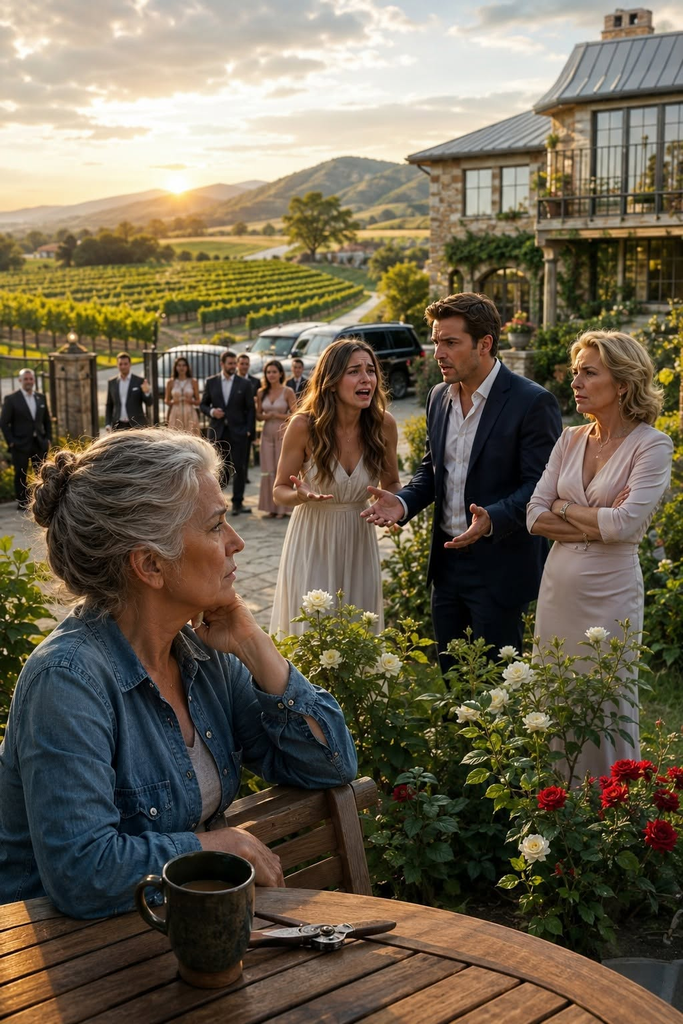
PART 3 (FULL STORY)
The roar of tractor engines drowned out Greg’s shouting as Ben maneuvered our heavy harvest machinery directly behind the wrought-iron security gate. On the outer county road, two commercial moving vans sat idling beside Greg’s rented sports car, their hazard lights blinking against the afternoon glare. Evelyn stood by the open passenger door, her tailored linen jacket looking wildly out of place against the dusty roadside gravel, clutching her designer handbag like a shield as she screamed into her phone.
I didn’t hide in the farmhouse. I walked slowly down the long gravel driveway lined with towering Italian cypresses, wearing my faded denim work shirt and scuffed leather boots. When I reached the gate, Deputy Miller from the county sheriff’s department was already standing beside his patrol cruiser, having arrived ten minutes earlier in response to my request for a standby officer to ensure private property boundaries were respected.
“Andrea!” Greg yelled, rushing toward the iron bars, his face flushed red with fury. “This is completely illegal! We hired those moving trucks from San Francisco! We have furniture, appliances, and wedding decor in those vans! Tell your worker to move those tractors right now!”
“You are standing on private agricultural land, Greg,” Deputy Miller said calmly, placing a resting hand on his utility belt. “The property owner has revoked your access. If you or those commercial vehicles attempt to breach this gate, you will be arrested for criminal trespass.”
Evelyn pushed past her son, her voice shaking with outrage. “Andrea, have you completely lost your mind? We have two hundred guests arriving in Sonoma this weekend! Judges, venture capitalists, senior partners! What are we supposed to tell them when they arrive at a locked gate?”
“Tell them the truth, Evelyn,” I replied through the iron bars. “Tell them that you raised a son who believes he can mock the woman who built this estate, demand an eight-million-dollar house as an entitlement, ban her from her own rose garden, and still expect her to foot the bill for his social vanity.”
“It’s just a house!” Greg shouted, his veneer of East Coast sophistication shattering entirely into raw panic. “You’re an old widow living alone on eighty acres! What do you even need the stone residence for? You practically gave it to us!”
“A gift given in love can always be rescinded when met with contempt,” I said. “The keys I handed you last week were for your inspection. The deed was never signed, and my estate lawyer formally dissolved the proposed trust transfer at eleven o’clock this morning.”
A heavy, suffocating silence dropped over the roadside. Behind Greg, Samantha stepped out of the sports car. Her eyes were swollen from crying, her hair disheveled, and she looked smaller than I had ever seen her. She walked slowly to the gate, her hands trembling as she gripped the cold iron bars.
“Mom,” she whispered, her voice breaking. “Please. Don’t do this to me. Greg and his parents said… they said his family needed a proper backdrop. I was just trying to keep the peace. I didn’t want any drama on my wedding day.”
I looked at my daughter—the girl whose scraped knees I had bandaged, whose college tuition my husband and I had paid from harvest profits, and who had spent the last four days letting strangers treat her mother like an embarrassing servant.
“You didn’t keep the peace, Samantha,” I said gently, without raising my voice. “You kept your comfort at the expense of my dignity. When you told me I wasn’t refined enough to stand in your wedding pictures, you made your choice. You chose Greg’s shallow approval over the woman who gave you everything. And real peace doesn’t come from letting other people erase who you are.”
Samantha lowered her head against the bars and sobbed. Behind her, the moving truck drivers realized they weren’t getting paid to wait in the heat and began turning their massive vehicles around in the county intersection. Evelyn furiously paced the road, making frantic phone calls to find a venue in the valley, only to learn that every vineyard and luxury hotel in the region was fully booked three seasons in advance.
With the caterers, florists, and musicians canceled, the lavish Saturday spectacle collapsed completely. To avoid total social humiliation, Greg’s family paid for an emergency private dining room at a hotel conference center forty miles away, holding a stiff, ten-minute ceremony attended by fewer than twelve people. The two hundred invited guests received abrupt cancellation notices, unleashing a wave of valley gossip that stripped away every ounce of prestige Greg had spent years fabricating.
The financial truth about Greg’s family surfaced rapidly over the following months. His parents were drowning in leveraged commercial loans, and Greg had intended to use the stone vineyard house as collateral for a high-risk investment scheme to fund a luxury wine-import business. Without my property to secure his loans, his financial house of cards collapsed. The lenders called in his debts, and the country club revoked his membership.
The marriage, built on entitlement and false promises, could not survive the weight of reality. Deprived of the wealthy vineyard lifestyle she thought she was stepping into, Samantha realized that Greg had never loved her—he had loved the estate she represented. Within ten months, she filed for divorce and moved into a small one-bedroom rental in Santa Rosa, taking a position as an administrative coordinator at a community arts center.
Meanwhile, life on the vineyard continued with the quiet, unhurried rhythm of the seasons. I partnered with the state agricultural university to convert the renovated stone house on the creek into an endowed center for sustainable viticulture. Every semester, four graduate students from humble farming backgrounds lived there tuition-free, conducting research on water conservation and organic rootstock cultivation.
Two years after that afternoon at the gate, a modest sedan pulled down the driveway. Samantha stepped out alone. She wore a simple cotton dress and flat sandals. There was no arrogance in her stride, no hurried demands, only the hesitant humility of someone who had spent two years learning the cost of her mistakes.
She walked up the porch steps where I was sitting with a notebook of harvest yields. She didn’t ask for money, nor did she ask for her old room back. She held out a small, potted white rose cutting she had grown herself.
“I planted this from the bush Dad gave me,” she said quietly, her voice steady. “I don’t expect you to forget what I did, Mom. But I wanted you to know that I finally understand what matters.”
I looked at the young plant in her hands, then up at my daughter. Forgiveness in a family doesn’t mean forgetting boundaries, but like the vines that survive the bitter winter frost, true roots are strong enough to grow new leaves when given honest soil.
“Put on some work boots, Samantha,” I said softly, standing up from my chair. “We have eighty acres of grapes to harvest, and the vines won’t wait.”
We walked out into the rows together beneath the golden autumn sun. As Samantha knelt beside the rich earth, her fingers digging into the soil where her father and I had labored for forty years, I took a deep breath of the crisp harvest air. The vineyard was thriving, peaceful, and unyielding—and for the first time in a very long time, everything in our lives was rooted in truth.