The $23,289 Dinner That Exposed Where My Restaurant Money Was Going
PART 3 (FULL STORY)
Beatrice stared at the first page, and for several seconds, she didn’t say anything.
The women around the table leaned closer, trying to see what had suddenly changed her expression.
I remained standing beside the door.
Gavin stood a few feet behind me, holding the payment terminal against his chest.
Beatrice finally looked up.
“What is this?”
“You told everyone you were paying for dinner,” I said. “So I thought you should have the complete account.”
She pushed the first page away as if it were dirty.
“I meant the dinner.”
“That is the dinner.”
“No.” Her voice sharpened. “I mean this other nonsense.”
One of her friends picked up the page.
Her eyes moved slowly down the printed lines.
“This is a bank statement.”
Beatrice snatched it from her.
“It has nothing to do with this meal.”
“It has everything to do with why you thought you could bring thirty-eight people into my restaurant and spend whatever you wanted.”
Her face tightened.
I opened the folder wider.
The first pages showed the restaurant charges from that afternoon.
The tasting menus.
The reserve wine.
The seafood.
The steaks.
The desserts.
The private dining room.
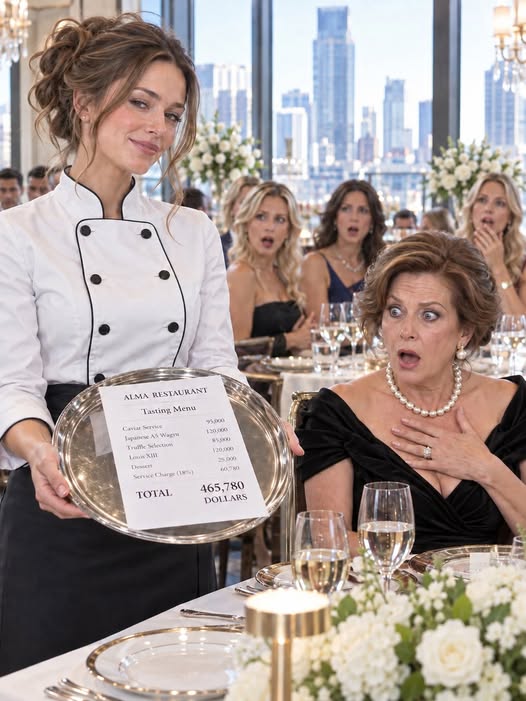
The total at the bottom was exactly $23,289.
Then came the pages behind it.
Hotel charges.
Luxury shopping.
A jewelry store.
A weekend resort.
Two airline tickets.
A series of transfers from Lumina’s operating account into an account I had never recognized.
And finally, copies of payments made toward debts that had never appeared in the restaurant’s accounting records.
Beatrice stopped turning the pages.
One of her friends whispered, “What are those?”
Beatrice looked at me.
“You had no right to go through my son’s business.”
“My business.”
She flinched.
I had spent years allowing people to repeat the same lie until I almost started doubting myself.
Lucas had told his mother he owned part of Lumina.
Beatrice had told her friends the restaurant belonged to the family.
But there was one problem with their story.
There was a paper trail.
And I had finally followed it.
Three months earlier, I had noticed that several payments from the business account were larger than normal.
At first, I assumed they were legitimate.
Restaurants had unpredictable expenses.
Suppliers changed prices.
Equipment broke.
Staff needed emergency payments.
There were always explanations.
But then I saw a hotel charge in Palm Springs on a weekend when Lucas had told me he was visiting his mother.
The following week, there was another hotel.
Then a luxury boutique.
Then a payment to a resort.
The amounts were not enormous individually.
Together, they formed a pattern.
I asked Lucas about the first hotel.
He laughed.
“You’re checking my expenses now?”
“I’m checking the restaurant account.”
“You know I use the business card sometimes.”
“For what?”
“Business.”
He never explained what business.
When I asked Beatrice, she told me I was becoming paranoid.
“You work too much, Camilla.”
That sentence had stayed with me.
So I stopped asking them questions and started asking the records instead.
I hired an accountant who had no connection to my husband or his family.
She found more.
Some transfers had been disguised as vendor payments.
Others had been described as consulting expenses.
A few had no useful description at all.
The money eventually led back to an account connected to Lucas.
Not directly.
But closely enough that the connection could not be dismissed as coincidence.
And then I found the name of the woman Beatrice had just mentioned over dinner.
Mara.
I had never met her.
But her name appeared beside several transactions.
Hotel rooms.
Dinner reservations.
Gift purchases.
A weekend rental.
The money had not simply disappeared.
It had been spent.
And someone had been keeping records of it.
That someone was me.
Beatrice put the pages down.
“This is ridiculous.”
One of her friends looked confused.
“What does Lucas have to do with this?”
Beatrice immediately answered.
“Nothing.”
I looked at her.
“You just told them he was paying for another woman with money from the restaurant.”
“I was joking.”
“You named the source.”
“I was drinking.”
“You told them exactly where the money came from.”
Beatrice glanced around the table.
The women who had laughed with her earlier were no longer laughing.
One woman slowly placed her wineglass down.
Another looked toward the door.
Beatrice pointed at me.
“You’re trying to embarrass me.”
“No.”
I looked at the bill.
“You embarrassed yourself when you promised to pay for thirty-nine people.”
“I don’t have twenty-three thousand dollars!”
The words came out before she could stop them.
The room became very still.
I nodded.
“That’s why I knew you weren’t planning to pay.”
Beatrice stared at me.
Then she looked toward Gavin.
“Tell her this was a family event.”
Gavin shook his head.
“The restaurant has no family account.”
She turned red.
“You know who my son is.”
“I know who your son is,” Gavin replied calmly. “And I know who owns Lumina.”
Beatrice looked back at me.
For years, she had treated Gavin like an employee beneath her.
Now she seemed to realize he had never been confused about who signed his checks.
One of her friends spoke quietly.
“Beatrice, maybe we should just split the bill.”
Beatrice whipped around.
“What?”
“We all ordered the food.”
“But I told everyone I was treating you.”
“Yes,” the woman replied. “And we believed you.”
Another woman pulled out her phone.
“How much would my share be?”
Gavin calculated it.
“About five hundred and ninety dollars each, depending on the wine.”
The women began talking among themselves.
Beatrice watched them with growing panic.
“No one is paying this.”
I said nothing.
She turned toward me.
“You’re my daughter-in-law.”
“Yes.”
“I’m family.”
“You are.”
“Then you wouldn’t humiliate me like this.”
I looked at the folder.
“I didn’t humiliate you.”
I pushed the bill toward her.
“You did that when you lied to thirty-eight people.”
She stared at the amount.
Then she said something I had expected.
“Lucas will fix this.”
I almost smiled.
Not because it was funny.
Because it was exactly what she would say.
“Call him.”
She froze.
“What?”
“Call Lucas.”
Beatrice picked up her phone.
Her hand shook slightly.
She called.
The phone rang.
Once.
Twice.
Three times.
No answer.
She called again.
Still nothing.
I knew why.
An hour earlier, I had sent Lucas one message.
We need to talk.
He had not replied.
That wasn’t unusual.
Lucas had become very good at disappearing whenever accountability appeared.
Beatrice looked at me.
“He’s probably busy.”
“Probably.”
“He’ll call back.”
“I’m sure he will.”
She narrowed her eyes.
“What did you tell him?”
“Nothing.”
That was true.
I hadn’t told Lucas about the dinner.
I hadn’t told him about the folder.
I hadn’t told him what I had discovered.
I wanted to see who would show up when the comfortable story finally collapsed.
Beatrice’s phone rang.
Everyone looked at it.
Lucas.
She answered immediately.
“Where are you?”
I watched her face change.
She listened.
Then she said, “No, I’m at Lumina.”
A pause.
“No, you need to come here.”
Another pause.
Her voice dropped.
“Now.”
She ended the call.
I waited.
“Well?”
“He’s coming.”
I nodded.
“Good.”
The women remained seated.
None of them wanted to leave while the situation was unresolved.
Twenty minutes later, the private dining room door opened.
Lucas walked in.
He looked irritated rather than worried.
Then he saw me.
His expression changed.
Then he saw the women.
Then the bill.
Finally, he saw the folder.
“What is this?”
Beatrice stood immediately.
“Your wife is attacking me.”
Lucas looked at me.
“Camilla, what are you doing?”
“I’m collecting a restaurant bill.”
“You know my mother.”
“She told everyone she was paying.”
“You could have handled this privately.”
“I tried handling things privately.”
I pointed toward the folder.
“For months.”
Lucas glanced at the papers.
His face lost some color.
He knew.
Not everything.
But enough.
“Where did you get these?”
“From the restaurant records.”
“You went through my transactions?”
“They were made with restaurant money.”
He said nothing.
One of Beatrice’s friends looked between us.
“Lucas, is this true?”
He ignored her.
“Camilla, we can talk at home.”
“No.”
His eyes hardened.
“Not here.”
“You’re right.”
I closed the folder.
“We should have this conversation somewhere else.”
Beatrice exhaled in relief.
Then I continued.
“So I already arranged for our accountant and attorney to meet us tomorrow morning.”
Lucas stared at me.
“Our attorney?”
“My attorney.”
That was when he understood.
This wasn’t an argument between husband and wife anymore.
It was a business matter.
And the records were no longer in his control.
“You can’t do this,” he said.
“I already did.”
Beatrice stepped between us.
“Camilla, you are making a huge mistake.”
“No.”
I looked at her.
“The mistake was believing I would keep paying for everyone while pretending I didn’t know where the money was going.”
She shook her head.
“You’re destroying your marriage.”
I answered quietly.
“You didn’t destroy my marriage.”
I looked at Lucas.
“You helped me see what was already destroyed.”
Lucas lowered his eyes.
For the first time that afternoon, he had nothing to say.
The next morning, we met in my attorney’s office.
The accountant brought every statement.
Every transfer.
Every receipt.
Every unexplained expense.
Lucas tried to say he had intended to reimburse the restaurant.
Then he said the money was temporary.
Then he said he was under pressure.
Then he said he didn’t realize how much had been spent.
None of those explanations changed the records.
My attorney asked him one simple question.
“Did you have authorization to use the company funds for personal expenses?”
Lucas stared at the table.
“No.”
The answer was quiet.
But it was enough.
The affair itself was no longer the central issue.
The financial records were.
The money belonged to the business.
Some of it had already been recovered from accounts connected to Lucas.
Other amounts would have to be addressed through formal proceedings.
I changed the banking permissions that afternoon.
Lucas no longer had access to the operating account.
I also separated our household finances.
There was no dramatic scene.
No screaming.
No smashed photographs.
Just paperwork.
That was somehow harder.
A week later, Lucas moved out.
Beatrice stopped coming to the restaurant.
For a while, I expected her to return with another accusation.
She didn’t.
Instead, she sent me a message.
You embarrassed me in front of my friends.
I read it twice.
Then I answered.
You promised them a dinner you had no intention of paying for.
She replied almost immediately.
You’re still my son’s wife.
I looked at the screen for a long time.
Then I typed:
That doesn’t make Lumina yours.
I never heard from her again.
The women from the dinner did something I hadn’t expected.
Three of them came back to Lumina.
Not together.
Separately.
One came for lunch.
Another brought her husband.
The third returned with a group of friends.
None of them mentioned Beatrice.
They simply ordered, paid, and left generous tips.
One afternoon, one of them stopped me near the host stand.
“I owe you an apology.”
I didn’t ask for one.
She continued.
“I believed what Beatrice told us.”
“I understand.”
“I shouldn’t have.”
I gave her a small smile.
“You don’t owe me anything.”
She looked toward the dining room.
“Your restaurant is beautiful.”
I glanced around.
The dark wood.
The open kitchen.
The brass lights.
The long counter I had chosen myself years earlier.
“Yes,” I said.
“It is.”
Months passed.
The restaurant became quieter in some ways and busier in others.
Without Lucas’s spending, the accounts stabilized.
Without Beatrice’s unpaid dinners, the inventory made sense again.
I stopped checking my phone every time a bank notification appeared.
I stopped wondering whether the next withdrawal would have another explanation.
I also stopped explaining Lumina to people who had already decided who I was.
I wasn’t just the woman who cooked.
I was the owner.
I had always been the owner.
I had simply spent too many years allowing other people to tell the story.
One Friday evening, almost a year after the dinner, Gavin came into my office carrying a familiar folder.
I laughed when I saw it.
“Please tell me that isn’t another twenty-three-thousand-dollar bill.”
He smiled.
“No.”
He placed it on my desk.
“Annual financial report.”
I opened it.
The numbers were clean.
Profitable.
Stable.
Mine.
I closed the folder and leaned back.
Through the office window, I could see the dining room filling with guests.
A server carried out a bottle of wine.
Someone laughed near the bar.
The kitchen bell rang.
Then another ticket printed.
The sound was ordinary.
That was what I liked about it.
Nothing was hidden inside that sound anymore.
No secret transfer.
No hotel bill.
No gift for someone I had never met.
No family story pretending to be a business plan.
Just dinner.
Just work.
Just the restaurant I had built.
I walked into the dining room and passed the table where Beatrice had once sat with thirty-eight friends.
The “Reserved” sign was standing there again.
This time, it belonged to a real reservation.
I straightened it with two fingers and walked away.
Behind me, the kitchen doors swung open, warm air carrying the smell of roasted garlic and fresh bread into the room.
Gavin called from the service station.
“Camilla, table twelve is ready.”
I turned toward him.
“Send it out.”
And for the first time in years, when I heard the sound of my restaurant serving another table, I didn’t wonder who would take something from me.
I knew exactly what belonged to me.