The Billionaire Who Rejected His Pregnant Wife Met His Three Daughters Five Years Later
PART 3 (FULL STORY)
“Heard what?”
Julian’s voice was controlled, but barely.
The woman beside the Bentley looked from him to me, then down at the three girls.
She had gone pale.
I knew exactly why.
Her name was Dr. Maya Chen, the obstetrician who had treated me during the pregnancy and had become one of the few people in my life who knew the entire story.
“Maya,” I said quietly.
She gave me an apologetic look.
“I’m sorry, Evelyn.”
Julian stepped closer.
“Who is she?”
“Maya Chen,” I said. “She was my doctor.”
His eyes sharpened.
“During the pregnancy?”
“Yes.”
He looked at the girls again.
“They’re mine.”
It wasn’t a question anymore.
I didn’t answer immediately.
Sophie had released my waist and was studying him with the careful curiosity children use when they sense that adults are hiding something.
Grace was still holding my hand.
Emma had moved behind my coat.
Julian crouched slowly so he was closer to their height.
For the first time since I had known him, the man who could command a boardroom full of executives looked uncertain about what to say.
“Hi,” he managed.
Sophie tilted her head.
“Hi.”
Julian smiled.
It was a small, broken attempt at the smile I remembered from years ago.
Sophie stared at him for another second.
Then she pointed at his face.
“You have the same dimple as me.”
Julian closed his eyes briefly.
When he opened them, they were wet.
“Yes,” he said.
“I think I do.”
I looked away.
Not because I felt sorry for him.
Because there were five years between us, and none of them could be crossed in a single afternoon.
Maya touched my arm.
“We should go.”
Julian stood.
“Wait.”
I turned.
“I need to know.”
“You already know.”
“No,” he said. “I need to know everything.”
I almost laughed.
Everything.
That was the one thing he had never allowed me to give him.
Five years earlier, I had stood in our bedroom with an ultrasound photograph in my hand.
I had been terrified, exhausted, and happier than I had ever been.
I had spent days planning how to tell him.
Our anniversary dinner was supposed to be that night.
I had even bought a tiny box and wrapped the ultrasound picture inside it.
Then he saw the medical messages on my phone.
He had been in New York for a week-long investor meeting, and I had been receiving messages from Maya about blood tests, medications, and the risks of a triplet pregnancy.
Julian saw the doctor’s name.
He saw words like “pregnancy,” “three babies,” and “high risk.”
But instead of asking me what they meant, he decided they meant someone else.
I still remembered his face when he confronted me.
Cold.
Hurt.
Furious.
I had tried to explain.
He had refused to listen.
Then I showed him the ultrasound.
He didn’t even look at it.
“If you’re pregnant, don’t expect me to raise another man’s child.”
Those words had ended our marriage before any lawyer had drawn up a single document.
The divorce had taken less than three months.
Julian had sent lawyers.
I had signed the papers.
He offered money.
I refused it.
He offered the apartment.
I left it.
He offered to make sure I was “taken care of.”
I told him I didn’t need to be taken care of by a man who had already decided I was a liar.
Then I disappeared.
I moved to Chicago because Maya had connected me with a research group working on clean-energy storage technology.
I took the job under my maiden name.
I worked through the pregnancy until my doctor told me to stop.
And when the girls were born, I built a life around them.
Not a perfect life.
A real one.
There were nights when Sophie cried because Grace had taken her stuffed rabbit.
There were mornings when Emma refused to wear anything except yellow.
There were three cribs in my apartment, three bottles warming at once, and three tiny hands that seemed determined to grab everything I owned.
I had been exhausted.
I had been afraid.
I had also never been more certain that leaving New York had been the right thing to do.
Julian looked at the girls now as though he were trying to calculate five lost years.
“How did you do this alone?”
I met his eyes.
“I wasn’t completely alone.”
His expression tightened.
“Maya helped.”
“My parents helped when they could.”
“And you?”
“I worked.”
He stared at me.
“You developed the battery system used by my company.”
“I helped develop an early version of it.”
“You left before the final patent.”
“Yes.”
“And you never told me?”
“You had made your position clear.”
His face changed.
“You thought I wouldn’t want them.”
“You told me not to expect you to raise another man’s child.”
“I was wrong.”
“Yes.”
The single word landed harder than anger would have.
Julian looked down.
“I was wrong.”
I said nothing.
He took a breath.
“I don’t know what else to say.”
“That makes two of us.”
Grace tugged my hand.
“Mom, are we going home?”
I looked at her.
“Yes.”
Julian’s face tightened at the word.
“Can I see them?”
I looked at the three girls.
Then at him.
“You can ask them.”
He hesitated.
That hesitation mattered to me.
For years, Julian had treated every problem like something money could solve.
This wasn’t something he could buy.
He had to ask three little girls for permission to enter their world.
He crouched again.
“Would you like to have lunch with me?”
Sophie looked at me first.
Grace looked at Sophie.
Emma looked at Julian.
“Do you know Mom?” Emma asked.
Julian swallowed.
“I used to.”
Sophie frowned.
“Were you her friend?”
I almost smiled.
Julian looked at me.
“We were married.”
The girls stared at him.
Emma frowned.
“Why aren’t you married now?”
Julian looked down.
“That was my fault.”
I hadn’t expected him to say it.
Neither had he.
We didn’t go to his hotel.
We went to a small restaurant near the lake because I knew the girls liked the pancakes there.
Julian followed in a second car.
He didn’t complain about the place.
He didn’t call ahead for a private room.
He simply sat across from the three girls and watched them argue over syrup.
At first, he said almost nothing.
Then Grace asked what he did.
“I run a company.”
“What kind?”
“Clean energy.”
“Like solar?”
“Something like that.”
Sophie leaned forward.
“Are you famous?”
Julian smiled faintly.
“Sometimes.”
She considered that.
“Mom isn’t famous.”
“No,” I said.
Julian looked at me.
“She should be.”
I ignored him.
The lunch lasted an hour.
Then two.
The girls slowly became comfortable around him.
Emma showed him a drawing.
Grace asked him whether billionaires really had helicopters.
Sophie asked if his house had a swimming pool.
He answered every question seriously.
When Grace asked if he had children, he stopped.
“I do now,” he said.
I looked at him.
The words were simple.
They still hurt.
After lunch, he asked if he could walk with us.
I almost said no.
Then I looked at the girls.
They were already running toward the lake.
So I agreed.
For several minutes, we walked without speaking.
Finally Julian said, “I want a DNA test.”
“I expected that.”
“I need to know.”
“I know.”
“And if they are mine—”
“They are.”
He stopped.
“How can you be so certain?”
I stared at him.
“Because I was there when they were born.”
He looked ashamed.
“That isn’t what I meant.”
“I know what you meant.”
I took a breath.
“Yes, Julian. They’re yours.”
He looked toward the girls.
“All three?”
“All three.”
He sat on a bench.
His shoulders dropped.
“Three daughters.”
“Yes.”
“I missed everything.”
“Yes.”
“First steps?”
“Yes.”
“First words?”
“Yes.”
“First day of school?”
“Yes.”
He looked down at his hands.
“I missed five birthdays.”
“Yes.”
“Why didn’t you tell me?”
I stared at him for a long time.
“Because you had already told me not to.”
He didn’t argue.
That was the first thing he did right.
For the next two weeks, Julian didn’t try to force himself into our lives.
He asked before visiting.
He brought gifts only after I told him the girls’ favorite things.
He learned that Sophie hated bananas, Grace couldn’t sleep without a night-light, and Emma wanted the same bedtime story every night.
He came to their school performance and sat in the back.
He didn’t announce himself.
He didn’t bring photographers.
He simply watched.
The girls began calling him Julian.
Not Dad.
Not yet.
He never pushed them.
One afternoon, I found him sitting on the floor of my living room helping Emma assemble a wooden wind turbine kit.
His expensive suit was covered in tiny pieces of cardboard.
Emma was giving him instructions.
He was following every one.
“You’re doing it wrong,” she told him.
“I know.”
“Then fix it.”
“Yes, boss.”
I stood in the doorway.
He looked up.
For a second, neither of us spoke.
“You don’t have to do this,” I said.
“I know.”
“You have a company.”
“I know.”
“You have a life.”
His eyes stayed on mine.
“I had a life.”
Then he looked at Emma.
“I didn’t have this.”
I didn’t answer.
The legal side came next.
Julian hired a family lawyer.
I hired my own.
There were discussions about custody, visitation, school, travel, and money.
For the first time, I saw the difference between the Julian I had divorced and the man sitting across from me now.
He never demanded immediate custody.
He never threatened me.
He never tried to use his wealth against me.
When his lawyer suggested a more aggressive approach, Julian rejected it.
“They’ve lived with Evelyn their entire lives,” he said.
“I don’t get to walk in and take half their childhood because I finally decided to pay attention.”
I heard that sentence from my lawyer later.
It didn’t erase what he had done.
But it mattered.
Then the DNA results arrived.
I opened the envelope alone.
The results confirmed what I had known since the day they were born.
Julian was their biological father.
I called him.
He answered on the first ring.
“Evelyn?”
“They’re yours.”
There was silence.
Then I heard him breathe out.
“I know.”
“No,” I said.
“You needed the paper.”
“I did.”
“And now?”
His voice cracked slightly.
“Now I have three daughters.”
I closed my eyes.
He asked if he could tell them himself.
I agreed.
That evening, we sat together in my living room.
The girls were on the rug.
Julian sat opposite them.
“There’s something I want to tell you,” he said.
Sophie looked up.
“What?”
“I am your father.”
The room went quiet.
Emma looked at me.
Grace looked at Julian.
Sophie was the first to speak.
“Like Daddy?”
Julian shook his head gently.
“I’ve never been your dad before.”
“Why?”
He looked at me.
Then back at them.
“Because I made a very bad mistake before you were born.”
Sophie thought about that.
“Are you going away again?”
The question nearly broke him.
“No.”
She watched him carefully.
“Promise?”
He nodded.
“I promise I will never disappear because I am embarrassed or angry or afraid.”
I looked down.
That was the promise I had once needed from him.
He was finally making it to the people who mattered.
Months passed.
Julian became part of their lives slowly.
He attended school meetings.
He learned how to braid hair badly.
He took Grace to soccer practice.
He helped Sophie with science projects.
He discovered that Emma’s favorite place in the city was a small bookstore with a crooked blue door.
He also changed things in his own life.
He stepped back from daily management of his company.
He stopped giving interviews about his private life.
He turned down several public appearances that would have made the girls’ existence a business story.
He didn’t do these things for forgiveness.
At least, that’s what he told me.
“I don’t expect you to forgive me,” he said one evening.
“I don’t even expect you to trust me.”
“Good.”
He smiled.
“But I am going to spend the rest of my life becoming someone you don’t have to worry about.”
I looked at him.
“You can’t change the past.”
“I know.”
“You can’t give me those five years back.”
“I know.”
“And you can’t make the girls remember a father who wasn’t there.”
“I know.”
“Then what do you want?”
He looked toward the window.
“The chance to be there for the next five.”
I didn’t answer.
But I didn’t tell him no.
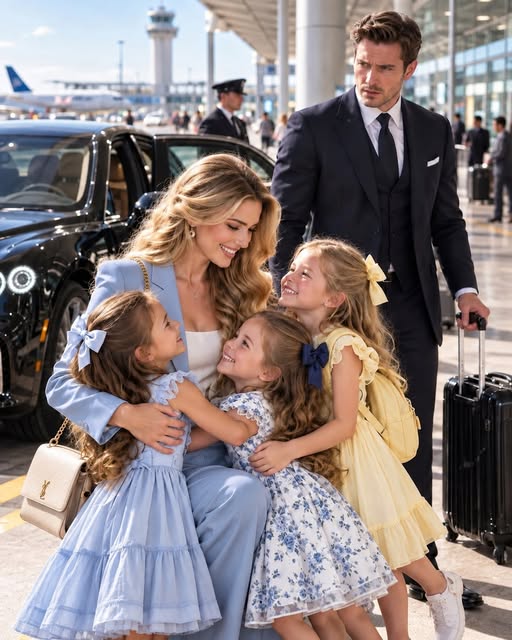
A year after the airport, we stood outside the same little bookstore with the crooked blue door.
The girls had grown taller.
Sophie had started wearing her hair in braids.
Grace had become obsessed with soccer.
Emma still carried the same yellow backpack everywhere.
Julian stood beside me.
He had stopped wearing the expensive watches.
He had stopped checking his phone every few minutes.
He looked less like the billionaire from magazine covers and more like a father waiting for his daughters to finish choosing books.
Sophie came running out.
“Mom!”
Grace followed.
Emma was carrying three books and struggling with the door.
Julian held it open for her.
“Thank you, Dad,” Emma said.
He froze.
Just for a second.
Then he smiled.
“Anytime.”
I watched him kneel to help her with the books.
Grace was already talking about dinner.
Sophie was arguing that she had chosen the best story.
Their voices overlapped as we walked toward the car.
Julian glanced at me.
“Evelyn.”
“Yes?”
“Thank you.”
I shook my head.
“Don’t thank me.”
He looked confused.
“Thank the girls.”
He smiled.
“I do.”
The old ultrasound photograph was still in my desk drawer.
The edges had softened with age.
For years, I had kept it because it was the only proof I had left of the moment before everything fell apart.
I no longer needed it for that.
That night, after the girls were asleep, I took it out and looked at the three tiny shapes on the faded image.
Five years ago, Julian had refused to look.
Now three grown little girls were asleep upstairs, and one of them had left a yellow crayon on the corner of my desk.
I put the photograph back in the drawer.
Then I placed the crayon beside it.
Some things belonged to the past.
Some things were still being drawn.