The Letter Julian Left Behind After Abandoning Me and Ten Children
PART 3 (FULL STORY)
I read the sentence again.
“I know you will hate me for what I did, but there is something I never told you about the ten children.”
My oldest son, Daniel, was standing behind my chair.
“Mom,” he said quietly, “what does he mean?”
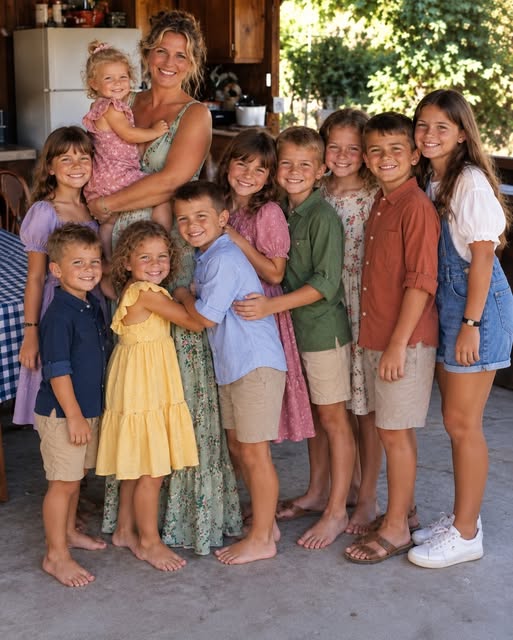
I looked at the ten faces around my table.
For thirty years, I had tried not to speak about Julian unless one of the children asked.
There had been no photographs displayed in the house.
No framed wedding picture.
No anniversary remembered.
Nothing that could make the children feel as though they had been waiting for a father who had chosen someone else over them.
I had answered their questions as honestly as I could.
“I don’t know why he left.”
That had always been the truth.
Now, for the first time, I was afraid that truth was about to change.
I unfolded the rest of the letter.
“By the time you read this, I will be gone, and the children will be grown,” Julian had written. “I have waited too long to explain what happened, and I know that waiting has made my decision harder to forgive.”
I stopped there.
Daniel put a hand on my shoulder.
“Keep reading.”
So I did.
“The night before I disappeared, I received a visit from a man named Victor Hale.”
The name meant nothing to me.
Julian continued.
“Victor had been handling a financial matter for my late wife’s family. After her death, I discovered that she had left behind debts I did not know existed. I believed they were ordinary business debts, and I intended to deal with them after the wedding.”
Then came the sentence that changed the way I remembered that week.
“Victor told me they were not ordinary debts.”
According to Julian, his late wife had unknowingly become connected to a business arrangement involving forged accounts and money that had been moved through several companies.
Julian had discovered that someone had been using her name after her death.
When he tried to investigate, Victor appeared at his house.
He told Julian that the people responsible knew about the ten children.
They knew where they went to school.
They knew where Julian lived.
They knew about me.
And they knew our wedding was one week away.
Julian had asked Victor what he wanted.
The answer was simple.
Julian had to disappear.
No police.
No explanations.
No contact with the children.
No attempt to bring me with him.
If he refused, Victor said the people behind the scheme would make sure the children suffered for what Julian had uncovered.
I lowered the letter.
For thirty years, I had imagined Julian standing in that kitchen, looking at his children, and deciding that leaving was easier than staying.
Now I was being asked to believe he had walked away because someone threatened them.
I wasn’t ready to forgive him.
Not yet.
Daniel seemed to understand.
“Mom,” he said, “you don’t have to.”
I looked at him.
He was fifty-two years old.
His hair had begun turning gray around the temples.
And suddenly I could see the little boy he had been, sitting on the kitchen floor with his shoes untied, asking me when his father was coming home.
I looked back at the letter.
Julian had written that after he left, he spent years moving from place to place.
He did not contact us because Victor’s warning had been specific.
If Julian reached out, the people watching him would know that he had not truly disappeared.
But there was another reason.
Julian had been ashamed.
He had convinced himself that if the children believed he had abandoned them, they would eventually stop looking for him.
He thought hatred would protect them better than hope.
That sentence made me angry.
It still does.
Children do not stop hurting because you give them someone to hate.
They simply learn to carry the hurt.
I continued reading.
“For the first two years, I watched from a distance.”
My breath caught.
He had been there?
Julian wrote that he had seen the children at school from across streets and parking lots.
He had watched Daniel receive an award.
He had seen Sarah perform in a school play.
He had watched the younger children grow taller.
But he never approached them.
He never spoke their names.
He never let them see him.
“I wanted to run to them every time,” he wrote. “But I believed that one moment of selfishness could put all ten lives in danger.”
Then he admitted something else.
He had secretly sent money.
Not enough to reveal himself.
Not enough to make anyone suspicious.
Just enough to help with school expenses, medical bills, and later, college tuition.
At first, I wanted to reject the story.
Thirty years of silence cannot be repaired by a few payments.
But then I remembered things I had never been able to explain.
The anonymous check that arrived when Daniel needed surgery.
The college fund that appeared for Sarah.
The mysterious payment that covered a winter heating bill when I was working two jobs and thought we might lose the house.
I had always assumed one of my relatives had helped secretly.
My parents had denied it.
My brothers had denied it.
I had eventually stopped asking.
Now I knew.
Julian had been there in the only way he believed he safely could.
I reached the next page.
And that was where the letter became harder to read.
“After six years, I discovered that Victor had lied to me.”
I looked up.
Everyone at the table was listening.
Julian explained that the threat had been real, but Victor had not been protecting the children.
He had been protecting himself.
The financial scheme had grown larger than Julian originally understood.
Victor was one of the people involved.
He had used Julian’s fear to force him into silence.
Julian had eventually collected enough evidence to expose him.
But by then, six years had passed.
The children were growing up.
And Julian had convinced himself that returning would destroy whatever stability I had managed to build.
He wrote that he had followed our lives through public records and occasional reports from people he trusted.
He knew when the children graduated.
He knew when they married.
He knew when the first grandchild was born.
He knew I had refused every opportunity to leave the family behind.
And he knew that I had never married anyone else.
That last sentence made one of my daughters cover her mouth.
I did not cry.
Not yet.
I kept reading.
“I wanted to come home more times than I can count.”
“But I had already missed too much.”
“I was afraid that if I appeared after twenty years, I would be asking you to carry my guilt along with your own life.”
Then came the sentence that made me finally put the letter down.
“You gave my children thirty years I had no right to ask you for.”
The room was quiet.
Not the dramatic silence of a movie.
It was the ordinary silence that happens when people are trying to understand something too large to answer immediately.
Daniel pulled out a chair and sat beside me.
“So he knew about us all this time,” he said.
“Yes.”
“And he never came back.”
“No.”
Sarah looked toward the envelope.
“Then why now?”
I turned the page.
The answer was waiting there.
Julian had become ill.
The lawyer, Arthur, had been handling his estate for several years.
Julian had finally decided that he could not die without telling us the truth.
But he had not wanted to appear at my door himself.
He believed he had forfeited that right.
So he had written everything down.
There was another envelope mentioned in the letter.
Arthur had it.
I looked at the front door.
For a moment, I wondered if I should call him.
Then my youngest daughter said, “Mom, do it.”
So I did.
Arthur answered on the second ring.
“I assume you’ve read the letter.”
“Yes.”
“Then you know why I came.”
“I know some of it.”
There was a pause.
“Mr. Vance asked me to give you the rest only if you wanted it.”
“What is it?”
“He left something for you.”
I almost laughed.
After thirty years, those words sounded cruel.
“What could he possibly leave me?”
Arthur answered quietly.
“The house.”
Nobody spoke.
Julian had owned a small house in another state.
I had never known about it.
Arthur explained that Julian had bought it years after disappearing.
He had kept it empty except for a study.
The study contained boxes of documents, photographs, letters he had written but never sent, and records of every payment he had made for the children.
He had never mailed most of the letters.
He had been afraid that sending them would expose his location.
But he had kept them anyway.
Arthur said Julian had also left me the proceeds from the sale of his remaining investments.
Not because he expected forgiveness.
Because he wanted me to have something that belonged to the life he had abandoned.
I asked the question that had been sitting inside me for thirty years.
“Did he ever regret leaving?”
Arthur was silent for several seconds.
“Yes.”
The word was simple.
It hurt more than a long explanation would have.
“He regretted it every day,” Arthur said. “But regret is not the same thing as repair.”
I closed my eyes.
That was the first thing anyone had said about Julian that sounded completely honest.
The next morning, I drove with all ten of my children to the house Arthur had told us about.
It was smaller than I expected.
Plain.
Quiet.
Nothing about it suggested the secret life of a man who had once been part of ours.
Arthur met us there.
Inside, the study was exactly as he had described.
Boxes lined the walls.
There were photographs.
School programs.
Newspaper clippings.
Birthday cards Julian had written and never sent.
One box had a label in his handwriting.
“Things I missed.”
I opened it.
Inside were small objects.
A photograph from Daniel’s graduation.
A program from Sarah’s wedding.
A newspaper clipping about one of my sons winning a local award.
A hospital bracelet from the year my youngest nearly died from pneumonia.
He had kept them all.
For a long time, nobody touched anything.
Then Daniel picked up a photograph.
It showed him at seventeen.
He was laughing beside a baseball field.
On the back, Julian had written the date.
Under it were three words.
“He looks happy.”
Daniel stared at those words.
Then he put the photograph down.
“He missed everything,” he said.
I nodded.
“He did.”
“But he was watching.”
“Yes.”
Daniel looked at me.
“Does that make it better?”
I thought about the question.
“No.”
It didn’t.
Nothing could make thirty years disappear.
Nothing could return the father they had needed when they were children.
Nothing could erase the nights they had wondered why they were not worth staying for.
Julian had protected them from one danger and created another wound himself.
Both things could be true.
That was the hardest part to accept.
Before we left, Arthur handed me one final envelope.
“This was dated three days before Julian died.”
I opened it alone.
The letter was short.
“I don’t expect you to forgive me.”
“I don’t expect the children to call me their father.”
“I only want you to know that when I left that morning, I believed I was saving them.”
“I was wrong about many things.”
“I was wrong to think hatred would hurt less than uncertainty.”
“I was wrong to let you carry ten children alone.”
“And I was wrong to believe that staying away was the only way to love them.”
There was a long space between the next two lines.
Then:
“If there is anything I hope you understand, it is this.”
“You did what I was too afraid to do.”
“You stayed.”
I folded the letter.
That night, all ten children came back to my house.
Just as they had every weekend for thirty years.
We ate at the same dining table.
We argued over who had brought dessert.
Someone complained that I had made too much food.
Someone else packed leftovers before anyone could stop them.
For the first time, Julian’s name was spoken freely.
Not with anger.
Not with worship.
Just as the name of someone who had been part of our lives and had left a complicated hole behind him.
Before everyone went home, Daniel helped me clear the dishes.
He found the old folded piece of paper I had kept for thirty years.
The one Julian had left on the kitchen table.
“I’m sorry. I can’t do this anymore.”
Daniel read it.
Then he looked at me.
“You kept this all this time?”
“Yes.”
He folded it carefully.
“Maybe you don’t need it anymore.”
He walked to the trash can.
For a second, I almost stopped him.
Then I didn’t.
He dropped the paper inside.
The next morning, I placed Julian’s final letter in a wooden box beside the photographs of the children.
I did not frame it.
I did not put it on display.
I simply kept it where I could find it.
Because forgiveness was not something I owed Julian.
And anger was not something I owed myself forever.
The past could remain what it was.
Thirty years ago, a man had walked out of my house and left ten frightened children behind.
Thirty years later, those same children were grown, sitting around my table, bringing their own children through my front door.
That was the part of the story Julian could never change.
He had left.
I had stayed.
And on Sunday evening, when the last of my children drove away, I stood at the kitchen window and watched their taillights disappear down the street.
Then I turned back toward the dining table.
There were ten empty plates waiting to be washed.
For thirty years, I had thought those plates were proof of everything I had lost.
That night, I smiled.
They were proof of what I had kept.