Thirty Years Later, the Gorilla I Loved Chose Whether to Remember Me
PART 3 (FULL STORY)
“Samuel… look at her hand.”
I couldn’t move.
Mara’s fingertips rested against the glass, spread loosely, almost casually.
I looked at my own hand.
It was still raised.
For a second, I wanted to believe the scene meant exactly what I had traveled nine hundred miles hoping it would mean.
But Rachel’s warning came back to me.
No promise she comes near you.
No promise she remembers.
So I stayed where I was.
Mara studied me for another few seconds, then lowered her hand.
My stomach dropped.
She turned away from the glass.
I let out the breath I’d been holding.
Then she stopped.
She looked back at me.
There was no sudden transformation.
No dramatic cry.
No magical recognition that erased thirty years.
There was only an old gorilla standing in an unfamiliar habitat, watching an old man who had once been part of her life.
Mara walked back to the tree.
She sat down.
Then she began stripping another branch.
I almost laughed through the pressure behind my eyes.
“She still does it,” I whispered.
Rachel didn’t answer.
She didn’t need to.
For the next several minutes, Mara did what Mara wanted.
Sometimes she moved farther into the habitat.
Sometimes she returned to the tree.
Once she ignored me completely.
I found that strangely comforting.
When I was thirty-six, I had believed every behavior needed an answer.
If Mara didn’t come when called, I thought I had to understand why.
If she refused a station, I repeated the cue.
If she turned away, I assumed I had failed.
Years later, I understood something much simpler.
An animal’s refusal was also information.
And it was not an insult.
Mara finally rose again.
She walked toward the glass.
I kept my hands at my sides.
She stopped in front of me.
Close enough that I could see the silver individual hairs around her face.
Her eyes moved over mine.
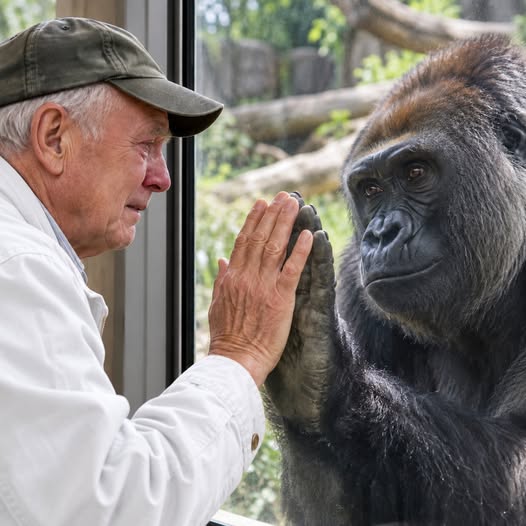
Then she raised one hand.
Slowly.
She placed it against the glass.
I did the same.
Our palms could not touch.
The barrier remained between us.
It was exactly where it needed to be.
I felt tears running down my face.
I didn’t wipe them away.
Mara kept her hand there for perhaps five seconds.
Then she lowered it.
She turned toward the tree.
And this time, I smiled.
Not because I knew what she remembered.
I didn’t.
I smiled because she had made a choice.
Her choice.
That was enough.
Behind me, I heard Laura quietly step away.
Rachel remained by the door.
Neither woman spoke.
After another minute, Mara moved to the other side of the habitat.
I watched her go.
The old part of me wanted to follow her with my eyes until she came back.
Instead, I looked at the clock.
Eight minutes had passed.
Rachel whispered, “You still have seven.”
I shook my head.
“She gave me what she wanted to give me.”
“You’re sure?”
“Yes.”
Rachel looked through the glass at Mara.
“She may come back.”
“She might.”
“And if she doesn’t?”
I smiled.
“Then she doesn’t.”
Rachel nodded.
There was something different in her face now.
Not approval exactly.
Maybe recognition.
The same recognition I had been missing for three decades.
She opened the door.
I stepped back into the hallway.
My legs felt strangely light.
Laura met me there.
“You really don’t want to wait?”
“No.”
She looked surprised.
“I thought you’d use every second.”
“I came here to see Mara.”
“You did.”
“Yes.”
That was the first time I said it without fear.
I had seen her.
Not the young gorilla in my photograph.
Not the animal I remembered from North Carolina.
Not the reunion I had imagined during hundreds of miles of highway.
I had seen Mara as she was now.
Older.
Changed.
Independent.
Alive.
And she had seen me.
Whatever that meant to her, I couldn’t honestly say.
Maybe she remembered my face.
Maybe she remembered nothing.
Maybe something about the gesture of my raised hand had simply caught her attention.
There was no ethical way for me to turn five seconds against the glass into proof of a memory.
I had spent too many years around animals to make that mistake.
Outside, the morning air was cool.
I sat on a bench and called my daughter.
She answered immediately.
“Well?”
I laughed.
“You’re going to have to ask a better question.”
“Dad.”
“I saw her.”
There was silence on the other end.
Then she said, “Did she remember you?”
I looked through the sanctuary window toward the habitat.
“I don’t know.”
My daughter was quiet.
“But she came close,” I added.
“How close?”
“Close enough.”
She laughed softly.
“That sounds like you.”
“No,” I said. “It sounds like Mara.”
I ended the call and sat there for another few minutes.
Then Rachel came outside carrying something.
It was my photograph.
“You left this in the viewing room,” she said.
I took it from her.
The old picture had been folded slightly at one corner.
Young Mara sat behind the training barrier.
I stood on the other side with my hand raised.
For thirty years, I had thought the photograph captured the beginning of a relationship.
That morning, I realized it had captured something else.
A boundary.
A hand raised on one side.
An animal choosing whether to cross the space between us.
When I was young, I had believed my job was to get Mara to the answer I wanted.
As I grew older, I learned that care sometimes meant accepting an answer I didn’t like.
That lesson had brought me all the way back to her.
Rachel sat beside me.
“You handled yourself differently than some visitors do.”
“I had a good teacher.”
“Mara?”
I smiled.
“Mara.”
Rachel looked at the photograph.
“Do you want to know what I think?”
I hesitated.
Then nodded.
“She recognized something,” Rachel said carefully.
“What?”
“I don’t know.”
I laughed.
“You’re becoming very good at that answer.”
“It happens when you work with animals.”
She handed the photograph back.
“Whatever she recognized, she chose to approach.”
I looked down at the picture.
“That’s enough.”
Rachel stood.
“Your train?”
“Tomorrow afternoon.”
“You could stay.”
I shook my head.
“No.”
She looked toward the habitat.
“You’re really leaving?”
“Yes.”
“Why?”
I folded the photograph and placed it carefully inside my jacket.
“Because if I stay hoping she’ll do it again, then this stops being her choice.”
Rachel smiled.
“Fair enough.”
I drove back to my hotel.
The nine-hundred-mile trip home waited for me the next morning, but it no longer felt like the same journey.
I had spent the drive to Asheville rehearsing every possible version of disappointment.
Mara might have died.
Mara might have been sick.
Mara might have ignored me.
Mara might have looked at me and shown no recognition at all.
I had feared the possibility that thirty years had erased me.
Instead, I discovered something more difficult and more peaceful.
Maybe the reunion was never mine to receive.
It belonged to Mara too.
That afternoon, I called my wife and told her everything.
She listened while I described the silver in Mara’s coat, the way she stripped leaves from branches, the way she had stood at the glass.
When I finished, my wife said, “You sound relieved.”
“I am.”
“Because she remembered?”
I looked at the photograph on the hotel desk.
“No.”
I paused.
“Because I finally stopped needing her to.”
My wife didn’t answer for a few seconds.
Then she said, “That sounds like the man who came home thirty years ago.”
I smiled.
“I was hoping he was still in here somewhere.”
The next morning, I left Asheville before sunrise.
At a gas station outside town, I bought coffee and sat in the car with the engine running.
The photograph was on the passenger seat.
I picked it up one more time.
Young Mara.
Young Samuel.
One raised hand.
One barrier.
I turned the photograph over.
On the back, in faded blue ink, I had written a date and a few words.
Mara’s first voluntary station.
I stared at the handwriting.
Then I laughed quietly.
I had forgotten the date.
But I remembered the lesson.
Voluntary.
I placed the photograph in the glove compartment instead of carrying it in my pocket.
Then I pulled onto the highway.
Nine hundred miles home.
This time, I wasn’t driving toward an ending I had already imagined.
I was driving away from one I had finally learned to accept.
Three days later, a small envelope arrived at my house from Blue Ridge Primate Sanctuary.
Inside was a printed photograph.
Rachel had sent it.
Mara was standing near the glass.
Her hand was raised.
Not touching it.
Just raised.
On the other side of the glass, the empty visitor space waited.
I turned the photograph over.
Rachel had written only one sentence.
“She came back to the glass after you left.”
I read it twice.
Then I placed the photograph beside the old one on my desk.
I didn’t try to explain it.
I didn’t call it proof.
I didn’t decide what Mara had remembered.
I simply looked at the two photographs.
Thirty years apart.
Two raised hands.
And, between them, the same lesson I should have understood when I was thirty-six.
Sometimes the most respectful way to love something is to let it choose how close it wants you to be.
I closed the drawer.
Then I left both photographs there, side by side, with the old training picture underneath the new one.
For the first time in thirty years, I didn’t need to open it again.