The Christmas Gift That Finally Forced a Family Secret Into the Open
PART 3 (FULL STORY)
The Christmas Gift That Finally Forced a Family Secret Into the Open
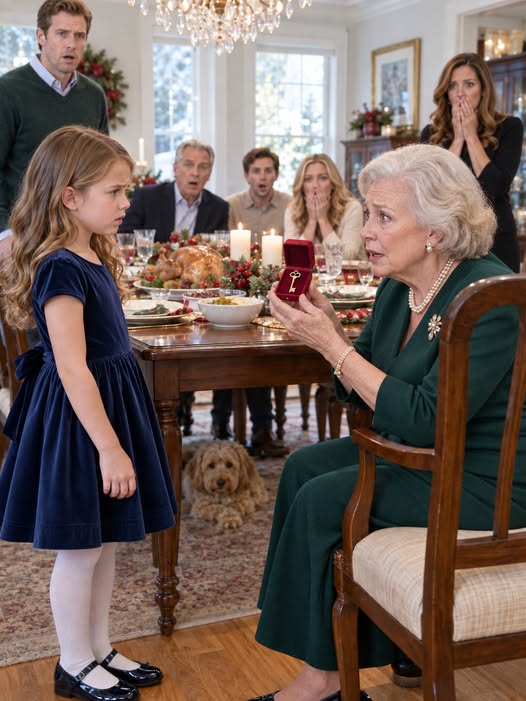
Beatrice kept staring at the key.
For several seconds, nobody moved.
Then she pushed the card toward Caleb.
“You had no right.”
Caleb did not touch it.
“You gave me the right three years ago.”
“I did no such thing.”
“You did.”
His voice stayed low, almost painfully calm.
“That night in your office, after Dad’s funeral, you told me you wanted control of the family trust until the younger grandchildren were old enough to understand what their grandfather had left them.”
Beatrice’s face tightened.
“That has nothing to do with Chloe.”
“It has everything to do with her.”
I looked at Caleb.
This was the first time I had heard this part of the story.
He had never told me about a trust.
Beatrice had always made the family’s finances sound like something nobody outside her inner circle had the right to discuss. Her late husband had left investments, a small vacation property in northern Minnesota, and several accounts that had been divided among his children and grandchildren.
Caleb had told me years earlier that he wanted nothing to do with his mother’s money.
Apparently, that was not the whole story.
After his father died, Beatrice had convinced everyone that managing the assets herself would keep the family together.
What she had not expected was Caleb asking questions.
He had discovered that his father’s estate plan included every grandchild, including Chloe.
Not because Chloe was biologically related to Beatrice.
Because Caleb had legally adopted her.
That part had happened quietly, without a celebration.
Caleb had signed the papers a year after we married.
Chloe had been five.
He had never used the adoption to impress anyone.
He simply called her his daughter and went about being her father.
Beatrice had never accepted it.
To her, blood determined belonging.
The adoption papers did not change the way she treated Chloe.
But legally, they changed everything.
Caleb reached into his coat pocket and removed a second folded document.
“I gave Mom one condition,” he said.
Beatrice shook her head.
“Don’t.”
“If she continued treating Chloe as though she had no place in this family, I would remove myself and Chloe from every arrangement that depended on her.”
“You think you can just walk away?”
“I already did.”
He placed the document on the table.
“This is the resignation from the family trust.”
Beatrice stared at it.
“You’re threatening me.”
“No.”
Caleb looked toward Chloe.
“I’m keeping my promise to my daughter.”
Chloe was still holding the brass key.
She looked confused.
“Why does the key matter?”
Caleb crouched beside her.
“Because Grandma has a locked cabinet in her office.”
Beatrice closed her eyes.
Inside that cabinet were the original trust records.
There was also a signed letter Caleb had left there three years earlier.
He had written it after Beatrice first refused to acknowledge Chloe as his daughter at a family dinner.
The letter had not been a threat.
It had been a boundary.
Caleb had written that if Beatrice ever excluded Chloe again, he would take the steps necessary to separate our household from hers and relinquish any financial connection that allowed Beatrice to control our family.
He had left the letter in the cabinet because he wanted there to be no argument later about what he had said.
And the brass key was the key to that cabinet.
Beatrice had forgotten about it.
Or perhaps she had hoped everyone else would.
She stood abruptly.
“You’re making a scene in my house.”
Caleb did not raise his voice.
“You made the scene when you handed a seven-year-old a candle marked ‘Caleb’s Girl.’”
One of the older cousins looked down at Chloe.
“I thought she was your daughter.”
“She is,” Caleb said.
His sister finally spoke.
“Mom, why did you keep doing this?”
Beatrice looked at her.
“Doing what?”
“Calling her that.”
“She isn’t my blood.”
Nobody answered.
Caleb’s sister shook her head.
“She was five when you started.”
“She has a father.”
“She has two parents.”
Beatrice’s eyes moved to me.
For three years, I had tried to keep the peace.
I had swallowed comments.
I had redirected conversations.
I had told myself Chloe was young and would eventually stop noticing.
But children notice.
They notice who gets called sweetheart.
They notice who gets handed a wrapped box and who gets a grocery-store bag.
They notice whose name appears on a place card.
And they especially notice when adults pretend they don’t.
I walked over to Chloe.
She was still holding the key.
“Do you want to give it back?” I asked.
She thought about it.
Then she shook her head.
“No.”
Beatrice looked offended.
“Excuse me?”
Chloe met her eyes.
“Dad said I could decide.”
That was the sentence that broke something in Beatrice’s expression.
Not because a seven-year-old had challenged her.
Because Chloe was no longer asking to be chosen.
She had been chosen already.
By Caleb.
By me.
And, slowly, by herself.
Beatrice sat down.
For the first time since I had known her, she looked uncertain.
Caleb picked up the trust papers.
“There is one more thing.”
Beatrice looked up.
“The trust does not disappear because I resign.”
Her eyes narrowed.
“My father set it up to protect the grandchildren, not to give you control over them.”
“I have protected this family for years.”
“You controlled it for years.”
“That is not the same thing.”
“No,” Caleb said. “It isn’t.”
He opened the document.
“Starting today, an independent trustee takes over.”
Beatrice’s mouth opened.
Then closed.
The money would no longer pass through her hands.
The family property would be managed separately.
And Caleb would no longer need her approval for anything involving Chloe’s share.
There was no dramatic police arrival.
No shouting match.
No one threw anything.
That would have been easier.
Instead, Beatrice sat at the head of the table while one by one, the adults began reading the documents Caleb had brought.
The family had spent years assuming Beatrice’s authority was permanent.
It wasn’t.
And the strangest part was that Caleb had never wanted her money.
He wanted his daughter to stop feeling like she had to earn a place at Christmas.
After the others left the dining room, Chloe remained near the doorway.
Beatrice called her name.
“Chloe.”
She turned.
“Are you still angry with me?”
Chloe looked at the candle sitting on the table.
Then she looked at the place card that still said GUEST.
“I don’t know.”
It was such an honest answer that Beatrice seemed unable to respond.
Chloe walked over and picked up the candle.
She held it out.
“You can keep this.”
Beatrice frowned.
“Why?”
“Because Dad said no tag decides who I am.”
She placed the candle beside Beatrice’s plate.
Then she walked back to us.
We left Minneapolis that afternoon.
Snow had covered the driveway, and the sky had already begun turning gray.
In the car, Chloe sat between us in the back seat.
She was quiet for a while.
Then she asked Caleb something that made him glance at me before answering.
“Dad?”
“Yeah?”
“Am I really your daughter?”
Caleb pulled the car to the side of the road.
He turned around in his seat.
“You know the answer.”
“I want to hear it.”
He reached back and took her hand.
“You are my daughter because I chose you, you chose me, and I have spent every day since trying to be worthy of being your dad.”
Chloe nodded.
Then she leaned forward and hugged him as far as the seat belt allowed.
I looked out the window because I didn’t want either of them to see me cry.
The brass key stayed in Chloe’s little purse.
We never needed to use it again.
Months later, the trust was transferred to the independent trustee.
The family property was divided according to the original estate plan.
Beatrice was no longer in charge of anyone else’s inheritance.
She also stopped hosting Christmas.
At first, I thought that meant the family would fall apart.
Instead, something quieter happened.
People began making their own plans.
Caleb’s sister invited us to Thanksgiving.
One cousin came to Chloe’s school concert.
Another sent her a birthday card with her full name written across the front.
Nobody made a speech about it.
Nobody asked for forgiveness in front of an audience.
They simply started treating her like she belonged.
Beatrice took longer.
For nearly six months, she barely spoke to us.
Then, one afternoon, an envelope arrived.
Inside was a new place card.
It was plain white.
No glitter.
No fancy handwriting.
Just one name.
Chloe.
There was also a short note.
Beatrice did not apologize for everything.
She did not suddenly become warm or affectionate.
She wrote only that she had been wrong to make a child carry an adult’s bitterness.
Chloe read the note twice.
Then she folded it and put it in her desk.
“Are you going to write Grandma back?” I asked.
“Maybe.”
“What will you say?”
Chloe shrugged.
“I’ll think about it.”
That was enough.
She didn’t owe anyone an immediate answer.
Christmas came again the following year.
This time, there was no Minneapolis dining room.
No carefully arranged hierarchy.
No gifts displayed like prizes.
We stayed home.
Caleb made cinnamon rolls, although he burned the first batch.
Chloe laughed so hard she nearly dropped the spoon in her hand.
After breakfast, she opened the drawer beside the kitchen table and pulled out the little red velvet box.
The brass key was still inside.
She looked at it for a moment.
Then she placed the key back in the box and closed the lid.
“What are you doing?” Caleb asked.
“Keeping it.”
“For what?”
Chloe smiled.
“Just in case.”
Caleb laughed.
I reached over and squeezed her shoulder.
The cheap candle from that first Christmas was gone.
But the little paper tag was still in my desk.
To Caleb’s Girl.
I had kept it because, once, I thought it represented the worst thing Beatrice had ever done to my daughter.
I understood differently now.
The tag had been cruel.
But it had also exposed something that needed to be exposed.
Chloe had never been Caleb’s girl.
She was his daughter.
And when we packed away the Christmas decorations that year, the red velvet box went into the same drawer as the old place card.
The key inside it no longer meant someone could be removed.
It meant Chloe never again had to wonder whether she belonged.