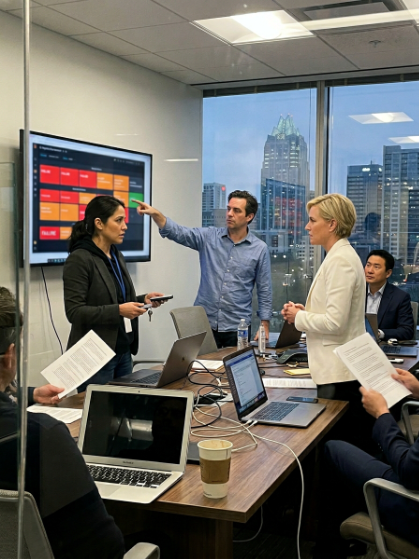
The room did not breathe while the drive mounted.
That is what I remember most.
Not the red dashboard.
Not Harper’s white jacket.
Not Miles standing two feet from the screen, pretending he was still in charge of the fire he had set.
I remember the little progress light on my laptop, blinking like it did not care who had equity, who had a title, or who had been blamed in front of investors.
Systems are rude that way.
They respond to what is true.
Sloane Kim asked what I was doing.
Her voice was calm, but both hands were flat on the table.
I said I was verifying the last clean snapshot against the transition plan.
Miles laughed again.
Lena, he said, you cannot just plug in an old drive and undo a migration.
I did not look at him.
No, I said. That is why I wrote a rollback procedure.
The sentence landed quietly.
The best technical sentences often do.
Harper tried to step in.
She said the board should pause before letting a former employee touch production systems.
Former employee.
Not founder.
Not architect.
Not the person whose ignored memo was sitting in Sloane’s hand with the exact failure printed three months before it happened.
Sloane looked at me.
Can you do this without exposing customer data?
Yes.
Can you do it without overwriting the current failed environment?
Yes.
Can you show us each step?
I turned my laptop slightly so the board could see the terminal and the recovery dashboard side by side.
Yes.
That was the third yes.
It felt better than anger.
Miles moved toward the table.
Sloane stopped him with one hand.
Do not touch her machine.
His face changed.
For six months, he had been the person allowed to touch everything. Repos. Credentials. Roadmaps. My old architecture diagrams with his initials written over them.
Now he was being told to stand back from the one thing that still worked.
I started with validation.
Not restore.
Validation.
That mattered.
I checked the snapshot hash against the archive index. I checked the time against the last successful backup job. I checked the migration freeze window and the old access key rotation date.
Everything matched the transition document Harper had signed and Miles had dismissed.
I heard Harper whisper something to the CFO.
I heard Miles mutter that this was theater.
I kept typing.
The first clean status line appeared.
Snapshot intact.
Sloane leaned closer.
The second line appeared.
Rollback target available.
A board member I barely knew exhaled like he had been underwater.
Then Miles said the thing that sealed him.
He said, Even if that works, it proves she maintained unauthorized access.
I stopped typing.
Slowly.
Not because he had scared me.
Because he had finally opened the exact door I needed.
Advertisement
I pulled up the transition plan.
The one with Harper’s signature.
The one with Miles copied on the final email.
The one that stated the legacy recovery key would remain under my custody until the new environment passed load testing and rollback validation.
There was silence while Sloane read it.
Then she asked Miles when rollback validation had passed.
He did not answer.
She asked again.
Harper said this was not the immediate issue.
Sloane turned to her.
It is the entire issue.
I had spent years in rooms where business people used technical risk as background noise until it threatened valuation. I expected Sloane to protect the money first.
She did.
That was why she listened.
A dead product could not be spun.
A breached process could not be press-released into stability.
Miles finally said the test environment had passed enough.
Enough.
That word has broken more systems than bugs ever will.
I highlighted the line in my memo where I had warned against that exact phrase.
Define passed before launch.
Do not substitute confidence for validation.
Harper’s mouth tightened.
The recovery window was closing. Customers were still locked out. Support tickets were stacking by the minute.
I did not have the luxury of making the room admit everything before acting.
So I said what I needed from them.
I need written authorization from the board to run the rollback from the clean snapshot, observation-only access for Miles, and no communication to customers until the restore is verified.
Miles objected to observation-only.
Sloane did not.
She opened a new document, wrote the authorization, and had three board members approve it by email while I waited with my hands off the keyboard.
That wait was the longest part of the night.
Not because of the outage.
Because for once, I refused to be useful without a record.
When the approvals came through, I began.
Restore staging.
Validate dependencies.
Route a small traffic sample.
Check data integrity.
I narrated each step because the board needed to hear that competence was not magic. It was sequence. It was discipline. It was all the boring things Miles had called obsolete because he did not want to be slowed down by proof.
The red dashboard did not turn green all at once.
It changed one service at a time.
Authentication.
Payments.
Customer workspace load.
Notification queue.
Every green square felt like a bruise being pressed and released.
Harper sat down halfway through.
That was when I knew she understood.
Miles kept standing.
That was when I knew he did not.
At 7:18 p.m., the first full customer session completed in the restored environment.
At 7:24, error rates dropped below the emergency threshold.
At 7:31, support confirmed customers were getting back in.
No one clapped.
I would have hated that.
Sloane only said, Record the timeline.
I already had.
Of course I had.
After the product stabilized, the room became more dangerous in a quieter way.
A crisis invites action.
After action, people start rearranging blame.
Harper said we needed to present the recovery as a team effort.
I almost admired the speed.
The product had been breathing again for less than ten minutes, and she was already trying to put a logo on my labor.
Sloane asked who approved wiping the old fallback before load testing.
Miles said the team had agreed.
I said, Which team?
He looked at me.
I pulled up the migration channel export Sloane had requested from a current engineer before I entered the room. I had not known if I would need it.
People underestimate infrastructure engineers.
We pack for failure.
The channel showed two engineers asking whether the rollback had been validated. Miles answered that the old architecture was politically contaminated and should be removed before anyone got sentimental.
Politically contaminated.
That was me.
My architecture was contaminated because my name was still attached to the parts that worked.
Harper rubbed her forehead.
Miles said Slack messages lacked context.
Sloane said the outage had supplied context.
By nine o’clock, the board had separated the recovery review from Harper’s communications plan. By ten, Miles’s production access was suspended pending investigation. By midnight, Sloane asked me whether I would serve as interim technical authority through the postmortem.
Interim.
A careful word.
I said I would do it under three conditions.
Full audit of the migration decision.
Public correction to the team that my systems had not caused the outage.
Written authority to enforce rollback and validation standards without executive override.
Harper said that sounded adversarial.
I said preventable downtime is adversarial to customers.
Sloane approved all three.
The next morning, the company sent a customer update that did not name me, which was fine. Customers did not need my story. They needed access, honesty, and a system less likely to fail the same way twice.
But the internal postmortem named the process failure.
It named the ignored memo.
It named the wiped fallback.
It named the successful rollback path.
That mattered.
Not because I needed applause.
Because women in technical rooms are often accused in adjectives and cleared in whispers.
This time, the correction had headers.
Miles resigned two weeks later before the board finished the access review. The official language was personal reasons. The engineering team’s private language was shorter.
He broke the rollback.
Harper stayed longer, but not untouched. Sloane removed her unilateral authority over technical launches. A release-readiness committee replaced hallway confidence. Every migration had to include a tested rollback with an accountable owner.
Boring rules.
Beautiful rules.
I returned as chief infrastructure officer three months after the outage, with founder equity corrected for the period Harper had tried to squeeze me out. I did not get everything back. No one does. Trust, once treated like a line item, does not simply reappear because the board signs a new resolution.
But the company lived.
The team lived.
And the next time someone called risk documentation alarmist, three engineers sent them my memo.
I kept the old server access key in my desk drawer.
Not as a trophy.
As a reminder that the unglamorous thing can still be the thing that saves everyone.
On the anniversary of that outage, a new engineer asked me why our rollback drills were so strict.
I showed her the dashboard from that night.
Red blocks turning green one by one.
Then I said, Because hope is not a recovery plan.
She wrote it down.
I went back to my desk and put the backup drive beside the key.