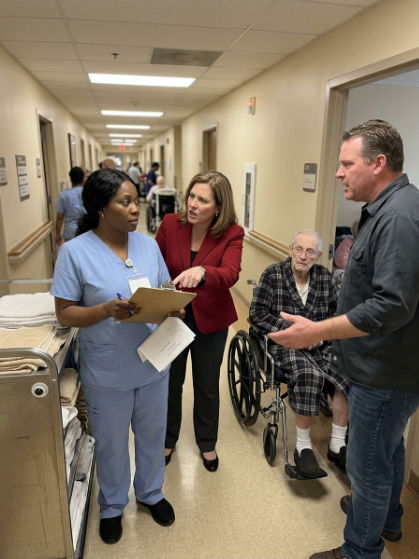
The badge cover made a small plastic sound under my thumb.
That was all.
No thunder.
No dramatic music.
Just a click in a beige nursing home hallway while Leo Whitaker’s call light blinked behind me.
Paula Grimm heard it.
Her eyes moved from the pen to my chest.
Aaron Whitaker stopped mid-sentence.
For the first time since he had arrived, he looked at my badge instead of my face.
I peeled the temporary aide cover away.
Underneath was the state seal.
My full name.
My inspector number.
The words Paula had been careful not to invite into her building.
State elder-care inspection unit.
Paula’s expression changed so quickly it was almost clean.
Confusion.
Recognition.
Calculation.
Then offense, because people like Paula often reach for offense when fear shows too much of its face.
She said, This is highly irregular.
I said, So is clearing call lights before entering rooms.
The hallway went still.
Not quiet.
Still.
A resident’s television murmured behind a half-closed door. A meal cart rattled somewhere near the nurses’ station. The fluorescent lights hummed overhead.
But the people closest to us stopped moving.
Aaron looked at Paula.
Then at Leo.
His anger had nowhere to stand for a moment, so it wavered.
Paula lowered the folded report.
You should have identified yourself.
I reached under the linen cart and pulled out the sealed inspection folder.
I did.
To the state.
That was not a clever line.
I had not planned it.
But it hit the hallway with enough force that one of the other family members stepped closer from the room across the hall.
Paula tried to recover.
She said the facility cooperated with all official reviews.
She said staffing concerns were being addressed.
She said family emotions had escalated a routine visit into a scene.
It was impressive, in a terrible way, how quickly she tried to make the truth sound like bad manners.
I opened the folder.
I did not show resident medical details to the hallway.
I did not need to.
The first page was a summary of call-light response times, stripped of private identifiers but tied to room numbers and dates the facility had already submitted to the state.
Room 214.
Leo’s room.
Forty-seven minutes that morning.
Thirty-two minutes two nights before.
Eighteen minutes after a documented fall risk note.
Aaron read the top line.
His mouth closed.
That silence did more than his yelling had.
Leo looked at his son with an expression I had seen too many times in care homes.
Hope mixed with dread.
Residents often fear being believed because belief can make their families feel guilty, and guilt sometimes turns into more anger.
I kept my voice level.
Mr. Whitaker, your father has been asking for help. The delay is documented.
Advertisement
Aaron swallowed.
He looked smaller, suddenly.
Not weak.
Just stripped of the easy target he had chosen.
Paula said the log was incomplete.
I turned to the second page.
The linen-cart camera timeline.
Not faces.
Not private care.
Movement.
Hallway activity.
The call light blinking, cleared on the system, then answered later.
The kind of pattern administrators hope nobody has the patience to assemble.
Paula reached toward the folder.
I moved it back.
Do not touch state evidence.
Her hand froze.
That was when the charge nurse from the desk came down the hallway, followed by two aides who had clearly heard enough to risk being seen listening.
One of them looked at me with relief so naked I almost had to look away.
Short staffing hurts residents first.
It hurts good workers second.
And it protects bad managers until the numbers stop being private.
Paula asked to speak in her office.
I said we would speak in a conference room after I notified the regional supervisor.
She said I was escalating.
I said the call-light delays already had.
Aaron stepped closer to Leo’s wheelchair.
Dad, he said, did you tell me it was this bad?
Leo looked down at his lap.
I tried.
Two words.
That was all.
They rearranged Aaron’s face more completely than any folder I carried.
He crouched beside the chair.
Not perfectly.
Not redeemed in a single moment.
But lower.
Close enough that Leo did not have to lift his head.
I thought you were confused, Aaron said.
Leo’s hand trembled on the wheel.
I know.
That broke the hallway open.
Not loudly.
A woman across the hall began crying with one hand over her mouth. One of the aides turned toward the wall. The charge nurse stared at the floor like she was counting every shift she had survived without enough hands.
Paula tried one more time.
She said the facility had budget limits.
I opened the folder to the staffing schedule.
The schedule showed one aide covering too many residents, skipped breaks, and night coverage altered after complaints were closed internally. It showed that the problem was not one bad morning. It was a system that had learned how to look compliant on paper.
The clean shift report was still in Paula’s hand.
I asked her if she wanted to withdraw her request that I sign it.
She did not answer.
The regional supervisor arrived within the hour.
By then we were in the conference room, not Paula’s office.
That mattered.
Offices belong to directors.
Conference rooms, at least in theory, belong to the record.
Aaron sat beside Leo.
The charge nurse sat with her hands folded so tightly her knuckles had gone pale.
Two aides gave statements.
One cried before she finished because she had been told documenting delays would make her look incompetent.
The supervisor read the preliminary findings and issued an immediate order: no admissions to the affected wing until staffing met minimum ratio, no clearing call lights without bedside response, and state monitoring on all night shifts pending full review.
Paula objected to every sentence.
She used words like context and burden and misunderstanding.
The supervisor listened, wrote each word down, and asked for the staffing sheets Paula had not planned to show anyone.
That was the beginning of the end of her control.
Not her job yet.
Systems rarely move that fast.
But control.
The hallway no longer belonged to her explanations.
Leo was moved that evening to a room closer to the nurses’ station until the wing could be staffed properly. The charge nurse personally checked his call button, then checked it again after he pressed it just to be sure.
He looked embarrassed.
I told him testing equipment was not a character flaw.
He smiled for the first time that day.
Aaron stood beside the bed and could not stop apologizing.
At first, the apologies came too fast.
Dad, I’m sorry. I should have listened. I should have asked. I shouldn’t have said that about her.
Leo finally raised one thin hand.
Aaron stopped.
Leo said, Listen next time.
It was not forgiveness.
Not yet.
It was instruction.
Better, in some ways.
Aaron found me by the medication cart after the supervisor left.
His face was red, his voice rough.
He said he was sorry for what he said about my accent.
I told him I accepted that he understood it was wrong.
I did not tell him it was fine.
It was not fine.
An apology does not erase the fact that his first instinct was to blame the newest woman in scrubs instead of the system ignoring his father.
But people can learn from shame if they do not immediately ask to be excused from it.
Aaron nodded like he knew the difference.
A week later, Paula was placed on administrative leave.
The full report took longer.
Full reports always do.
But the emergency order stayed.
Night staffing increased.
Call-light logs were audited by the state, not by the people whose bonuses depended on them looking clean.
The linen-cart cameras were removed from my temporary setup, but not before the facility installed proper hallway monitoring with privacy safeguards and clear policies.
Good aides stopped being told to choose between honesty and employment.
Leo’s daughter, the one who had called the hotline until someone listened, came to visit on the second week. She hugged him so carefully, as if both of them were made of glass.
Then she found me near the front desk.
She asked if I was the inspector.
I said yes.
She said, Thank you for hearing him.
I thought of Aaron yelling in the hallway.
I thought of Paula’s pen.
I thought of Leo’s eyes when he said, I tried.
I said, He was not quiet. People were not listening.
That became the line I wrote at the top of my personal notes when the case closed.
Not in the official report.
Reports need citations.
Personal notes are allowed to remember the human thing.
Months later, I returned to Bellamy House without the aide uniform.
Official follow-up visit.
Real badge visible.
No cover.
The hallway looked the same at first: beige walls, disinfectant smell, laundry cart rolling somewhere behind me.
But the call lights were different.
Not silent.
No care home is silent.
Different because when one blinked, someone moved.
Leo was in the common room with a blanket over his knees and a deck of cards on the table.
Aaron sat beside him, losing badly and pretending not to care.
When Leo saw me, he lifted one hand.
Not high.
Enough.
I waved back.
The call light above Room 214 stayed dark.