Daniel came around the corner with his easy smile already loaded, the apology for being late already on his lips — and then he saw us.
Both of us. Sitting side by side in the waiting room he’d been so careful to keep separate.
I have never watched a face do what his did. The smile didn’t fall so much as evaporate, like it had never been real, which I suppose it never had been. He looked at me. He looked at Sofia. He looked back at me, and I watched his brain run the calculations he’d been running for years — which lie, which version, which name — and arrive, for the first time, at nothing. There was no version for this. He’d never built one, because he’d never imagined the two rooms could touch.
“Megan,” he said. Then, “Sofia.” Just our names, like saying them might reset something.
Neither of us stood up.
I want to tell you what I expected to feel, and what I actually felt, because they were not the same.
I expected to scream. I’d imagined it before, in the abstract paranoid way you imagine things when your husband has gotten quietly strange — the scene where I catch him and I rage and I throw something and it’s loud and it’s cathartic.
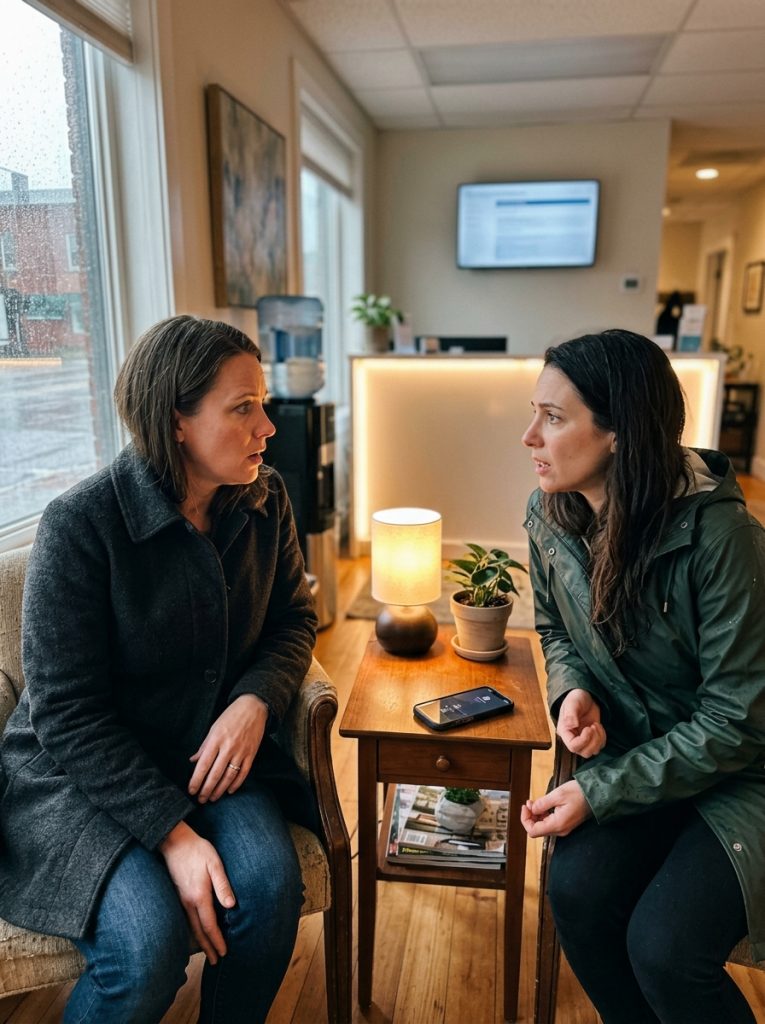
What I actually felt, sitting next to Sofia in that small room with the rain on the window, was a terrible, clarifying calm. Because the screaming version assumes there’s still something to fight for. And the moment I saw his face do that math, I knew there wasn’t. There was nothing here to save. There never had been. He’d been running two marriages like two accounts, telling each of us we were the one he was working to keep, and the “work” was the alibi for the other.
Sofia spoke first. Her voice was steadier than I expected.
“How long,” she said. Not even a question. A demand for a number.
Daniel did the thing liars do when the lie is finally too big to hold — he reached for the smallest true thing he could find and offered it like a gift. “It’s not what it looks like,” he said.
“It’s exactly what it looks like,” I said. And I was surprised by how level my own voice was. “You booked us back to back. Forty-five minutes apart. You sat in this chair and watched one of us leave and the other one arrive. You’ve been doing couples counseling. With two different counselors. To save two different marriages. To the same man.”
Saying it out loud made it land for all three of us at once.
The receptionist had gone very quiet behind her desk. Somewhere down the hall a therapist’s door opened and the appointment Daniel had booked — under whose name, I still don’t know — went unfilled.
Here’s the part that I think about most.
Sofia and I left together.
We didn’t plan it. We just both stood up at the same time, and we walked past Daniel — who was still standing there saying our names like an incantation that had stopped working — and we went out into the rain together and stood under the awning, two strangers who’d just discovered we’d been living inside the same lie from opposite ends.
We didn’t become best friends. That’s a movie ending and this isn’t a movie. But we sat in her car for an hour with the rain coming down, and we put the timeline together, and it was worse and longer than either of us had guessed alone. The “work trips.” The second phone. The standing Tuesdays. The way he’d learned to be calm and tender after these sessions — because, we realized, performing devotion to two people is its own exhausting skill, and he’d gotten good at it.
Eleven years for her. Nine for me. Overlapping. The whole time.
That’s the part that doesn’t have a comeuppance, and I want to be honest about it, because so many of these stories end with the villain getting dramatically destroyed and the wronged woman walking away triumphant in slow motion.
I didn’t get slow motion. I got paperwork.
I got the slow, unglamorous work of disentangling a life I’d thought was real. The lawyer. The accounts I discovered I didn’t fully understand. The friends who said “I had no idea” and the one or two who, it turned out, had an idea and said nothing. The house. The dividing of nine years.
And underneath all of it, the quieter grief, the one nobody warns you about: not the loss of him, but the loss of the nine years. The version of my life I’d believed I was living. The Tuesdays I thought were healing us. The tenderness I’d been so grateful for, which turned out to be a man getting good at his second performance of the day.
You can’t get those years back. That’s the “too late” of it. I didn’t catch him early, in some clean moment that saved me from wasting my thirties. I caught him at forty-one, in a waiting room, by accident, because another woman happened to use my own nickname for him.
Sofia and I check in sometimes. Not often. It’s tender, the way a healing bruise is tender — we remind each other of something we’d both rather not look at directly. But there’s also something I can’t explain, a strange grace in having one other person on earth who understands the exact shape of the specific lie I lived inside. She knew the nickname. She knew the calm-after-Tuesday face. She knew.
There’s one more thing I learned, weeks later, that I’ll share because it reframed the whole thing for me.
When the lawyers got involved and the accounts got pulled apart, it turned out Daniel hadn’t only been running two marriages. He’d been running two budgets, two stories, two entire architectures of a life — and the “couples counseling” was load-bearing in both. To me, the Tuesday sessions were proof he was committed to us. To Sofia, the same. He’d weaponized the very thing couples do to heal. He’d taken the appointment where you go to be honest and turned it into the alibi for the dishonesty.
That’s the detail that still makes me cold. Not that he cheated. People cheat. But that he sat in a therapist’s office, twice over, and performed the work of saving a marriage as a cover for betraying two of them. He looked two different counselors in the eye and lied in the one room built for telling the truth.
I asked my own therapist — the real one I see now, alone, on a day that is not Tuesday — how a person does that. She said something I’ve kept: “People who can perform intimacy that convincingly usually learned it as survival, long before you met them. It doesn’t excuse it. But it means the warmth you felt wasn’t your imagination. It was real. It just wasn’t yours. It wasn’t anyone’s. It was a performance he gave to everyone and kept for no one.”
That helped, oddly. Because for months I’d been interrogating my own memory — was any of it real, was I a fool, did I miss signs a smarter woman would have caught. And the answer is: the warmth was real, the lie was also real, and both being true at once is exactly what made it so hard to see.
Daniel tried, for a while, to do the thing — the calls, the long texts, the version where it was a sickness and he was getting help. I didn’t engage. Not out of strength. Out of the simple, bone-deep knowledge that there was nothing left to engage with. You can’t reconcile with a performance. There’s no real person backstage to forgive.
I kept the nickname out of my mouth. That was the hardest small thing — I’d said “fashionably Daniel” for nine years, reflexively, fondly, and breaking the habit was like picking a splinter out a millimeter at a time.
I don’t say it anymore.
I’m okay now. Mostly. I’m in my own place, with my own quiet Tuesdays that are actually mine. I’m slower to trust and I’ve decided that’s not damage, it’s just accuracy.
But I think about that waiting room. The rain. The half-second a contact photo lit up a screen and rearranged my whole life. The kind-faced stranger who used a private word and didn’t know she was handing me the truth.
Sometimes the truth doesn’t arrive in a thunderclap. Sometimes it arrives in a small warm room on a rainy afternoon, in someone else’s voice, saying the thing you thought only you and one other person knew.
And by the time you understand it, the only thing left to do is stand up, walk past the man still saying your name, and go out into the rain to start the long work of getting your own life back.
Too late to save the years. But not too late to save the rest of them.