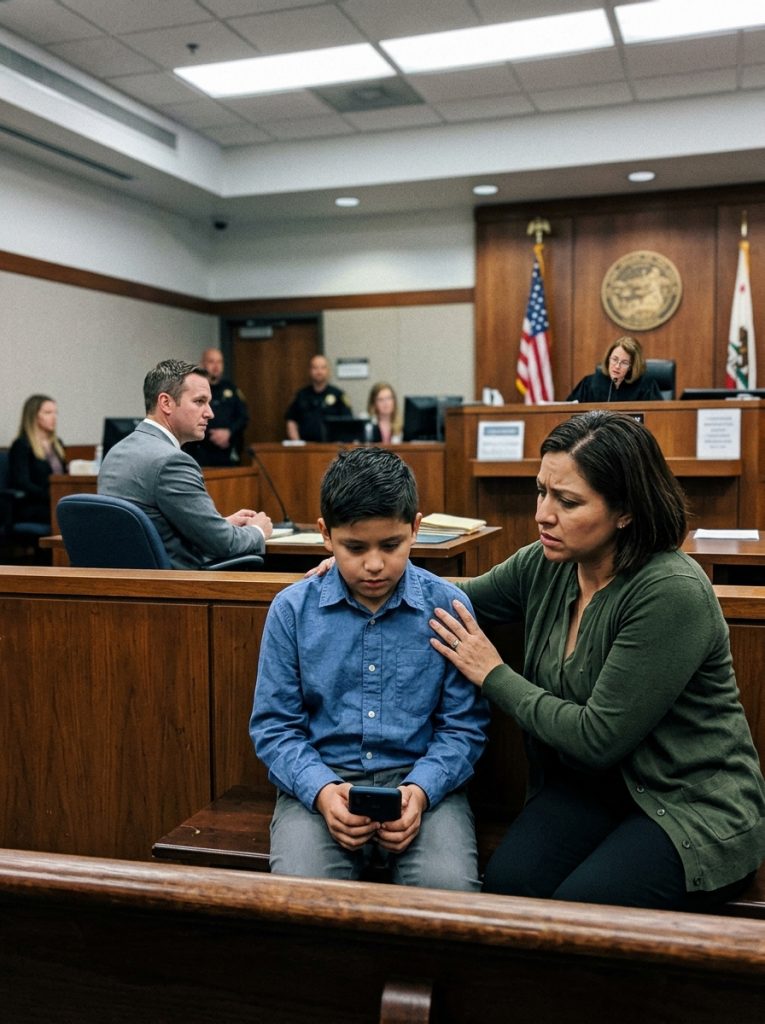
Diego’s thumb pressed the screen. He turned the phone’s volume all the way up with the careful concentration of a kid who’d practiced this in his head a hundred times. And he held it out, a little, toward the judge.
The courtroom filled with my son’s recorded voice first — small, whispering, the date and a few words of explanation, the way a frightened child narrates evidence he doesn’t fully understand he’s collecting.
“This is from Dad’s car. He doesn’t know I’m recording. I’m scared.”
Then Brett’s voice.
I had spent nine years married to that voice, so I knew all of its registers. The warm one. The reasonable one. And the one underneath, the one that only came out when he was sure no one who mattered was listening.
It was that last one on the recording.
I’m not going to transcribe all of it here. Some of it belongs only to my son and the court. But the core of it — the part that made Judge Hartwell sit very still and a clerk stop typing — was Brett telling Diego, in that low flat voice, that if the custody ruling didn’t go his way, the two of them would “just go somewhere your mother can’t find us.” That Diego was not to tell anyone about their conversations. That if Diego talked, “you won’t see me again, and it’ll be your fault, and your mom will be alone.” That he should “be a man and keep his mouth shut.”
A threat to disappear with a child. A threat dressed up as a secret. A man teaching his eleven-year-old that silence was love and talking was betrayal.
That was why Diego had stopped speaking. Not because of me. Because his father had loaded the weight of our whole family onto his small shoulders and told him the only way to keep us safe was to say nothing.
The recording ended. The courtroom was silent.
Brett’s attorney was on his feet immediately, objecting — admissibility, authentication, a dozen things. Judge Hartwell let him finish. Then she said, in a voice I will be grateful for as long as I live, “Counsel, the recording was made by the minor child, voluntarily offered by the minor child, in response to a direct question from the court about his own safety. I’m going to hear it. And I’m going to consider it very carefully.”
She looked at Brett.
“Mr. Connors. Do you dispute that this is your voice?”
Brett’s mouth opened and closed. His lawyer touched his arm. There was a long pause, and in that pause I watched the confident man in the gray suit understand that there was no reasonable voice that could explain away what the room had just heard.
“I’d like a recess,” his lawyer said.
“I’m sure you would,” said Judge Hartwell.
What happened over the following weeks was not fast and it was not clean — the legal system rarely is. But it moved, finally, in the direction of the truth.
The court ordered a forensic review of the recording, which confirmed it was authentic and unedited. Diego was assigned a child advocate — a kind, patient woman named Ms. Okafor who let him talk at his own pace, and who told me, after their first session, that my son was “one of the bravest small clients she’d ever had.”
Because think about what he did. An eleven-year-old, frightened, believing that talking would make his father vanish and leave me alone — and instead of staying silent, he found a third option. He didn’t talk. He recorded. He gathered proof, the way he’d seen people do on the police shows he liked, and he carried it in his pocket for weeks, waiting for a grown-up safe enough to give it to.
He chose a judge. In a courtroom. Under oath. My eleven-year-old waited for the safest possible moment and then he set the weight down.
Custody was awarded to me. Full physical custody, with Brett’s parenting time ordered to be professionally supervised, pending a separate review that I’ll let stay private because it involves my son and not the internet.
Brett did not disappear with Diego. He never got the chance. The thing he’d threatened became the thing that undid him.
I want to tell you about Diego now, because the custody ruling isn’t the real ending. The real ending is slower and better.
He started talking again. Not all at once. The first week after the hearing, he was still quiet, like he didn’t quite believe the weight was really gone. Then one night at dinner he told me the entire plot of a movie, start to finish, the way he used to, narrating every scene, and I had to put my fork down because I was crying and I didn’t want him to think it was a bad thing.
“Why are you crying?” he asked.
“Because I missed your voice,” I said.
He thought about that. Then he said, “I missed it too. I just didn’t know how to use it without messing everything up.”
We got him a therapist — a good one, who specializes in kids who’ve been put in the middle. He’s doing the work. Some days are hard. He still flinches at certain kinds of quiet. But he laughs again, big and unguarded, and last month he joined the debate club at school, which his counselor called “a beautiful irony for a kid who went silent,” and which Diego called “fun, because now people have to listen to me on purpose.”
I want to say something about the four months of silence, for any parent reading this whose kid has gone quiet in the middle of a custody fight.
I spent those months terrified that I was the problem. The evaluator’s report implied it. Brett’s lawyer said it outright. And when your child stops talking and a professional writes that it’s “consistent with a high-conflict environment,” you start to wonder if maybe you’re the conflict. Maybe your fear is leaking onto him. Maybe you’re the unstable one after all.
That doubt is a weapon. Brett used it expertly. The whole strategy depended on me being too rattled and too disbelieved to do anything but cry in the right ways at the wrong times.
What I wish I’d understood sooner is that a child’s silence is information, not a verdict. Diego wasn’t quiet because of me. He was quiet because he was protecting both of us from a threat he’d been told to keep secret. The silence wasn’t the symptom of a bad mother. It was the sound of a little boy carrying something no eleven-year-old should have to carry.
If your kid goes quiet, don’t assume the courtroom’s reading is the true one. Get them somewhere safe. Get them someone safe to talk to who isn’t you and isn’t the other parent. And trust that what looks like withdrawal might be a child waiting — the way mine was — for one safe adult to ask the right question in the right room.
He keeps the phone, by the way. Same one. He upgraded the case but kept the device. I asked him once if he wanted a new one, fresh start, and he said no.
“It’s the one that worked,” he said.
I think about that a lot. The thing his father weaponized — secrets, silence, the idea that a child should carry an adult’s threats alone — my son turned inside out. He didn’t keep the secret. He kept the evidence. And when a grown-up finally asked him the right question in a safe enough room, he had the answer ready in his pocket.
They asked why the boy wouldn’t speak.
It turned out he was saving it all for the one moment his words could actually save us.
And they did.