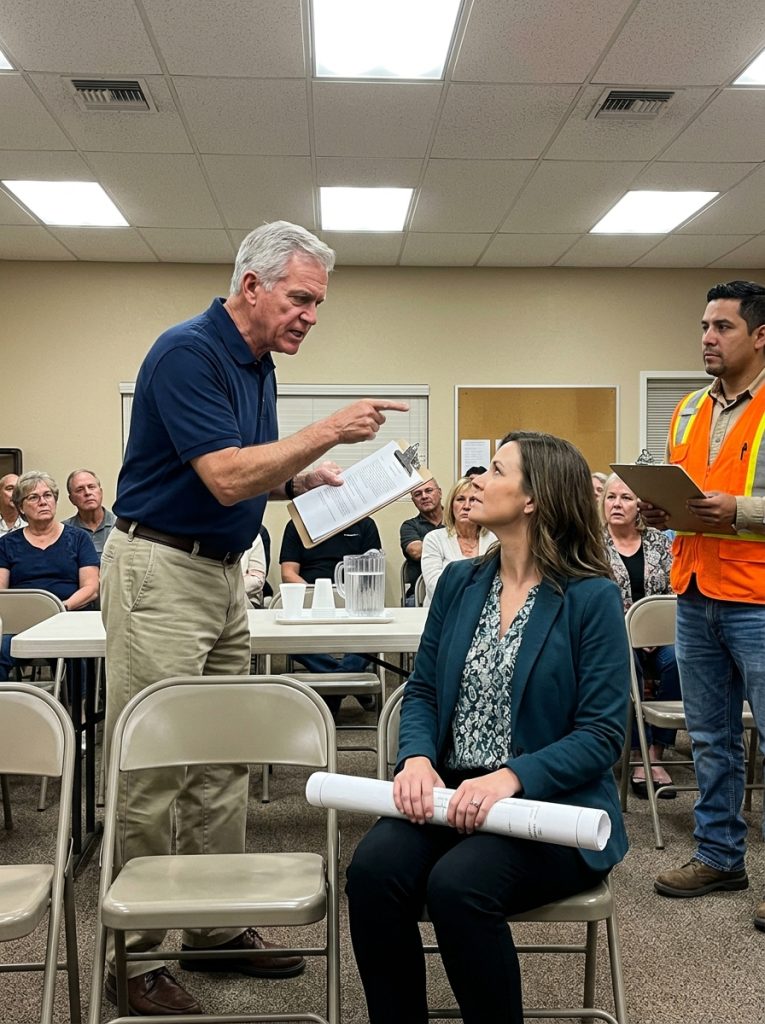
Hector Salas stood up in his hi-vis vest, unrolled his survey across the front table, and the meeting room got very quiet.
“I was hired by Ms. Whitlock to confirm her fence placement,” he said. “It’s compliant. It sits one inch inside her own property line. The violation notice is incorrect.”
Roger Pell opened his mouth. Hector kept going.
“While I was on site, I was also asked to verify the rear property line, which abuts the community greenbelt — the common area maintained by all homeowners’ dues. The lot directly behind Ms. Whitlock’s belongs to the board president.”
You could feel the room lean in.
“The president’s fence,” Hector said, “encroaches twenty-six inches onto the common greenbelt. And the pool deck behind it encroaches an additional fourteen inches. That’s a hard encroachment onto shared property. By the same rule being applied to Ms. Whitlock’s one inch, it would carry the same daily fine — retroactive to the date of construction.”
He set down his pointer.
“Three years ago,” he added, because I’d asked him to check the permit history too. “The pool deck was built three years ago. Without an approved variance from this board.”
The clubhouse was so quiet I could hear the AC cycle on.
Roger tried to do what Roger always does. He went on offense. “This is a personal attack. Ms. Whitlock is clearly trying to deflect from her own violation by—”
“My violation doesn’t exist,” I said, standing up. “Your surveyor’s report says so. The one you didn’t hire, because you never thought anyone would measure back.”
I turned to the room — to the neighbors who’d been fined for wreaths and door colors and trash cans, the ones who’d torn down fences and repainted shutters and apologized for things that were never against the rules.
“Roger’s run this community on the assumption that fighting him costs more than folding,” I said. “He’s right that it usually does. I spent four hundred dollars on a survey to fight a fine that would’ve cost me less than that to just comply with. I did it on principle. And the principle turned out to be sitting in his own backyard the whole time.”
Then I did the thing I’d actually come to do.
I made a motion.
Under our bylaws — which I had read, cover to cover, the same week I hired Hector — any member can move to compel enforcement of the covenants against any other member, including a board officer, and the board must act on a documented violation. I moved that the same enforcement Roger had tried to apply to my one inch be applied to his forty inches of encroachment onto common property: removal at his cost, plus the retroactive daily fines he was so fond of.
A neighbor two rows back seconded it before I’d finished the sentence.
Roger objected that he couldn’t be subject to a vote he was chairing. Our bylaws had an answer for that too. An officer with a personal conflict must recuse from the chair for that item. The vice president — a quiet woman named Sandra who I don’t think had said three words in five years of meetings — took the gavel with a steadiness that told me she’d been waiting for this longer than I had.
The vote wasn’t close.
But the encroachment fine wasn’t the real reckoning. The real reckoning came from a man in the back named Hollis, seventy-one, who stood up after the vote and asked, in a shaking voice, whether he could get back the eight hundred dollars he’d been fined two years ago for a “non-conforming” wheelchair ramp his late wife had needed. A ramp Roger had cited as an “unapproved structural modification.”
Then a young couple stood up about the door they’d been forced to repaint twice. Then the family with the wreath. Then a widow who’d been fined for a “dead” plant that turned out to be a native species going dormant.
One by one, the kingdom Roger had built on everyone’s reluctance to fight came apart in a single meeting, because one person finally unrolled a map.
The board voted to open a review of every fine Roger had issued in the last three years. Sandra, as acting chair, requested his resignation as president pending the review. He gave it two weeks later, in a terse email, after his lawyer told him the encroachment and the unpermitted pool deck were a much bigger problem than any fine he’d ever written.
The recall election was almost a formality after that. We didn’t even need it; he was already gone. But we held a regular election, and the community asked me to run.
Before I tell you about that, I have to tell you about the part of the meeting I didn’t plan for — the part that turned a property dispute into something the whole neighborhood had apparently been waiting years to say.
After the vote on Roger’s encroachment passed, the room didn’t empty out the way meetings usually do. People stayed. And one by one, they started standing up — not about fences anymore, but about everything.
A man named Dev stood and said he’d repainted his front door three times in one summer chasing Roger’s “approved palette,” only to be told each new color was also wrong, and that he’d eventually figured out there was no approved color, just Roger deciding to make an example of the new family on the street.
A retired teacher stood and said she’d stopped putting out her bird feeders because Roger cited them as “unapproved structures,” and that she’d missed the cardinals for two years over a rule that didn’t exist.
A young mother stood and said her kids weren’t allowed to chalk the driveway — chalk — because of a “surface defacement” clause Roger had invented.
It went on for almost forty minutes. Years of small humiliations, each one too minor to fight alone, all of them adding up to a neighborhood that had quietly learned to keep its head down. Sandra, in the chair, wrote every single one into the minutes. She said, later, that it was the most anyone had spoken at an HOA meeting in the entire history of Sienna Ridge.
That’s the thing about a bully with a clipboard. The power was never really in the bylaws. It was in everyone’s certainty that they were alone, that their one inch or one door or one bag of sidewalk chalk wasn’t worth the fight. The survey didn’t just expose Roger’s fence. It gave everyone permission to stop being alone about it.
I almost said no when they asked me to run. I didn’t want to become the thing I’d just dismantled — another person with a clipboard and too much power over my neighbors’ wreaths.
So I ran on one promise: that I’d cut the fine schedule in half, require competitive bids on every contract, and put the bylaws — the actual rules, in plain language — on the community website so nobody would ever again fold to a fine just because they didn’t know they could measure back.
I won. Sandra’s my vice president. Hollis got his eight hundred dollars back, with an apology read into the minutes. The young couple got their repaint money. The widow’s plant, it turns out, is thriving.
Roger still lives in the community. I see him sometimes, in his backyard, behind the fence he had to move twenty-six inches and the pool deck he had to permit after the fact. He doesn’t drive the golf cart looking for violations anymore. He waves, stiffly, when he can’t avoid it.
I wave back. I’m not interested in lording it over him. That was always his game, not mine.
But I kept the survey. It’s framed in my home office now — the rolled map that cost four hundred dollars and ended a five-year reign.
People ask me sometimes how I had the nerve. I tell them the truth.
I didn’t have nerve. I had a tape measure, a copy of the bylaws, and the simple refusal to believe that one inch of my fence mattered while forty inches of his didn’t.
Turns out that’s all it takes. You just have to be the one who measures back.