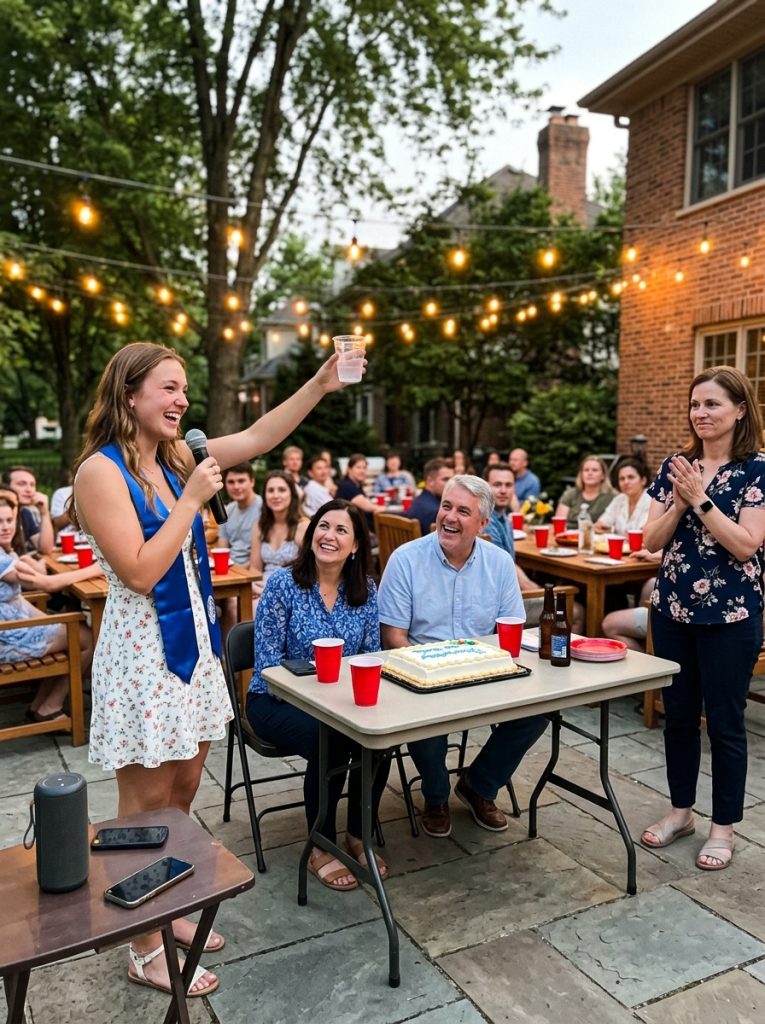
Madison set the microphone down on the table, and in front of the whole backyard, she walked across the patio to me.
I didn’t know what was coming. Six years of distance had taught me not to assume. I braced for embarrassment, for her to laugh it off, for someone to grab the phone and kill the audio and for all of us to pretend it hadn’t happened.
That’s not what she did.
She stopped in front of me. Her eyes were wet. And she said, loud enough that she didn’t need the microphone anymore, “I never told anyone about that night. Because I was ashamed. And because if I told the story, I’d have to tell the part where you’re the one who came.”
The string lights buzzed. Nobody moved.
“I’ve spent six years acting like you were a guest in my house,” she said. “And you spent six years acting like that was okay with you. It wasn’t, was it.”
I shook my head. I couldn’t talk yet.
“I called you,” she said, “because I knew you’d come and you wouldn’t make me feel like garbage about it. You drove an hour at one in the morning and you got me water and you took the long way home so I’d sober up, and you never told Dad, and you never held it over me. Not once. Not even when I was awful to you.”
She wiped her face with the heel of her hand, the way she did when she was little, before I knew her.
“I’m sorry, Joanne. I left you out of the toast. I want to do it again.”
And she picked the microphone back up.
I have replayed what she said next more times than I can count.
“I want to thank my mom and my dad, who I already thanked, because I love them.” A small laugh from the crowd. “But I left someone out. My stepmom, Joanne. Who I have not made it easy to love. Who came for me on the worst night of my life and asked for nothing. Who bakes the cake every year and stands at the edge of the photos. I don’t want you at the edge anymore. Thank you for staying. Even when I didn’t make you welcome. Thank you for staying.”
She raised her cup toward me.
And the whole backyard — my husband, her mother, her grandmother, all of them — raised their cups too, and turned toward the woman who’d spent six years being a houseguest, and for the first time I was inside the photo instead of at its edge.
Greg reached me first. He put his arm around me. He was crying, which I’d seen maybe twice in our marriage. He whispered, “I should have made them include you years ago. I’m sorry I let you stand at the edge.”
I told him it wasn’t his job to give me a place. It was mine to stop apologizing for needing one.
I should tell you about the rest of that night, because the toast wasn’t the whole turn.
After the cups came down, Madison’s mother — Greg’s ex-wife, Diane, who had spent six years being perfectly polite to me in the chilly way of a woman who hadn’t decided whether I was an ally or a replacement — came and found me by the drink table.
I braced. Diane and I had an unspoken treaty: we were civil for Madison’s sake, and we never, ever talked about anything real.
She didn’t say anything for a moment. Then she said, “I didn’t know about that night. The party. The drinking.” Her voice was tight. “Madison never told me. If I’d known she’d been in that situation, I’d have wanted to be the one—” She stopped. Started again. “I’m her mother. It should have been me she called.”
And there it was — the thing under six years of cool politeness. It wasn’t that Diane disliked me. It was that she was terrified I was taking her place. That every lunch I packed and every practice I drove to was a withdrawal from an account she was afraid of emptying.
“She called me because I was closer that night and she was scared you’d be disappointed,” I said. “Not because you weren’t enough. Because you mattered too much to disappoint. That’s not the same thing.”
Diane looked at me for a long moment. Something in her face loosened.
“Thank you for going,” she said. “I’ve spent six years resenting you, and you spent one of those nights keeping my daughter safe and never once used it against me. I’m ashamed of that.”
We didn’t become friends overnight. But that was the night Diane and I stopped being rivals over a girl who had more than enough room for both of us. We text now, the two of us, about Madison — coordinating, comparing notes, two women on the same team instead of two women guarding the same border.
Madison watched that conversation happen from across the patio. She told me later it was the first time she’d ever seen her mom and her stepmom talk like people instead of like diplomats. “That,” she said, “was weirder than the voice memo.”
Here is what I’ve learned about being a stepparent, in case you’re standing at the edge of your own patio somewhere.
You don’t get the love automatically. Blood gets that. You get the long way around. You get the version where you show up and show up and show up, and most of it goes unthanked, and you have to decide that you’re doing it because it’s right and not because anyone’s keeping score.
For six years I’d assumed the score was being kept and I was losing.
It turned out Madison had been keeping a different score the whole time — a quiet one, in a voice memo she was too ashamed to delete, in the memory of the one adult who came when she called.
The party went on. The cake — my cake — got cut. Madison made me sit at the family table, not the edge. Her grandmother, who had always been cool to me, sat down next to me and said, “I didn’t know about that night. She never told us. Thank you for being there.” It was the first warm sentence the woman had ever offered me.
But the moment I keep is later, after most of the guests had gone, when Madison found me stacking chairs.
“Can I ask you something?” she said.
“Anything.”
“Why didn’t you ever tell Dad? You could have. It would’ve made you look good. The good stepmom who saved the kid.” She wasn’t being cruel. She was genuinely trying to understand.
I thought about how to say it.
“Because the second I told him,” I said, “it would’ve stopped being something I did for you and started being something I did for me. You needed one adult in your life who’d keep your secret without spending it. I wanted to be that, even if you never thanked me. Especially if you never thanked me.”
She started crying again. Then she hugged me — really hugged me, the kind where the other person’s full weight comes into your arms — and she said into my shoulder, “I’m so glad it was you who came.”
So am I.
We’re not perfect now. I want to be honest about that, because the internet loves a story where one moment fixes everything, and life doesn’t work like that. Madison still calls her mom first. There are still days the wall goes back up a little. We’re stepfamily; the load-bearing walls take years to settle.
But she texts me now. Little things. A meme. A question about a recipe. Once, “thinking about you,” with no reason attached, which undid me at a stoplight.
And when she left for college in the fall, she hugged her mom, and she hugged her dad, and then she came and found me last, and held on the longest, and said, “Thanks for staying. Still.”
I’ll stay as long as she’ll let me.
That’s the whole job, really. Not winning. Not replacing anyone. Just being the one who stays — and trusting that someday, maybe at a graduation party, in front of everyone, the kid you stood beside will turn around and finally see you standing there.
She always comes.
It turned out I wasn’t the only one who’d been keeping that promise. Madison had been keeping it too — in a recording she was brave enough, finally, to let the whole world hear.