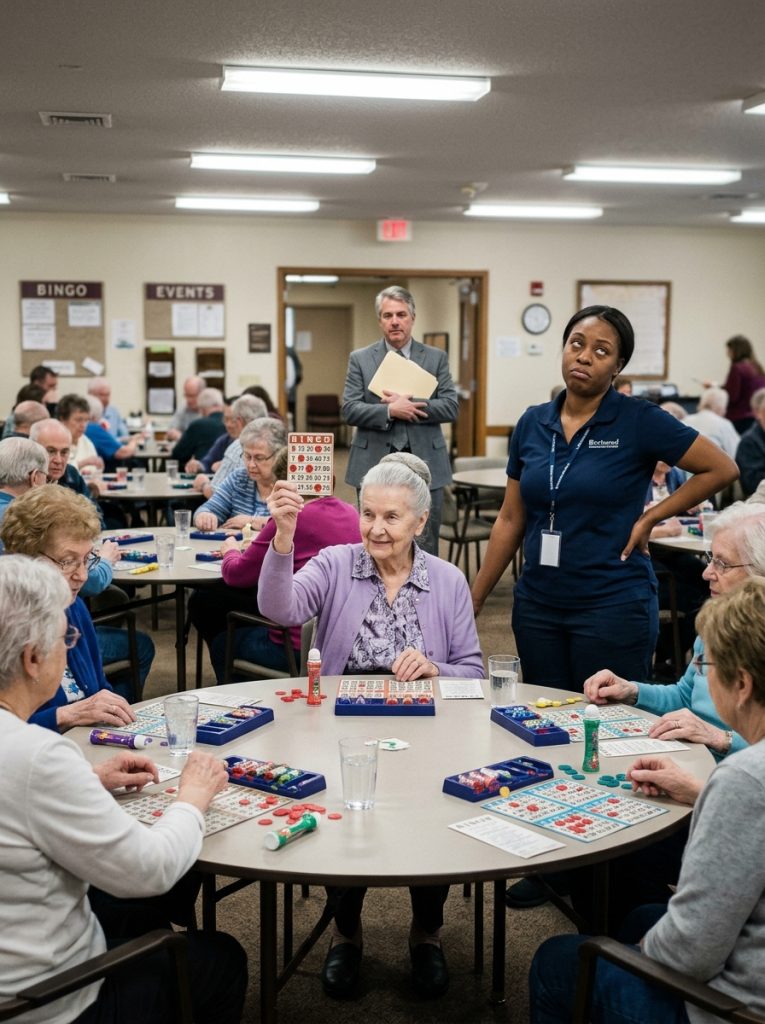
The man in the gray suit introduced himself to the whole bingo hall as David Krause, regional director for the ownership group that runs Birchwood and eleven other facilities across the upper Midwest.
Then he asked Brenda Mosley to step into the hallway with him.
I want to tell you what I learned in the days after that afternoon, because the truth turned out to be bigger and quieter than anyone in that hall could have guessed.
Eleanor Hartley was not on a county subsidy. That part — the part Brenda had built her little joke around — was wrong from the start. Eleanor’s billing came through a trust account, and the trust account had an unusual name attached to it that the front-desk staff had never bothered to look up, because who looks up the billing of a sweet old woman in a lavender cardigan?
Eleanor Hartley is the principal beneficiary and settlor of the blind trust that owns Birchwood Senior Living.
She built it herself. She and her late husband, Walter, ran a chain of hardware stores across Minnesota for forty years, sold them in the nineties, and put the money into something Walter believed in: dignified places for old people to live. They funded three senior communities quietly, through a trust structured so that the residents and staff would never know the owner was living among them.
Eleanor moved into Birchwood four years ago, after Walter passed. She could have lived anywhere. She chose to live in one of her own buildings, as an ordinary resident, because — she told me later — “you cannot know how a place really treats people unless it treats you like nobody.”
She wanted to see Birchwood from the inside. From the bingo table. From the budget meal plan she deliberately requested so she’d be served the same food as the residents the staff thought didn’t matter.
And for two years, she watched.
She watched which aides knelt down to talk to residents at eye level and which ones talked over their heads. She watched who got their call lights answered quickly and who got left. She watched Brenda Mosley run the activities program like a popularity contest, lavishing attention on residents with money and family while treating the others — the quiet ones, the alone ones — like furniture that occasionally won at bingo.
She watched Brenda call her the budget queen, in front of the room, again and again.
And she wrote it all down. Not for revenge. Eleanor doesn’t have revenge in her. She wrote it down because the trust was due for its periodic ownership review, and Eleanor had decided to stop being a silent resident and start being a silent owner who finally spoke.
David Krause was there that afternoon because Eleanor had called him herself the week before and said, simply, “It’s time. Come see what I’ve seen.”
In the hallway, Krause did not fire Brenda. That surprised me. I’d been so sure that was where it was headed.
Instead, what unfolded over the next month was something I didn’t expect and have come to respect more than any dramatic firing could have earned.
Eleanor asked for a full operational review of Birchwood — staffing ratios, call-light response times, complaint logs, meal quality, the works. The trust funded it. The findings were exactly what she’d witnessed: understaffing on the memory-care wing, response times that lagged worst for residents without visiting family, a culture where attention followed money.
Eleanor’s response was not to punish individuals first. It was to fix the structure that made the cruelty possible.
She funded eleven new positions across the facility. She raised the base pay for the frontline aides — the ones who actually do the lifting and the listening — by a margin that made three of them cry in the break room when the letter came. She established a resident advocate role reporting directly to the trust, not to local management, so that the quiet residents would have a voice that couldn’t be talked over.
And she instituted a dignity-in-care training program. Mandatory. For every staff member.
The first session was led by Eleanor herself.
She stood up in the same activities room where she’d been mocked, in the same lavender cardigan, and she introduced herself — really introduced herself — to a staff that had spent years thinking they knew exactly who she was.
I was there. I watched Brenda Mosley’s face the entire time.
Eleanor didn’t name her. She didn’t have to. She talked about what it feels like to be called a charity case in a room full of people. She talked about the particular loneliness of being treated as if your presence is a budget line rather than a life. She talked about Walter, and the hardware stores, and the simple idea that built everything: that how you treat the people who can do nothing for you is the only honest measure of who you are.
“I have been your resident for four years,” she said. “I have also, the whole time, been your employer. I did not tell you because I did not want you to perform for me. I wanted to see the truth. And I did.”
You could have heard a pin drop.
Brenda was not fired. She was placed on a performance plan and required to complete the dignity training, then to shadow the highest-rated aides for a month. Eleanor’s view, which she shared with Krause, was that you don’t fix a culture by removing one person and keeping the system that grew her. You give people a real chance to change — and you watch what they do with it.
Some staff didn’t make it through. Two resigned rather than do the training. Brenda, to her credit and to my genuine surprise, stayed. I watched her over the following weeks actually learn to kneel down at eye level. Whether it was real or self-preservation, I can’t fully say. But the residents noticed the difference, and at our age, difference is what matters.
The aide who’d been kindest to Eleanor — a young woman named Priya on the memory-care wing — was promoted to lead the new resident-advocate program. Eleanor requested her by name.
As for me, Eleanor found me one evening on my rounds. She patted the chair beside her and asked about my daughter’s science fair — she remembered it, of course — and then she said, “Carol, you brought me tea on the nights nobody was watching. I was always watching. Thank you.”
I didn’t know what to say. So I just held her hand for a minute in the dim hallway, two women who’d both spent years being underestimated in that building.
A few weeks later, an envelope appeared in my mailbox at home. Inside was a handwritten note from Eleanor and a scholarship letter — the trust had established an education fund for the children of frontline staff, and my daughter was the first recipient. The note said only: “For the science fair girl. Walter would have liked her. — E.H.”
I sat on my front step and cried, the good kind.
I asked Eleanor about it the next time I saw her. I told her it was too much. She waved her hand the way she waves off a bingo win.
“Money is only worth what it does while you’re alive to watch it do it,” she said. “Walter and I spent forty years selling hammers and nails so that people could build things. I spent the last four years finding out which of my buildings actually builds people up and which ones grind them down. Now I get to fix that. Do you know how lucky I am, at eighty-four, to still get to fix something?”
I think about that more than she knows.
Eleanor still plays bingo on Wednesdays and Fridays. She still wins more than seems statistically fair. She still wears the lavender cardigan.
But nobody calls her the budget queen anymore.
They call her Mrs. Hartley. And they say it the way you say the name of someone who turned out to be holding the whole building up the entire time you thought she was the one being carried.