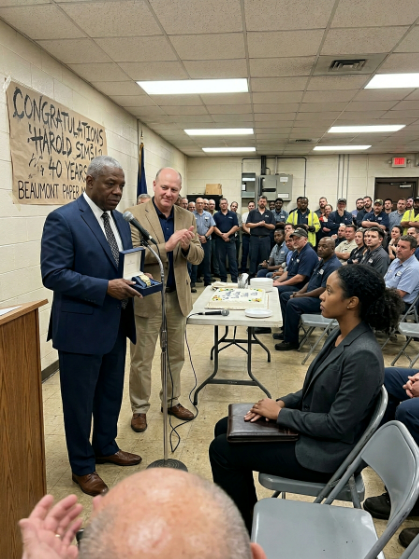
I stood up, and two hundred people in folding chairs turned to look at the granddaughter in the front row, and Doug Metzger’s forced smile finally cracked all the way through.
My grandfather stayed at the podium. He didn’t sit. He held that folded memo in one hand and the open watch box in the other, and he waited for me the way he’s waited for me my whole life — patient, certain, letting me take my time.
“My name is Janelle Sims,” I said. “I’m a labor attorney. And I represent my grandfather.”
You could feel the room try to figure out what kind of moment this was. A few people still had their hands half-raised from clapping.
“Forty years ago, this company made my grandfather a promise,” I said. “He gives you his back, his shoulders, his hearing, four decades of 4 a.m. alarms — and at the end, you give him a pension he can retire on. That was the deal. He kept his half. Every shift. Forty years.”
I held up the memo so the room could see there was paper, even if they couldn’t read it.
“Three weeks ago, the board of this company circulated this. It’s an internal proposal to reclassify my grandfather’s final five years of employment as ‘independent contractor’ work. Retroactively. On paper. If those five years aren’t ’employment,’ he falls just short of the vesting threshold for his full pension. The company saves a significant amount of money. My grandfather loses most of what he spent his life earning.”
The room made a sound. Low. The sound of two hundred mill workers all realizing at once that what was being done to Harold could be done to any of them.
Doug stepped forward fast. “Now hold on — that memo was a draft, a internal discussion document, nothing was finalized—”
“It was circulated to the full board with an implementation timeline,” I said. “I’m an attorney, Mr. Metzger. I read the whole thing. Including the part where someone wrote, and I’m paraphrasing only slightly, that Harold ‘wouldn’t have the resources to challenge it.'”
That line did something to the room. Because every person in it knew exactly what it meant. It meant: he’s just a mill worker. He won’t have a lawyer. Who’s going to stop us.
What the board didn’t know — couldn’t have known — is who Harold raised.
Here’s the part that still makes me emotional. When I was sixteen, I interned in this very company’s front office for a summer. I told them I wanted to be a lawyer. And a man who is, to this day, on that board, laughed at me. He told me to be realistic, that girls from my part of Macon don’t become attorneys, that I should look into something “more achievable.” I went home and cried. Then I framed the memory and put it on my wall, and it was there through every all-nighter in law school, through the bar exam, through every day I wanted to quit.
They didn’t recognize me at that ceremony. To them I was just the granddaughter with a camera. They had no idea that the kid they told to be realistic had spent ten years becoming the exact thing they swore she’d never be — and that she specialized in this. In ERISA. In the federal law that governs pensions. In exactly the kind of retroactive reclassification scheme they’d just put in writing.
I laid it out for the room, plainly, the way I’d lay it out for a judge. Reclassifying an employee retroactively to dodge a vested pension obligation isn’t a clever accounting move. It’s a potential violation of federal law. And they’d documented their own intent in a memo, which is the kind of gift opposing counsel dreams about.
Then my grandfather did the thing we’d planned at the kitchen table the night before, while he ironed that navy suit.
He closed the watch box. He set it on the podium, gently, next to the microphone. And he said, in that low, steady voice: “I appreciate the watch. Forty years, and I do appreciate it. But I think I’ll hold out for what I was promised.”
He slid the box across the podium toward Doug.
I want to tell you about the night before, because it’s the part I’ll keep.
When I found the memo, my first instinct was to march into that company and threaten everyone in a suit. That’s the lawyer in me. But Grandpa stopped me. He said if we were going to do this, we’d do it his way — quiet, dignified, in front of the people he’d worked beside for forty years, so they’d know it could happen to them too. So they’d know to check.
So we practiced. At the kitchen table, while he ironed that navy suit he hadn’t worn in ten years, pressing the same lapels over and over even where they were already flat. I’d say my part, the attorney part, and he’d say his line — “I appreciate the watch, but I’ll hold out for what I was promised” — and then he’d stop and make me say my part again, slower, “so the young ones can follow it.” He wasn’t nervous for himself. He was thinking about the room. About making it land for the people who needed to hear it.
My grandmother sat with us and didn’t say much. At one point she put her hand over his on the iron and said, “Forty years, Harold.” That was all. Forty years. He just nodded.
That’s the man the board decided “wouldn’t have the resources to challenge it.” A man who, the night before he reclaimed his own pension, was mostly worried about whether the other workers in the room would understand the lesson.
We filed the ERISA complaint the following Monday. I won’t pretend the company rolled over — they had lawyers too, and there were weeks of letters. But the memo was the memo. Their own words, their own timeline, their own casual little line about Harold not having the resources to fight. Once they understood that Harold very much had the resources — that the resources were sitting in the front row at the ceremony — the posture changed fast.
The reclassification scheme was withdrawn. My grandfather got his full pension, every dollar of it. And here’s the part that matters most: he wasn’t the only one. When we pulled the thread, we found the board had quietly flagged seventeen other long-tenured employees for the same treatment, all of them close to vesting, all of them chosen because someone decided they “wouldn’t have the resources.” All seventeen were made whole. Seventeen retirements, saved by one ironed suit and one memo a granddaughter happened to be able to read.
A week later, a small package arrived at the company addressed to the board. It was the gold watch, back in its velvet box, with a note in my grandfather’s careful handwriting. I helped him word it, but the line was all his.
“You can’t buy forty years for fourteen karats.”
He didn’t keep the watch. He didn’t need it. He’s got the pension, and he’s got my grandmother, and last month he finally took her to the coast like he’d promised her for years.
I think a lot about that board member who laughed at sixteen-year-old me. I don’t know if he ever connected the dots — that the “more achievable” girl was the attorney who cost the company that scheme and seventeen others. I hope he did. Not for revenge. For the lesson.
Because here’s what they got wrong, all of them. They looked at my grandfather — quiet, calloused, navy suit he hadn’t worn in a decade — and they saw someone who wouldn’t fight. They looked at me and saw someone who’d never amount to a threat. They built an entire scheme on the assumption that the people they were robbing were too small to stop them.
They forgot that small people raise the people who stop them.
My grandfather gave that mill forty years. The least I could do was make sure it gave him back what it owed.