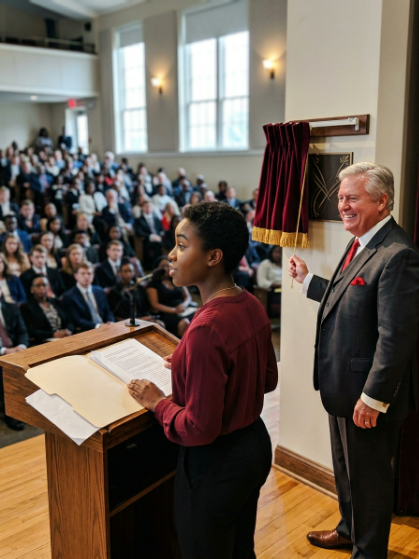
He nodded, delighted, and I turned the page — and the page underneath my thank-you speech was the Form 990.
“Mr. Tate’s foundation gave two and a half million dollars,” I said, to the room, to the two hundred people in their Saturday best, to the press along the side wall. “That number is printed on the program in your hands. And I wanted to understand it, because I’m an accounting major, and understanding numbers is the thing I love most in the world.”
Randall was still smiling. His hand was still near the unveiling cord. He thought this was praise.
“So I pulled his foundation’s public tax filing,” I said. “Anyone can. It’s called a 990, and the law requires every charitable foundation to make it public, precisely so that generosity can be checked. My professor taught me that. Follow the money, she says. A charity tells you who it really is in the 990, not in the press release.”
The room was still warm. Still with me. They thought I was building toward something sweet.
“The Tate Foundation reported two and a half million dollars in charitable disbursements,” I said. “But when you follow where the money actually went, most of it didn’t go to students. It didn’t go to this university. It went to a company called Tate Consulting Group, listed as ‘administrative and advisory fees.'”
I let that sit for one breath.
“Tate Consulting Group is Mr. Tate’s own firm.”
I watched the smile go. Not all at once — in pieces, the way Vince Morello’s did in a different city, the way they always do when a person realizes the thing being read aloud is true and public and already out of their hands.
“Two point one million dollars of the two point five,” I said, “came back to him. The scholarship I received is real. My tuition was paid. I am grateful for it, and I will be paying it forward for the rest of my life. But it was the small, photogenic part — the part you put a student on a stage to thank you for — while the rest of the ‘gift’ quietly circled home and bought a tax deduction and a building with his name on it.”
Randall finally found his voice. “This is — young lady, you don’t understand how foundations work. Administrative costs are normal, there are professionals who—”
“I do understand how foundations work,” I said. “That’s the whole problem. I’m going to be one of the professionals who reads these. And I can tell the difference between an administrative cost and a foundation that exists mostly to move a man’s money from one of his pockets to the other while everyone applauds.”
I closed the folder.
“I just thought,” I said, “that before the university carves your name into a wall, the people in this room should be able to read the same public document I did. That’s all. Thank you for the scholarship. And thank you for teaching me to read the fine print.”
I sat down.
I’d like to tell you the room erupted. It didn’t. It did something better and stranger — it murmured, the sound of two hundred people quietly pulling out their phones to search “Form 990” and “Tate Foundation” for themselves, because the beautiful thing about citing a public document is that anyone can check it on the spot. And they did. And it said exactly what I said it said.
My mother was three rows back the whole time, in the nicest dress she owns, and I couldn’t look at her while I spoke because I knew if I did I’d lose my nerve. She’d worked two jobs to raise me. She’d never once asked anyone for a handout, and she’d taught me that you say thank you and you mean it. Part of me was terrified she’d be ashamed — that she’d think I’d embarrassed the man who paid my tuition, in public, in front of everyone who mattered in this city.
Afterward, in the parking lot, she found me. She didn’t say anything for a long moment. Then she put both hands on my face the way she did when I was small, and she said, “Baby, gratitude doesn’t mean you let people lie to you. I raised you to read. I’m glad you read.” And that was the moment I stopped being afraid of what I’d done.
The provost was in the second row. He’s the one who stood up first. He walked to the podium, thanked me — carefully, the way you thank someone who has just detonated your morning — and announced that the university would be “pausing the dedication pending a review of the gift’s structure.” Pausing. Reviewing. The polite institutional words for we did not check, and a twenty-year-old did.
The curtained plaque never got unveiled. It just stayed there under its little velvet drape while the room emptied, and then somebody quietly took it down.
Here’s what I didn’t say from the podium, because it wasn’t the moment.
I almost didn’t do it. For two weeks I sat on that 990 and argued with myself. He’d helped me. My mother raised me to be grateful, and I am — grateful is the foundation of my whole life. Who was I, a junior on a scholarship, to take down a man who could buy a building? I kept hearing a voice that said be quiet, be thankful, don’t make trouble, you got yours.
But there was another voice, and it was my professor’s, and it just kept saying the same four words: follow the money. And when I followed it, I realized that staying quiet wasn’t gratitude. It was complicity. The whole machine of it depended on the scholarship kid standing on the stage and smiling. I was the photogenic part. I was the two point one million’s alibi. The moment I understood that, I couldn’t unknow it.
The story traveled. It turns out a first-generation accounting student reading a tax form out loud at a naming ceremony is exactly the kind of thing people share. A few weeks later I got an email I had to read three times. The state attorney general’s office runs a charities-oversight division — the people who investigate exactly this kind of self-dealing foundation. They’d seen the coverage. They offered me a summer internship.
Me. The kid Randall Tate thought he was buying a thank-you from.
I took it. I spent the summer learning how the people whose actual job is reading 990s do the reading. My professor wrote my recommendation. She told me, when I asked her why she’d drilled “follow the money” into us so relentlessly, that she’d spent her early career as an auditor watching powerful people count on the fact that nobody would do the boring work of checking. “The fraud isn’t usually hidden,” she said. “It’s just filed somewhere nobody bothers to look. The whole scheme is the bet that you won’t read it.”
I read it.
I think about Randall Tate sometimes. Not with hatred — I don’t have the energy for that. Mostly I think about how close it came to working. How many ceremonies like that one happen every year, with a real scholarship kid and a real check and a name going up on a wall, and nobody in the room ever pulls the filing. He didn’t lose because he was uniquely greedy. He lost because, this one time, the photogenic part of his plan happened to be an accounting major who couldn’t stop herself from doing the homework.
My tuition’s still paid. My name’s not on any building. But I read the fine print now for a living, more or less, and there are people doing quiet self-dealing in plain sight all over this country who should know that the boring kid in the back row might just pull the document.
Follow the money. It tells you who everyone really is.