The Pentagon cafeteria was never quiet, but it had a kind of ordered noise. Trays sliding. Voices low. The occasional laugh from a table of junior officers. General Thomas Canist usually avoided it. He preferred the officer’s mess on the fourth floor. But today his meeting had run long and his aide had suggested the cafeteria would be faster.
He had been wrong.
The line moved slowly. Canist stood with his tray, waiting his turn at the soup station. He wasn’t in a hurry. The day had already been long enough.
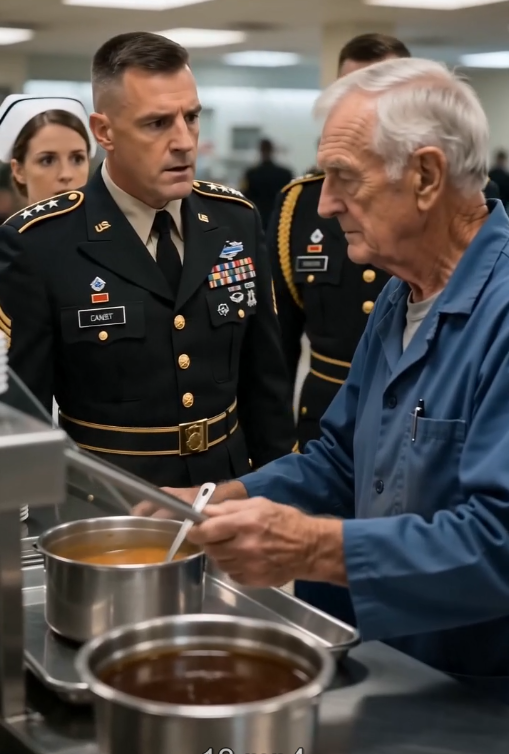
The old man working the station had white hair and deep lines around his eyes. His hands moved with the careful precision of someone who had done the same task for years. Blue work shirt. Name tag that said “HARRISON”. No rank. Just a civilian employee doing his job.
Canist didn’t recognize him at first.
Then the old man looked up.
Their eyes met.
Something passed between them. Recognition. Not the polite kind. The kind that comes from shared ground that no one else in the room would understand.
“Sir,” the old man said quietly. “That’s the medic from Kandahar.”
Canist felt the words hit him in the chest. He hadn’t heard that name spoken out loud in almost two decades. Kandahar. The night the convoy hit the IED. The night everything changed.
He had been a captain then. Leading a patrol that was supposed to be routine. The medic — a young corporal named Harrison — had been attached to his unit for the week. Good kid. Steady hands. Never complained.
When the second IED went off, Harrison had been the one pulling people out of the burning vehicle. Canist remembered the blood. So much blood. He remembered dropping to his knees beside the medic, pressing his hands against the wound in Harrison’s side while the world exploded around them. He had held pressure for what felt like hours. Talking the whole time. Telling Harrison to stay awake. Promising he would get him home.
Harrison had lived. Canist had made sure of it. He had carried the memory of those hands — the medic’s hands saving others, then his own hands trying to save the medic — for twenty years.
And now here he was. Serving soup in the Pentagon cafeteria.
“I watched it once,” Canist said. The words came out before he could stop them. “The tape. After they medevaced you. I watched the bodycam footage. I needed to know if I had done enough.”
Harrison nodded. He had heard stories over the years. About the captain who wouldn’t let anyone else near him that night. About the promotion that came after. About the general who still asked about certain names from that deployment.
“You held my blood in with your hands,” Harrison said. It wasn’t an accusation. It was a statement of fact. “I remember your voice. You kept telling me my wife was waiting. That I had a kid on the way. I didn’t even have a girlfriend back then. You made that up so I’d fight harder.”
Canist felt something crack in his chest. He had forgotten he said that.
“I didn’t know what else to say,” he admitted. “I just needed you to stay with me.”
Harrison looked at the general’s uniform. The stars. The ribbons. The weight of twenty years.
“I came back,” he said. “They fixed me up. Gave me a desk job for a while. Then I got out. Figured the quiet life was better. My wife — the one you invented that night — she found me anyway. We have two kids now. Both in college. I work here three days a week. Keeps me moving. Keeps the hands busy.”
Canist looked down at his own hands. They were clean now. Manicured. The hands of a man who gave orders instead of holding pressure on wounds.
He had thought about this moment for years. What he would say if he ever found the medic again. He had imagined medals. A ceremony. Something official.
Instead they were standing over soup pots in a cafeteria.
“I never got to thank you properly,” Canist said. “For what you did before you got hit. You saved three of my men that day. You were the reason any of us made it back.”
Harrison shrugged. The gesture was the same as it had been twenty years ago. “Just doing the job, sir. Same as you.”
Canist set his tray down on the metal counter. He reached across and put his hand on Harrison’s shoulder. The same way he had gripped it that night in the dust.
“You did more than the job,” he said. “You gave me back my men. And you gave me a reason to keep fighting when it would have been easier to stop.”
Harrison looked at the hand on his shoulder. Then at the general’s face.
“I’m glad you made it, sir,” he said. “That’s enough for me.”
Canist nodded. He picked up his tray again. The soup was getting cold.
” If you ever want something different,” he said, “a better job, better hours, you call my office. No speeches. No ceremonies. Just a door that stays open.”
Harrison smiled. Small. Real.
“I’m good here, General. But I’ll remember the offer.”
Canist turned to go. Then stopped.
“Harrison.”
The old man looked up.
“Thank you. For that night. And for every night after.”
Harrison gave one last nod.
“Anytime, sir.”
Canist walked away with his tray. The cafeteria noise continued around him. But something had shifted. The weight he had carried for twenty years felt a little lighter.
Some debts you pay with medals.
Others you pay with a hand on a shoulder and a quiet word over a soup pot.
Both kinds mattered.