The commissioning of the USS Vigilant was supposed to be clean. White gloves. Brass polished until it hurt to look at. Speeches that mentioned sacrifice in the abstract. Chief Petty Officer Daniel Reyes had done three of these already. He knew the rhythm: the band, the chaplain, the admiral’s remarks, the moment the ship was officially alive.
He had not expected the welder.
The man stood just outside the velvet rope, boots planted like he intended to grow roots there. His coveralls were the color of every shipyard floor he had ever stood on — oil, metal dust, coffee stains that never came out. The hard hat in his left hand had a crack across the brim. His right hand stayed free, fingers still slightly curled from decades of gripping a torch.
When the young seaman tried to guide him back, the old man spoke.
“I built this rail.”
Daniel had heard a lot of things at these ceremonies. Drunken veterans. Proud mothers. Politicians who had never seen the inside of a hull. But this was different. The man wasn’t asking for attention. He was stating a fact.
The officer in charge — Commander Hale — gave Daniel the smallest nod. Handle it.
Daniel kept his voice low. “Sir, the working area is behind the line. For your safety.”
The old man — Frank Ellison, though Daniel wouldn’t learn the name until later — turned his head just enough to look at the sailor. His eyes were the pale blue of a man who had spent too many years staring at sparks.
“I welded the keel section that rail bolts to. Section forty-two. Port side. Three hundred and twelve passes. You can still see my stamp if you know where to look.”
Daniel felt the words settle. He had grown up in a navy family. His father had been a chief. His grandfather had served on carriers. But he had never stood this close to the men who actually built the ships his family sailed on.
Commander Hale stepped closer. “Mr. Ellison. We appreciate every hand that went into her. But today is for the crew.”
Frank Ellison didn’t raise his voice. He didn’t need to.
“Then maybe the crew should know whose hands kept her from sinking before she ever touched water. We worked double shifts when the contract said single. We fixed the mistakes the engineers drew on paper. We stayed when the rain came through the roof and the lights went out. And when she slides down the ways next month, every one of us will still be standing on the dock because we can’t afford the tickets to the party.”
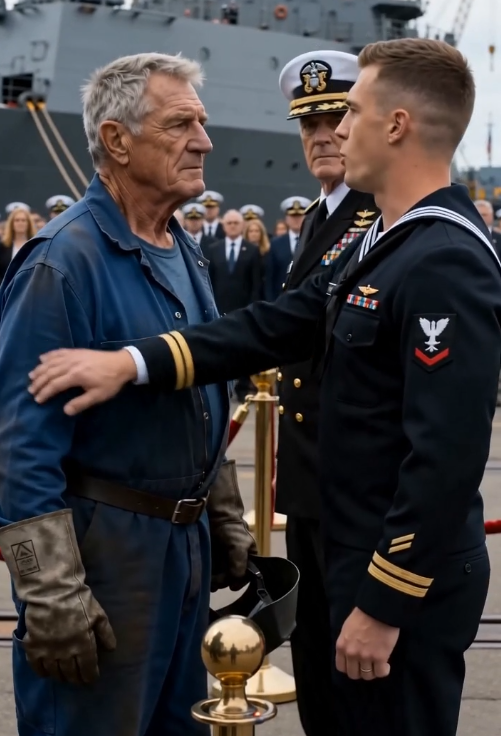
A photographer’s flash went off somewhere behind the rope. Daniel saw the old man’s face in the brief white light — the deep lines around the mouth, the burn scar along the jaw, the quiet dignity that didn’t ask to be noticed.
Daniel’s hand was still on the man’s shoulder. He hadn’t moved it.
He thought about his own father, who had retired last year after thirty-two years. His father had never built a ship. He had only sailed them. There was a difference.
Frank Ellison looked at the young sailor one last time.
“Just remember,” he said. “When you stand on her deck and feel her move under you, some of that movement is ours.”
Then he stepped back behind the rope without being asked again.
Daniel watched him go. The old man didn’t look back at the ship. He looked at the other men in dirty coveralls who had come with him — five of them, standing in a loose line, hard hats in their hands like they were at a funeral.
Daniel turned to Commander Hale.
“Sir,” he said quietly. “Maybe we should invite them to the reception. Just the ones who worked the hull.”
Hale was quiet for a long moment.
“See if the caterer has enough coffee,” he said finally. “And tell the band to play something with steel in it.”
Daniel nodded. He looked back at the brass stanchion. The reflection in the golden sphere still showed the ship, but now it also showed the faint outline of a man in coveralls walking away.
Some ships are launched with speeches.
The best ones are launched with the weight of every hand that refused to let them sink.