The Little Girl in Red Led a Billionaire to the Woman He Never Forgot
PART 3 (FULL STORY)
Cameron stared at the envelope in his hand.
For several seconds, he did not open it.
The hospital corridor seemed strangely quiet after the chaos of Terminal B. Machines beeped behind closed doors. Nurses moved quickly between rooms. Somewhere farther down the hall, a child laughed at something on a television, completely unaware that another child was sitting nearby wondering whether her mother would wake up.
Hope watched him.
“Is that yours?”
“I don’t know,” Cameron said.
She pointed at the envelope.
“Mommy wrote your name.”
Cameron turned it over.
There was no return address.
No hospital number.
No explanation.
Only one word written across the front in handwriting he had not seen in more than seven years.
Cameron.
His stomach tightened.
He opened it.
Inside was a single folded sheet of paper.
The first line made him stop breathing for a moment.
Cameron,
If you are reading this, then Hope has found you.
He read the sentence twice.
Then he looked at the little girl beside him.
Hope had already stopped watching his face and was staring through the glass doors toward the treatment room where her mother was fighting for her life.
He continued.
I never intended for you to meet her this way.
Cameron lowered the paper.
There was only one woman in his life who had ever written to him like that.
Emily.
Seven years earlier, Cameron had been twenty-nine, already wealthy enough that people assumed money had solved every problem he could possibly have.
It hadn’t.
He had been working eighteen-hour days, flying between New York, London, and Tokyo, convinced that the only way to build something lasting was to keep moving before anyone could ask him what he actually wanted.
Then he met Emily Parker.
She worked at a small bookstore near his apartment.
She had no interest in his money.
She didn’t know who he was the first time he walked into the store.
She simply told him he was standing in the wrong section.
“You’re looking for business biographies,” she had said.
Cameron had glanced at the shelf.
“I am.”
“You’re in poetry.”
“I noticed.”
“You’ve been standing here for five minutes.”
“I was thinking.”
“You were pretending to think.”
He had laughed.
It was the first time in months.
He started coming back.
Sometimes he bought books.
Sometimes he bought coffee for both of them.
Sometimes he stayed until closing while Emily told him about stories she loved and people she had met.
She knew his wealth eventually.
But she never treated him differently.
That was what made him trust her.
For the first time in his adult life, Cameron had allowed himself to imagine a life that didn’t revolve around acquisitions, meetings, and numbers.
Then one night, everything changed.
Emily told him she was pregnant.
Cameron remembered the exact room.
The narrow kitchen.
The rain against the window.
The mug sitting between them with a crack near the handle.
He remembered the fear on Emily’s face.
Not fear of him.
Fear of what his world would do to the child.
Cameron had wanted to marry her.
He had wanted the baby.
But his father had intervened.
At the time, Cameron’s company was preparing for its largest expansion yet, and his father had convinced him that Emily was a distraction, that she wanted access to his fortune, that the pregnancy was being used to trap him.
Cameron had believed the wrong people.
He and Emily had argued.
She had walked out.
By the time Cameron realized how badly he had been manipulated, Emily was gone.
He searched for her.
He found nothing.
Eventually, he convinced himself she had chosen to leave.
It was easier than admitting that he had failed her.
Seven years had passed.
Now her daughter was sitting beside him wearing a red dress.
Cameron looked back at the letter.
I wanted to tell you about Hope.
I wanted to tell you everything.
But after what happened between us, I couldn’t bring myself to come back and ask you for anything.
I worked.
I saved.
I raised her.
And I told myself that was enough.
His vision blurred.
He kept reading.
But Hope knows you.
She has seen your picture.
I never told her you were her father because I didn’t want her growing up waiting for a man who might never come.
Cameron stopped.
Father.
The word seemed too large for the narrow corridor.
He read the next line.
She has your eyes.
He looked at Hope.
She was six years old.
Small.
Tired.
Terrified.
And suddenly every detail he had noticed at the airport felt different.
The shape of her face.
The dark eyes.
The stubborn little crease between her eyebrows when she was frightened.
He had spent years wondering why Emily had disappeared.
He had never once considered that the answer might have been standing in front of him.
A doctor came through the emergency doors.
Cameron folded the letter.
“How is she?”
The doctor looked toward Hope.
“Are you family?”
Cameron hesitated.
He didn’t want to claim something he hadn’t earned.
“I may be.”
The doctor studied him.
“Her condition is serious, but we stabilized her.”
Hope stood immediately.
“Can I see Mommy?”
“Not yet.”
“She’ll wake up, right?”
The doctor didn’t make the promise Cameron had made in the airport.
“She has a chance.”
Hope looked at Cameron.
He crouched beside her.
“She has a chance,” he repeated.
This time he didn’t lie.
Hope leaned against him.
“I don’t want her to die.”
“I know.”
“What if she doesn’t wake up?”
“Then we’ll be here when she does.”
Hope looked up.
“You promise?”
Cameron swallowed.
“I promise.”
A nurse came toward them.
“Mr. West?”
“Yes?”
“There is something else.”
She handed him a small plastic evidence bag.
Inside was a key.
A brass key with a tiny blue ribbon tied around it.
Cameron stared at it.
“Your name was found in her personal effects,” the nurse said.
Hope reached for the bag.
“That opens Mommy’s box.”
Cameron looked at her.
“What box?”
“The blue one.”
“Where is it?”
“At home.”
She paused.
“Mommy said I wasn’t supposed to open it unless something happened to her.”
Cameron’s expression hardened.
“Do you know where your home is?”
Hope nodded.
The hospital social worker arrived a few minutes later.
There were procedures.
Questions.
Documents.
People who needed to verify who Hope was and why Cameron was involved.
For once, Cameron didn’t use his name to make those procedures disappear.
He sat through every question.
He answered what he knew.
He admitted what he didn’t.
And when the social worker asked why he was willing to take responsibility for a child who might not even be his, Cameron looked at Hope.
“Because she’s alone.”
That was enough.
By late morning, Cameron was sitting in Emily’s small apartment.
It was nothing like the homes he knew.
There were mismatched chairs.
A tiny kitchen table.
A stack of unpaid bills tucked beneath a fruit bowl.
Three work uniforms hanging behind the bedroom door.
A child’s drawings covered the refrigerator.
Hope walked directly to a closet and pulled out a blue metal box.
She placed it on the table.
Cameron used the brass key.
Inside were photographs.
A hospital bracelet.
A tiny pair of newborn socks.
And another envelope.
This one had two words written across it.
For Cameron.
He opened it.
Cameron,
If you’ve come this far, then I suppose life finally decided to make us honest.
I didn’t leave because I stopped loving you.
I left because I couldn’t raise Hope inside a war between your family and me.
I didn’t want your money.
I didn’t want your company.
I wanted you to believe me.
You didn’t.
That was the part that broke me.
Cameron sat down.
The apartment suddenly felt too small to contain seven years of regret.
The letter continued.
I worked three jobs because I wanted Hope to grow up believing she could stand on her own.
I never told her to hate you.
I never told her you abandoned her.
I told her you were someone who made a terrible mistake.
She asked me once whether terrible mistakes could be forgiven.
I told her they could, but only if the person who made them was willing to change.
Cameron closed his eyes.
A small sound came from across the room.
Hope was looking at him.
“Did Mommy forgive you?”
He looked at the child.
“I don’t know.”
“Did you forgive her?”
Cameron shook his head.
“I never blamed her.”
“Then why didn’t you find us?”
He had no good answer.
So he gave her the truth.
“Because I believed people who were wrong about your mother.”
Hope thought about that.
“Are you going to leave too?”
“No.”
The answer came before he could think about it.
“No, Hope.”
She nodded once.
Then she climbed onto the chair beside him.
For the first time since the airport, she stopped looking like a child waiting for disaster.
Three days passed.
Cameron canceled the Tokyo negotiation.
His board protested.
His lawyers called.
His chief financial officer warned him that walking away from the forty-million-dollar deal would cost the company millions.
Cameron listened.
Then he said, “Find another buyer.”
“You’re serious?”
“Yes.”
“Why?”
Cameron looked through the glass wall of his office at Hope sitting on the floor with a coloring book.
“Because some things are worth more than forty million dollars.”
He didn’t turn the decision into a public announcement.
He didn’t call the newspapers.
He simply made it.
Meanwhile, Emily remained unconscious.
Hope visited every afternoon.
She talked to her mother about school.
About the red dress.
About the man at the airport who had dropped an expensive briefcase just to kneel beside her.
Cameron sat quietly nearby.
On the fourth evening, Emily’s fingers moved.
Hope saw it first.
“Mommy?”
Cameron stood.
The monitors changed.
A nurse called the doctor.
Emily’s eyes opened slowly.
For several seconds, she looked confused.
Then she saw Hope.
“My baby.”
Hope burst into tears.
Cameron stayed near the doorway.
He didn’t know whether he belonged in the room.
Emily looked past Hope.
Their eyes met.
Neither spoke.
The silence between them wasn’t romantic.
It wasn’t dramatic.
It was seven years of hurt sitting quietly in a hospital room.
Finally, Emily whispered, “You missed your flight.”
Cameron almost laughed.
“I did.”
“I suppose that’s one way to get you to slow down.”
He lowered his eyes.
“I should have slowed down a long time ago.”
Emily looked at him.
“And Hope?”
Cameron looked at the little girl.
“She found me.”
Emily closed her eyes for a moment.
“I was afraid she would.”
“Why?”
“Because I didn’t know what you would do when you found out.”
Cameron stepped closer.
“I should have been there.”
Emily didn’t answer.
“I can’t change that,” he continued.
“I can’t give you seven years back.”
“No,” Emily said quietly.
“But you can decide what you do with the next seven.”
Cameron nodded.
“I want to.”
Emily looked at Hope.
Hope was holding both their hands now.
The three of them stayed that way for a long time.
There was no instant forgiveness.
No magical repair.
Emily still had questions.
Cameron still had guilt.
Hope still needed time to understand why the father she had only known from a photograph had suddenly appeared in her life.
But they had something they had not had before.
The truth.
Months later, Emily returned home.
She couldn’t keep working three jobs.
Cameron offered help, but she refused anything that felt like charity.
So they made a different arrangement.
Emily returned to school and began training for the teaching certificate she had abandoned years earlier.
Cameron paid for nothing without her agreement.
Instead, he offered her a job helping oversee a foundation his company had created for working parents.
She accepted only after making him promise she would have authority over the program.
He agreed.
Hope started school with a new last name on some forms and the same red dress hanging in her closet.
Cameron never asked her to call him Dad.
He let her choose.
For a long time, she called him Cameron.
Then one evening, while they were walking home from school, she slipped her hand into his.
“Dad?”
Cameron stopped.
Hope looked embarrassed.
“Never mind.”
He crouched down.
“No.”
His voice broke slightly.
“Say it again.”
She smiled.
“Dad.”
He didn’t say anything.
He just held her hand.
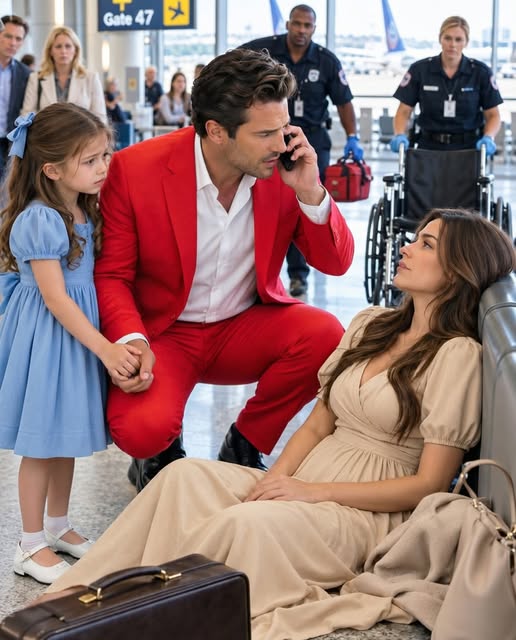
Years later, Cameron would still remember Terminal B whenever he saw a red dress.
He would remember the abandoned briefcase lying on the airport floor.
He would remember the woman in yellow.
And he would remember the little girl who had grabbed his expensive suit jacket because she didn’t care how much money he had.
She only needed someone to help.
Cameron had missed a flight that morning.
He had lost a forty-million-dollar deal.
He had walked into a hospital carrying a stranger’s child and discovered a daughter he never knew he had.
But the thing he remembered most wasn’t the money.
It wasn’t the business deal.
It wasn’t even the letter.
It was the tiny hand that had slipped into his at Gate 47.
Years afterward, the red dress was still folded in a drawer at home.
Hope had outgrown it long ago.
Cameron kept it anyway.
Not because he wanted to remember the worst morning of their lives.
Because that was the morning he finally stopped running long enough to find his way back home.