The ballroom doors opened at seven o’clock sharp, and the whole room turned to look.
They always do, when a woman like Dorothy Whitfield walks in.
Navy sheath dress. The pearls Harold gave her on their fortieth anniversary. Her chin up, her hand resting light on my arm, like we’d been arriving at places together our whole lives.
I felt every head at that head table swivel toward us. Hodges first — he always had to be first at everything. His ruddy face went through a quick little weather system: confusion, then recognition, then the particular nausea of a man who has just realized that two facts he kept in separate drawers belong in the same one.
The towel man. And the widow.
Together.
“Frank?” he said. His whiskey stopped halfway to his mouth. “What are you — why are you —”
“Gentlemen,” Dorothy said, and her voice carried, clear and unhurried, the way a schoolteacher’s does. “Most of you know me as Harold Whitfield’s widow. Some of you sent very nice flowers.”
A few of them had the decency to look at the tablecloth.
“I’d like to introduce my friend,” she went on. “Frank Deluca. You’ve all met him. He’s handed you towels and shined your shoes for two years. What you didn’t know is that before that, Frank spent thirty years as a homicide detective with the Charleston Police Department. He’s one of the best investigators this city ever produced.”
I watched it land on Hodges, Pratt, and Yoon at the same time. Three men, three identical expressions.
“I hired Frank fourteen months ago,” Dorothy said. “The week after Harold died. Because when I was going through my husband’s papers, I found his notebook. And in it, in the last entry he ever made, he’d written three names.”
She let the silence stretch.
“Yours.”
I set the binder down on the white tablecloth in front of Hodges. It made a heavy, final sound.
“You talked a lot in that locker room, Mr. Hodges,” I said. “All three of you did. You talked about a land deal. About squeezing Harold out. About moving money somewhere it couldn’t be traced, and watching the bank take everything he’d built. You laughed about the heart attack.”
I tapped the binder.
“You laughed about it twelve feet from a man who spent thirty years writing down what people say when they think no one’s listening.”
Hodges tried the only move men like him have. He stood up and got loud.
“This is slander. This is — you have a janitor and a grieving woman and a fairy tale. You have nothing.”
“I have the wire transfer receipt you left in your left oxford the third Tuesday of last month,” I said. “Account number, date, the whole thing. It matches the day the foreclosure cleared. I have your own voices, on a dozen different days, putting that deal together in detail. And I have a forensic accountant Mrs. Whitfield retained, who followed your offshore money the way you didn’t think anyone could.”
I looked at the three of them.
“I also have all of it sitting with the District Attorney’s office as of four o’clock this afternoon. I just wanted to be here when you found out.”
I’d seen a lot of guilty men in thirty years. There’s a moment their face does a specific thing — the bluster drains and the arithmetic starts, the frantic counting of what they said and to whom and how much of it I could possibly have. Hodges did that math right there at the head table, in front of every person whose respect he’d spent his life buying.
He sat back down.
I want to tell you about the day I found the receipt, because it matters more than the dinner did.
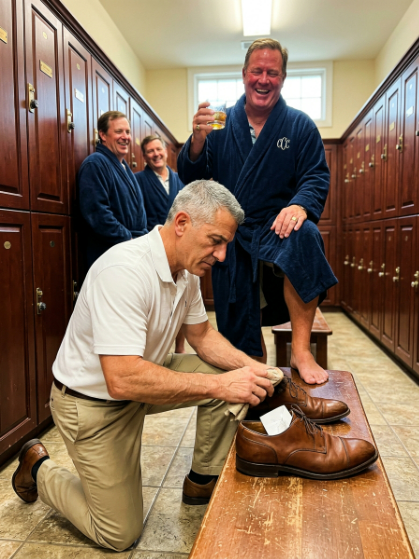
It was a Tuesday. Slow afternoon. Hodges had come in from eighteen holes, peeled off his shoes, and left them on the bench for me to shine while he steamed in the sauna and complained about his short game to whoever would listen. I picked up the left oxford the way I’d picked up a thousand of them, and I felt it — a stiffness under the tongue, where the leather shouldn’t have been stiff.
A folded slip of paper. Tucked there and forgotten, the way a careless man stuffs a receipt in the nearest pocket and never thinks of it again.
My hands knew what to do before my head caught up. Thirty years trains that into you. I didn’t unfold it fast. I didn’t look around. I worked it loose, opened it flat against my polishing cloth, and read it the way you read a confession.
A wire transfer. The date matched the foreclosure on Harold Whitfield’s property to the day. The receiving account ended in a string of digits that didn’t belong to any bank in this country.
I photographed it, front and back, behind the towel cart where the angle of the lockers hid me. Then I refolded it, slid it back under the tongue exactly as I’d found it, set the shoe down, and called out, “All set, Mr. Hodges,” when he came out of the sauna.
He grunted. He didn’t look at me. He never once looked at me.
That was the day I knew Dorothy had been right to wait.
The arrests came the following week. Wire fraud, conspiracy, a few things I’ll let the lawyers name. I won’t pretend it was quick after that — these things never are, when there’s enough money to fight. But the binder was clean. The recordings were clean. And the receipt in the shoe was the kind of small, stupid, arrogant mistake that closes cases.
The money came back. Most of it. The land Harold had loved — forty acres at the edge of the county that he’d dreamed of turning into something for people who had nothing — came back to Dorothy.
I’ll tell you something about Harold, though I never met the man. I got to know him the way a detective knows anyone — through what he left behind. Dorothy let me read his notebooks, all of them, not just the last entry with the three names. Harold Whitfield wrote things down the same way I did. Small observations. Who said what. Which handshake felt wrong. He’d suspected those three men for a year before they finished him. He just never got the chance to prove it.
In a strange way, I spent fourteen months finishing a case a dead man started. He’d done the hardest part — he’d noticed. He’d written it down. He’d trusted that someone, someday, would read it and act.
Dorothy was that someone. And she found me.
She didn’t sell it.
She built the thing Harold had drawn on a napkin years before. A community garden. Free plots for anyone who wanted to grow something. A greenhouse. Raised beds at wheelchair height. A little brass plaque by the gate that says, simply, “Harold’s place. Everyone’s welcome.”
I was there the day it opened. Dorothy made me cut the ribbon, which I argued about and lost.
And then I did the last thing I had to do.
I drove back to Crestwood Country Club, walked into the men’s locker room one final time, and set my key on the attendant’s counter.
The new fellow — young, nervous, didn’t know me from anyone — asked if I was a member.
“No, son,” I said. “I worked here. Two years.”
“What’d you do?”
I thought about that. About the towels and the shoes and the thousand things three rich men said over my bent back, certain I was too simple to understand a word of it.
“I listened,” I said.
He didn’t get it. That’s all right. He wasn’t supposed to.
People ask me sometimes why I took a job handing out towels at my age, after the career I’d had. Why I knelt on those tile floors and said “yes, sir” to men who tipped me a dollar and never once looked at my face.
I tell them about a woman in a navy dress who sat at my kitchen table and slid a folder toward me and said her husband had written three names before he died.
And I tell them what I told that nervous young attendant.
Gentlemen always talk too much when there’s a towel man in the room.
You just have to be patient enough to be the towel man.
I had thirty years of practice.
For Harold, I’d have done thirty more.