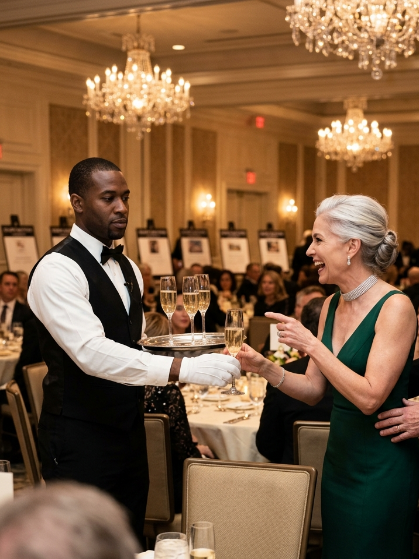
The story ran at six in the morning on a Tuesday.
By 6:15 my phone was a living thing, buzzing across the nightstand, refusing to stop. By seven, the Whitmore Foundation’s name was trending across the state. By eight, two of the donors I’d recorded laughing at Evelyn’s joke were releasing statements about how “deeply troubled” they were, as if they hadn’t been standing in the circle when she said it.
I’d spent four months as a waiter for this. I should have felt like I’d won.
I didn’t, exactly. But I’ll get to that.
The audio was the thing they couldn’t spin. You can argue with a reporter. You can call a story a smear, a hit piece, fake news, whatever the word of the week is. But you cannot argue with Evelyn Whitmore’s own voice, crisp and proud, telling a circle of Atlanta’s wealthiest people that the housing fund “kept it all in the family.”
Three nights of it. Time-stamped. Authenticated.
The Foundation tried, that first morning, the way they always try. A spokesman called my story “the work of a disgruntled individual misrepresenting overheard remarks.” I almost laughed. Disgruntled. As if I’d been passed over for a promotion to head waiter.
Then my editor posted the audio.
The spokesman stopped returning calls by lunch.
Within a week, the state attorney general opened an investigation. Within a month, the Whitmore Foundation was dissolved, its assets frozen pending review. Richard Whitmore’s development company — the one the “community housing fund” had been quietly feeding — was served with subpoenas that would keep its lawyers busy for years. Evelyn herself was charged with wire fraud and a string of counts I won’t pretend to have memorized.
The families. That’s what mattered. The actual point of all of it. Money that had been promised to people who needed homes, and stolen by people who already had three — some of it, not all of it, but some of it, was going to find its way back to where it was supposed to go.
I’d done what I set out to do.
So here is the part nobody warns you about.
The morning the story ran, I was a journalist who’d broken a major case. By the end of that month, I was a man no one would seat.
It started small. The catering company I’d worked for — my cover, the one that had no idea who I really was — put out a statement distancing themselves from me, then quietly told every other catering company in the city what I’d done. Within those circles, I wasn’t the reporter who exposed a fraud. I was the man who came into your event under a false name and recorded your guests.
It didn’t matter that the guests were confessing to crimes. It mattered that I’d been staff, and I’d listened.
The galas closed to me first. Then the sources. The kind of people who used to slip me a tip about a shady deal stopped picking up, because if Nate Cross could spend four months pouring champagne to catch Evelyn Whitmore, who was to say he wasn’t sitting in their kitchen right now?
I’d made the powerful people of an entire city afraid of their own waitstaff. They were not going to forgive me for it.
Other reporters were careful around me too. A few admired the work, said so privately. But admiration is a quiet thing, and distance is loud. At the press events, I started to notice the half-step people took to not be photographed beside me. The way a room rearranges itself around someone it has decided is radioactive.
There was one source in particular — a man I’d trusted for years, who’d fed me three good stories and a dozen dead ends, the way real sources do. I called him two weeks after the Whitmore piece ran. He let it go to voicemail. I called again. The third time, he picked up, and before I could say anything he said, very quietly, “Nate, I can’t be the guy who talks to you anymore. You understand. It’s nothing personal.”
It was entirely personal. That’s what he didn’t understand. Everything about this work is personal. You just spend years pretending it isn’t so you can sleep.
I sat in my kitchen that night with the lights off and ran the math the way you do at two in the morning. Four months of my life. A career’s worth of contacts, gone. An apartment that used to have people in it.
And on the other side of the ledger: a fund that would feed families, and a woman who would answer for what she did.
I told myself the ledger balanced. Most nights I even believed it.
I’d been the only one willing to do it. And being the only one, it turns out, is a lonely address.
There was a press conference the day Evelyn was formally charged. I stood at the back. I’d earned a seat at the front, but I’d learned by then where I belonged in these rooms. The attorney general thanked “members of the press” in general and named no one, which was its own kind of answer.
When it ended, I gathered my coat and got ready to go home to an apartment that had gotten very quiet.
That’s when a young woman caught up with me at the door.
She couldn’t have been more than twenty-three. A press lanyard from one of the small online outlets, the kind that doesn’t pay much and runs on people who still believe the work matters. Her hands were shaking a little.
“Mr. Cross?” she said. “I read your piece. I read it about forty times, honestly. I’ve been trying to figure out how you did it — not the undercover part, the other part. How you stood there and smiled and poured wine while she said those things, and didn’t break.”
“Practice,” I said. It came out more tired than I meant it. “And four months of folding napkins.”
She nodded like that was a real answer, then she looked at me very directly.
“Everyone in there is being careful around you,” she said. “I’ve been watching it all morning. They think you’re going to burn them too.” She swallowed. “I think you did the most important thing any of us has done all year, and you’re standing by the door alone. So I wanted to ask if I could buy you a coffee. And maybe — if you’d be willing — if you’d teach me how to do what you do.”
I looked at this kid who’d noticed the one thing the whole room was working very hard not to notice.
That the man who’d been right was standing alone.
And I thought about the version of me, fifteen years ago, who’d needed exactly one person to walk across a room and act like the work was worth doing.
“It’s a hard way to live,” I told her. “People will be afraid of you. You’ll be right, and it still won’t always feel like enough.”
“I know,” she said. “I still want to learn.”
I bought the coffee. We sat by the window, and I started talking.
People ask me, sometimes, if it was worth it. The four months. The blacklist. The quiet apartment.
I think about the families getting their fund back. I think about Evelyn Whitmore’s voice playing on a loop the morning the city finally heard her clearly.
And I think about a kid with a cheap lanyard and shaking hands, crossing a room everyone else had emptied around me, to ask the only question that mattered.
I was the only one willing to do it.
I’m trying very hard, now, to make sure I’m not the last.