The $28 Million Divorce Deal That Hid a Dangerous Family Secret
PART 3 (FULL STORY)
Sloane’s phone rang again.
She stared at it without answering.
Grant stood halfway between her and me, his face stripped of the confidence he had carried into the room. Eleanor was demanding answers from the attorney, while Conrad kept repeating that the laboratory report had to be wrong.
I said nothing.
Sloane finally rejected the call.
Three seconds later, someone knocked on the conference-room door.
Everyone turned.
A man in a dark suit stepped inside.
He wasn’t a Whitmore employee. I knew that immediately. He carried a slim leather case and looked directly at Sloane.
“Ms. Pierce,” he said, “we need to talk.”
Sloane’s face lost what little color remained.
Grant looked at her.
“Who is he?”
The man ignored him.
“I represent Dr. Adrian Vale.”
That name meant nothing to Conrad.
It meant everything to Sloane.
She whispered, “You weren’t supposed to come here.”
The lawyer placed the case on the table.
“I’m afraid circumstances changed.”
Grant looked between them.
“Someone tell me what is happening.”
I finally unlocked my phone and turned the screen toward him.
The DNA report showed exactly what I had already known.
Probability of paternity: 0%.
Grant stared at the number.
He read it again.
Then again.
His lips parted, but no words came.
Eleanor snatched the phone from his hand.
“No.”
She looked at the report as if refusing to understand could change the result.
“No. These tests can be manipulated.”
“They can,” I said. “That’s why I used an independent laboratory, sealed samples, and a chain-of-custody process.”
The attorney looked at me sharply.
“You had this done before today?”
“Yes.”
“How did you obtain the samples?”
I looked at Grant.
“While he was still wearing the wedding ring he promised me meant something.”
Grant closed his eyes.
He remembered.
Ten weeks earlier, at Lake Geneva, he had fallen asleep beside me after telling me he didn’t want to lose me.
The next morning, while he showered, he left his toothbrush beside the sink.
I had taken it.
At the time, I hadn’t known what I was going to do with it.
I only knew something inside me had stopped trusting him.
The report had given me the answer.
But it hadn’t given me the whole story.
Sloane suddenly spoke.
“The test is wrong.”
Her voice was barely audible.
Grant looked at her.
“Then tell me who the father is.”
She didn’t answer.
“Tell me.”
She looked at the lawyer.
He gave her a small, warning shake of his head.
That was when Grant understood there was more.
He stepped closer to her.
“You know him.”
Sloane backed away.
“Grant, please.”
“Who is he?”
Conrad slammed his palm against the table.
“This is a Whitmore matter. Whoever that man is, he has no place in this room.”
The lawyer opened his case.
“He does, actually.”
He removed a document and placed it in front of Conrad.
“This concerns the Whitmore family trust.”
Conrad stared at the page.
His expression changed.
“What is this?”
“A provision established twenty-six years ago.”
The lawyer pointed to a signature.
“Your late father created a succession clause stating that if a Whitmore heir was born outside the family line and falsely presented as a biological descendant, control of certain trust assets could be challenged.”
Eleanor looked at him.
“That clause was never supposed to matter.”
“Correct,” he said. “Until now.”
Grant looked at Sloane.
“You knew?”
She began crying.
Not dramatically.
Not loudly.
She simply covered her face with both hands.
“I didn’t know about the trust.”
“But you knew the babies weren’t mine.”
She lowered her hands.
“Yes.”
The word landed harder than anything else in the room.
Grant stepped backward.
“How long?”
Sloane swallowed.
“From the beginning.”
Eleanor stood.
“You lied to my son?”
Sloane laughed once through her tears.
“You think this was about him?”
Nobody moved.
She looked at Conrad.
Then at Eleanor.
Then at Grant.
“You all wanted an heir so badly that nobody cared where the story came from.”
Conrad’s face hardened.
“Who is the father?”
The door opened again.
This time, I knew the man who entered.
Adrian Vale.
I had met him once before.
Not socially.
Professionally.
He had been the genetic specialist who reviewed the preliminary results before the private laboratory finalized the report.
He walked straight to Sloane.
“You should have told them yourself.”
She looked down.
“I was afraid.”
“Of what?”
She glanced at Conrad.
“Of them.”
Nobody asked who she meant.
The answer was obvious.
Adrian placed another envelope on the table.
“The twins are mine.”
Grant stared at him.
Then he looked at Sloane.
“How?”
Sloane wiped her face.
“Before Grant and I became involved, Adrian and I were together.”
Grant laughed bitterly.
“You were together?”
“Yes.”
“And then?”
“My relationship with Adrian ended.”
She paused.
“Then I met Grant.”
I looked at her.
“And you became pregnant.”
She nodded.
“At first, I didn’t know who the father was.”
Adrian interrupted.
“I did.”
Everyone turned toward him.
“I had already undergone genetic testing before Sloane came to Chicago.”
He looked at Grant.
“She contacted me after she learned she was carrying twins.”
Grant’s face tightened.
“Why didn’t she tell me?”
Adrian answered before she could.
“Because she wanted the Whitmore name.”
Sloane shook her head.
“I wanted security.”
“You wanted both,” Adrian said quietly.
She didn’t deny it.
That was enough.
For eight years, I had believed the hardest part of my marriage was losing the children I had never managed to carry.
I had blamed my body.
I had blamed myself.
There had been nights when I lay awake wondering what was wrong with me while Grant slept beside me.
But now I understood something I hadn’t allowed myself to see.
Grant had stopped holding my hand long before Sloane appeared.
He had simply needed someone to blame for the emptiness he already felt.
Conrad finally looked at the divorce agreement.
“You signed it.”
“Yes.”
He frowned.
“You agreed to complete separation from future Whitmore family matters.”
“I did.”
The attorney slowly understood.
“Claire…”
I looked at him.
“Read the clause again.”
He did.
His eyes moved across the page.
Then he stopped.
“The agreement says she cannot make claims against Whitmore Holdings.”
“Correct.”
“And she cannot interfere with future Whitmore family matters.”
“Correct.”
“But it doesn’t prevent the company from being affected by facts that become public independently.”
I smiled.
“That was the point.”
Grant stared at me.
“You knew.”
“I knew enough.”
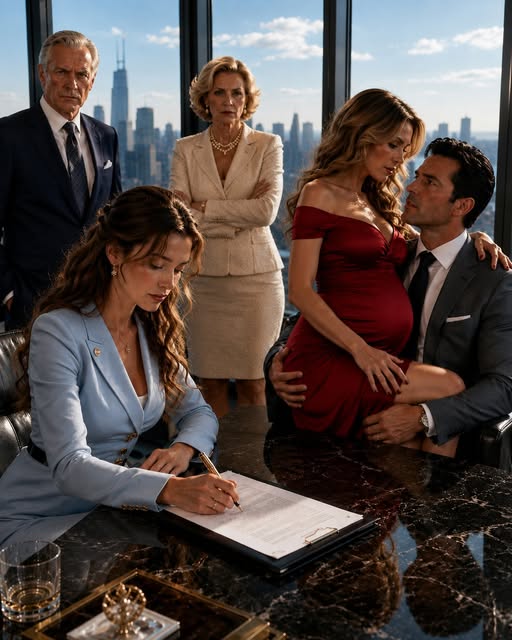
He looked at the gold pen lying beside the signed contract.
“You wanted the money.”
“Yes.”
“You planned this.”
“No.”
That answer surprised him.
“I planned to leave with my dignity,” I said. “The truth simply arrived before I did.”
The room stayed quiet.
Grant lowered himself into his chair.
For the first time since I had known him, he looked like a man who had no idea what to buy his way out of something.
Eleanor approached me.
“You could have told us before you signed.”
“I could have.”
“Why didn’t you?”
I picked up my purse.
“Because you spent eight years teaching me that my voice didn’t matter.”
Her expression shifted.
I continued.
“You offered me twenty-eight million dollars to disappear.”
I glanced at the signed agreement.
“So I decided to become very good at disappearing.”
Grant stood.
“Claire.”
I stopped at the door.
He looked older than he had an hour earlier.
“Are you marrying someone else?”
I looked at the message still waiting on my phone.
The wedding planner had written:
Venue confirmed. Saturday at four. He says he’ll be there early.
I thought about the man who had waited for me without demanding that I prove my worth.
“Yes.”
Grant swallowed.
“Do you love him?”
I didn’t answer immediately.
Then I said, “He never made me earn it.”
I walked out.
Three weeks later, the Whitmore family appeared in the news.
The divorce became public despite their attempts to keep it private.
The paternity dispute followed.
Whitmore Holdings denied wrongdoing, but the trust investigation exposed years of internal conflict over succession.
Conrad stepped away from several board responsibilities.
Eleanor stopped appearing at company events.
Grant remained CEO, but his position became far less secure.
Sloane moved out of Chicago.
Adrian filed for legal recognition of the twins as his children.
There was no glamorous revenge.
No public spectacle where I stood smiling while everyone begged for forgiveness.
Life was quieter than that.
The Charleston house was mine.
So was the Boston condo.
The twenty-eight million dollars arrived exactly as promised.
And for the first time in years, money didn’t feel like compensation for what I had lost.
It felt like a door.
I used part of it to establish a foundation supporting women undergoing fertility treatment.
I didn’t name it after myself.
I didn’t want my name on another building.
I wanted the money to do something useful.
The rest I invested carefully and left alone.
On Saturday afternoon, I stood in a small garden outside Chicago.
No ballroom.
No reporters.
No Whitmore family crest hanging over the entrance.
Just trees, white chairs, and the sound of wind moving through the leaves.
The man I had been planning to marry stood waiting near the aisle.
He wasn’t a billionaire.
He wasn’t interested in bloodlines.
And when he took my hand, he didn’t ask what I could give him.
He simply held it.
After the ceremony, I returned to the hotel room alone for a moment.
On the table was the same gold pen I had used to sign my divorce.
I had kept it.
Not because it reminded me of Grant.
It reminded me of the woman who had sat forty-eight floors above Chicago and realized she didn’t need to beg anyone to stay.
I picked up the pen, placed it inside a small wooden box, and closed the lid.
Then I opened the window.
Lake Michigan stretched beyond the buildings, silver beneath the afternoon light.
For eight years, I had thought signing my name meant the end of my life.
That afternoon, I finally understood what it had really been.
A beginning.