The Blue Envelope That Revealed My Family’s Buried Son
PART 3 (FULL STORY)
I stared at the second page until the words began to blur.
My brother.
The word sounded wrong in my head.
Nathan Keane had been a name I associated with whispered arguments, locked doors, and my father’s sudden anger. He had never been introduced to me as family. He had never appeared in the photographs hanging through my grandfather’s house. As far as I knew, he had simply been a young man who worked for the Whitmores and eventually left after some kind of disagreement.
But the document in my hands said something else.
My grandfather had acknowledged Nathan as his son.
Not publicly.
Not in the family records.
But legally.
I looked at Raymond.
“What happened four years ago?”
He pulled out the chair beside the kitchen table but didn’t sit.
“Your grandfather discovered the truth when Nathan was twenty-six,” he said. “He had already spent years believing his father was a man named Thomas Keane.”
“And he wasn’t?”
“No.”
Raymond glanced at Marissa.
“Your grandfather had an affair before he married your grandmother. Nathan’s mother was a young woman who worked at one of the Whitmore properties. When she became pregnant, your grandfather paid for her to leave Massachusetts. He promised to provide for the child quietly.”
I looked down at the document.
“Then why was Nathan treated like a stranger?”
“Because your father found out.”
My jaw tightened.
“My father knew Nathan was his half-brother?”
Raymond nodded.
“And he hated the idea of sharing the Whitmore estate.”
Marissa spoke quietly from across the table.
“Nathan never wanted to take anything from your family.”
I turned toward her.
“Then what did he want?”
She swallowed.
“His name.”
That answer hurt more than I expected.
Raymond explained that Nathan had approached my grandfather four years earlier, not demanding money, but asking him to acknowledge the truth before he died. My grandfather agreed. He prepared the blue envelope himself, including the legal acknowledgment, a letter, and instructions concerning a small trust he had created for Nathan.
But before the documents could be made public, my father discovered them.
“He told your grandfather that acknowledging Nathan would destroy the family,” Raymond said.
“And my grandfather agreed?”
“No.”
The answer came immediately.
“He refused.”
I looked at the signature on the bottom of the page.
My grandfather’s.
Then I looked at my father’s signature beneath the date.
“What did my father sign?”
Raymond took the document from me and turned it over.
“It was an agreement concerning the trust.”
My father had signed away control of it.
Not ownership.
Control.
The money had been placed beyond the family’s reach, with Nathan named as the sole beneficiary.
I sat down.
For four years, I had believed Nathan had tried to steal something from us.
He hadn’t.
Something had been kept from him.
“What happened to him?” I asked.
Marissa looked toward the window.
“He died two years ago.”
The room seemed smaller.
“How?”
“A truck accident.”
I closed my eyes.
There was no dramatic explanation.
No hidden murder.
No conspiracy.
Just a man who had spent his life carrying a truth nobody wanted him to have, then died before his family could publicly acknowledge him.
“What did he leave you?”
Marissa looked at the blue envelope.
“Instructions.”
She explained that Nathan had told her never to use the trust for herself unless she had absolutely no other choice. He had wanted it reserved for Owen.
“He said Owen should grow up knowing where he came from,” she said.
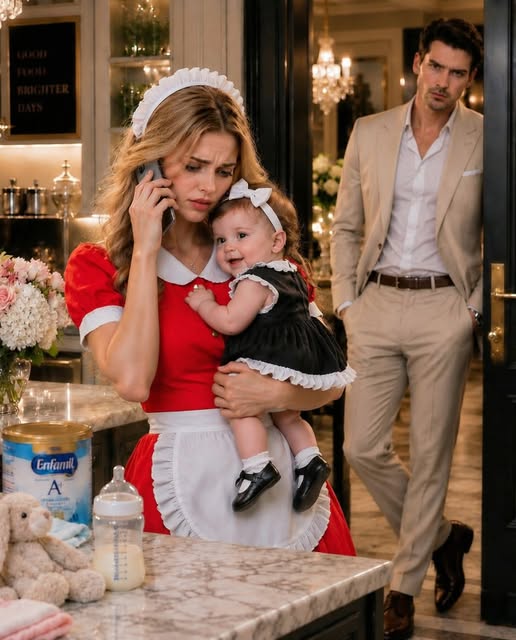
My eyes moved to the baby’s formula sitting beside the sink.
Twenty-eight dollars.
That was all she had needed that morning.
And she had been afraid to ask anyone.
I felt something inside me shift.
All my life, I had thought wealth made problems disappear.
For Marissa, twenty-eight dollars had become a private crisis.
For Nathan, a fortune had existed on paper while the only thing he truly wanted—recognition—had been withheld.
I looked at Raymond.
“Does my father know Marissa has this?”
“No.”
“Does he know the trust still exists?”
“He believes Nathan abandoned his claim.”
“Why?”
“Because that is what your father wanted everyone to believe.”
Marissa reached into the envelope again.
“There is another letter.”
She handed it to me.
The handwriting was unfamiliar but steady.
Nathan had written it shortly before his death.
He didn’t accuse my father.
He didn’t curse the Whitmore name.
He simply explained that he wanted Owen to know his grandfather’s name one day.
At the bottom, he had written one sentence.
I don’t need Adrian to give my son money. I need him to make sure Owen never has to wonder whether his father belonged anywhere.
I read it twice.
Then I folded the letter carefully.
“Marissa,” I said, “you shouldn’t have to choose between formula and groceries.”
She immediately shook her head.
“I didn’t come here for money.”
“I know.”
That mattered.
I wasn’t going to insult her by pretending this was charity.
“The trust belongs to Owen,” I said. “That doesn’t change. But until it can be properly transferred and managed, I’ll make sure your basic expenses aren’t crushing you.”
She looked uncomfortable.
“I can work.”
“I know you can.”
I paused.
“I also know you shouldn’t have to prove that by struggling.”
For the first time that evening, she looked directly at me.
“What are you going to do about Nathan?”
I didn’t answer immediately.
The easy thing would have been to keep the envelope hidden.
My father was still alive.
The Whitmore name still carried weight.
A public acknowledgment could create lawsuits, arguments, questions about my grandfather’s estate, and a family scandal that would reach every business newspaper in Boston.
But none of that changed what was written on the paper.
Nathan was my brother.
Owen was my nephew.
And for four years, I had benefited from a lie without even knowing it was a lie.
The next morning, I went to my father’s house.
He was in the library when I walked in.
He looked up from his newspaper.
“You’re early.”
I placed a copy of the acknowledgment on his desk.
His expression changed before he even read it.
“You found it.”
It was the first time I understood just how much he had known.
“You knew.”
He folded the newspaper.
“Adrian, this is family business.”
“Nathan was family.”
“He was a complication.”
“No.”
I kept my voice level.
“He was your brother.”
My father stood.
“You don’t understand what your grandfather was doing. He was going to divide everything.”
“He didn’t.”
My father stared at me.
“He protected Nathan’s trust.”
“He was going to ruin this family.”
I shook my head.
“You’re still talking about money.”
My father looked away.
“He had a right to the truth.”
“He had a right to nothing.”
The words landed between us.
I realized then that my father’s anger had never really been about Nathan.
It had been about losing control.
I placed the blue envelope on the desk.
“You kept this from him.”
My father stared at the Whitmore crest.
For the first time, he looked old.
“I thought if he disappeared, the matter would end.”
“It didn’t.”
“No.”
He sat down slowly.
“What are you going to do?”
I thought of Marissa standing in that small apartment with an almost-empty container of formula.
I thought of Nathan writing that his son should never wonder where he belonged.
“I’m going to tell the truth.”
My father closed his eyes.
“You’ll damage the family.”
“Then the damage was already there.”
A month later, the estate attorney formally recognized Nathan’s claim.
The trust was transferred into a protected account for Owen, with Marissa overseeing his care and an independent trustee handling the investments.
There was no grand press conference.
No dramatic family gathering.
Just paperwork, signatures, and a quiet correction to records that should have been corrected years earlier.
Nathan Keane was entered into the Whitmore family history.
His name appeared beside my grandfather’s.
Not hidden.
Not explained away.
Just there.
I also changed the way Marissa was employed.
She stopped working full-time in my house and took a position managing household operations for one of my charitable foundations, with regular hours and benefits.
She accepted only after I made it clear that the job was hers because she was qualified.
She never asked me for a favor again.
She didn’t need to.
Months later, I visited her apartment with Owen’s first birthday present.
It wasn’t expensive.
It was a wooden box.
Inside was a photograph of Nathan that Raymond had found among my grandfather’s private papers.
Marissa held it for a long time.
Then she placed it beside Owen’s crib.
“He would have loved seeing this,” she said.
I nodded.
On the wall above the crib was a small framed copy of the document that had started everything.
Not the financial section.
Not the trust.
Just the line acknowledging Nathan as my grandfather’s son.
Owen was too young to understand it.
Someday, he would.
Before I left, Marissa walked me to the door.
“Adrian?”
I turned.
“Thank you for that twenty-eight dollars.”
I smiled.
“I never actually gave you twenty-eight dollars.”
She laughed softly.
“No.”
She pointed toward the kitchen.
“You left three cans of formula, groceries for a week, and enough cash to cover the electric bill.”
I shrugged.
“I wasn’t very good at doing things quietly.”
“You were.”
She looked at me.
“You just weren’t very good at admitting you cared.”
I didn’t know what to say to that.
So I nodded and stepped into the hallway.
Behind me, I heard Owen laugh.
The sound followed me down the stairs.
Four years earlier, my family had tried to erase a name.
That rainy Tuesday, I had only gone looking for a way to help a woman who needed twenty-eight dollars.
Instead, I found my brother.
And for the first time, the Whitmore family crest didn’t feel like something we owned.
It felt like something we finally had a responsibility to live up to.