The Daughter My Mother Was Told Had Lost Her Father
PART 3 (FULL STORY)
Mom looked at Ethan.
For the first time that night, Ethan looked afraid.
I noticed it immediately.
Until that moment, he had looked irritated, embarrassed, even bored by the whole situation.
Now he looked like a boy who had just realized a secret was much bigger than he had expected.
The police officer stepped farther into the room.
“Mr. and Mrs. Coleman, I need to ask you both some questions,” he said. “Your daughter was found outside in dangerous weather. She says she was forced out of the house after being accused of stealing eight hundred dollars.”
Dad looked at me.
“Claire, this is not the time for—”
“It is,” the officer interrupted. “Because if someone deliberately put a fourteen-year-old outside during a winter storm, that matters.”
Nobody answered.
Daniel was still holding the photograph.
He looked at my mother.
“Her name was Claire,” he said quietly. “You promised me you would tell her.”
Mom wiped her face.
“I thought you were dead.”
“You knew I wasn’t.”
“No,” she whispered. “I knew what they told me.”
Dad stared at her.
“Who told you?”
Mom looked at him.
And that was when I understood something.
My parents had not simply been shocked to see Daniel.
They were afraid of what his existence meant.
Daniel pulled a chair closer to my bed and sat down.
“I met your mother when we were young,” he said to me. “Before Richard. Before this house. Before any of this.”
I watched him carefully.
“Are you my father?”
He didn’t answer immediately.
Mom did.
“Yes.”
The word barely came out.
Everything inside me seemed to go quiet.
I looked at Daniel again.
He had the same dark eyes I had seen every morning in my own face.
I had spent fourteen years believing Richard Coleman was my father.
Suddenly, I didn’t know what was real.
Dad turned toward Mom.
“You told me he died.”
“I was told he died.”
“You married me after that.”
“Yes.”
“And Claire was already born.”
Mom nodded.
Dad’s face hardened.
“So you knew.”
“I knew she was Daniel’s daughter.”
Daniel leaned forward.
“I left Pennsylvania before Claire was born because I was threatened.”
My mother looked at him.
“I was twenty-two,” she said. “I didn’t know what to do.”
Daniel explained that he had been working construction at the time.
He had witnessed something he should not have seen involving a local businessman and several men who were moving stolen equipment through a warehouse.
When Daniel threatened to report it, he was attacked.
He survived.
But before he could return home, he was told that his mother and his pregnant girlfriend would be harmed if he came back.
He disappeared instead.
A few months later, someone sent my mother a report saying Daniel had died in a warehouse fire.
She believed it.
Or at least, she believed enough of it to stop looking.
Years passed.
Richard came into her life.
He knew she had a child.
He knew I was not his biological daughter.
But according to Mom, he had promised to raise me as his own.
For most of my childhood, I had never questioned it.
Richard was simply Dad.
Daniel reached into his coat again.
This time he pulled out several folded papers.
“I spent years trying to find you,” he said.
Mom looked at the papers.
“Why didn’t you contact us?”
“I tried.”
She stared at him.
Daniel’s voice became quieter.
“I came back once when Claire was six. I saw you outside the school.”
Mom covered her mouth.
“You were there?”
“Yes.”
“Why didn’t you come to me?”
“Because Richard was standing beside you.”
Dad stepped forward.
“You watched us?”
“I watched from across the street.”
His eyes dropped to the floor.
“I saw Claire run toward you and call you Dad.”
Nobody spoke.
“I thought she was safe,” Daniel continued. “So I left.”
Something about that sentence hurt more than I expected.
Not because he had left.
Because he had been close enough to see me and still believed disappearing was the safest thing he could do.
The officer cleared his throat.
“I understand this is a family matter, but we still have the theft.”
His attention shifted to Ethan.
“Your father says the money was in a locked drawer.”
Ethan swallowed.
“I don’t know anything about it.”
“You told your parents Claire stole it.”
“I saw her upstairs.”
“Did you see her take the money?”
Ethan looked at Dad.
“No.”
“Then why did you say she did?”
Ethan didn’t answer.
Dad’s voice rose.
“Ethan.”
My brother finally looked at me.
“I didn’t think they’d actually throw you out.”
The room changed.
Mom stared at him.
“What did you do?”
Ethan’s eyes filled with tears.
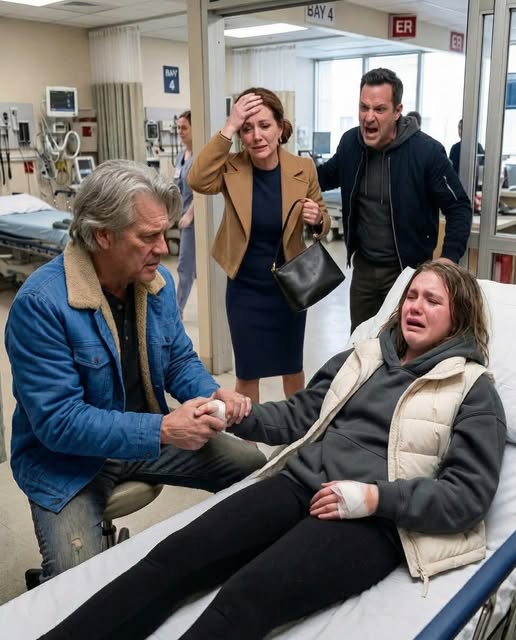
“I took the money.”
Dad closed his eyes.
“Why?”
“I needed it.”
“For what?”
Ethan hesitated.
Then he reached into his pocket and pulled out a receipt.
He had used part of the money to pay a debt to an older boy who had been threatening him.
He was afraid.
He thought if Dad believed I had stolen it, Ethan could replace the money before anyone discovered the truth.
He had expected me to be grounded.
Maybe yelled at.
Maybe punished.
He had never imagined Dad would actually put me outside.
I looked at him.
“You knew it was freezing.”
“I know.”
“You saw me leave.”
His face crumpled.
“I thought Dad would bring you back.”
That was the part I could not forgive.
Not the lie.
Not even the money.
He had watched me walk into the snow and trusted someone else to care enough to stop it.
Dad sat down heavily.
For the first time, he looked less angry than broken.
The officer took Ethan’s statement and told my parents that the situation would be documented.
He also made it clear that because I was a minor, child welfare authorities would be involved in determining where I could safely stay.
Mom immediately said I would come home.
I shook my head.
“No.”
She looked at me.
“Claire—”
“I don’t want to go back tonight.”
Daniel’s hand rested on the edge of the bed.
He didn’t touch me.
He waited.
That mattered.
The nurse came in a few minutes later and told me I needed to rest.
Mom stayed near the door.
Dad stood beside her.
Ethan sat alone in the hallway.
Daniel remained beside my bed.
I looked at him.
“Why did you help me?”
He gave a tired smile.
“Because you were fourteen years old and freezing beside a gas station.”
“That’s all?”
He looked at me for a long moment.
“No.”
He reached into his wallet and removed an old photograph.
It was the same photograph he had shown Mom.
But this one was different.
On the back was a date.
My birthday.
Under it were the words:
“For our daughter, when she is old enough to know the truth.”
“I carried this for twenty years,” he said.
I stared at the handwriting.
It was my mother’s.
I looked toward her.
She nodded through her tears.
“I wrote it before you were born.”
Daniel placed the photograph in my hand.
“I never stopped looking for you.”
I didn’t know what to say.
So I held the photograph.
For the first time in my life, I was holding something that belonged to the story of my birth instead of the story my family had told me.
The next morning, everything became official.
Social services arranged for me to stay temporarily with a licensed family friend while they investigated the circumstances surrounding my being put outside.
Daniel gave them every document he had.
He also gave them the name of the investigator who had originally told my mother he was dead.
That opened a much older case.
The warehouse fire had never actually produced a confirmed body.
Daniel’s death had been based on an identification made from personal belongings.
The report had been wrong.
And someone had wanted it to be wrong.
Over the following weeks, Daniel and I met several times.
At first, we talked about ordinary things.
What music I liked.
What subjects I hated at school.
Why I always left books open facedown.
He remembered small things about my mother.
I told him things about myself he had never known.
Neither of us pretended fourteen lost years could disappear in a few conversations.
They couldn’t.
But we started building something new.
Mom visited me regularly.
I let her sit with me.
I listened.
Sometimes I forgave her for one thing.
Sometimes I couldn’t.
She never demanded that I forgive her faster.
Dad was different.
He wanted everything to go back to normal.
He apologized for believing Ethan.
He apologized for sending me outside.
But every time he said he had made a mistake, I remembered his exact words.
I won’t feed a thief.
Those words had been said to a fourteen-year-old girl wearing thin sneakers in a snowstorm.
An apology could not erase them.
Eventually, Dad admitted something else.
He had always known Daniel might still be alive.
Years earlier, he had found an old letter addressed to Mom.
He had never shown it to her.
He had been afraid Daniel would come back and take away the family he had built.
That confession changed the way I saw him.
Not because it made him a monster.
It made him human in a way that was harder to accept.
He had been afraid.
And instead of facing that fear, he had built a lie around it.
Ethan had done something similar.
He had been afraid of the consequences of his own mistake.
So he pushed the blame onto me.
Fear had shaped almost every terrible decision in that house.
But I was the one who had ended up outside in the snow.
Months later, the investigation into Daniel’s disappearance was reopened.
The people connected to the old warehouse case were questioned.
Daniel finally learned what had happened to the evidence from twenty years earlier.
None of it brought back the years he had lost.
None of it returned my childhood.
But the truth was no longer buried.
I never moved back into the house with Dad.
I stayed with my temporary guardians until a longer arrangement was made.
Eventually, I spent more time with Daniel.
He rented a small house not far from town.
The first time I visited, he had cleared a shelf for me.
There were no childhood photographs because he didn’t have any.
Instead, he left the shelf empty.
“You can put whatever you want there,” he told me.
So I did.
The first thing I placed on it was the photograph from the hospital.
Not the picture of Daniel and Mom.
The other one.
The picture of me sitting beneath a hospital blanket with Daniel holding my hand.
I kept it because that was the first moment I knew the truth about where I came from.
It was also the first moment someone had found me when I was cold, frightened, and completely alone.
Years later, I still remembered the January night.
I remembered the locked drawer.
The accusation.
The jacket hitting my hands.
The front door closing behind me.
And I remembered the headlights appearing through the snow.
Daniel never called himself my hero.
I never called him that either.
He was simply the man who stopped.
That distinction mattered to me.
Because my story wasn’t really about the eight hundred dollars.
It wasn’t even about discovering who my biological father was.
It was about what happened when the people who were supposed to protect me decided I wasn’t worth believing.
And what happened when a stranger did.
Ethan eventually apologized.
I accepted the apology without pretending the damage had vanished.
Mom and I slowly rebuilt a relationship.
Dad took longer.
Some wounds became scars.
Some remained tender.
But I stopped waiting for my family to give me permission to decide who I was.
I knew.
I was Claire.
I was fourteen on the night everything broke.
I was the girl who walked into a snowstorm because nobody believed her.
And I was also the girl who survived it.
Years later, when winter returned, Daniel and I stood outside his house after the first snowfall.
He looked at the sky.
“Cold enough for you?”
I laughed.
“Not even close.”
He smiled.
We went inside.
On the shelf near the window sat the old photograph.
The edges had become worn from being handled so often.
I turned it over one last time.
The faded blue handwriting was still there.
For our daughter, when she is old enough to know the truth.
I put the photograph back exactly where it belonged.
Then I closed the door against the cold.
This time, I was the one choosing to go inside.