The Billionaire I Cried On at JFK Was About to Become My Boss
PART 3 (FULL STORY)
“What happened to you at the airport?”
For a moment, I considered pretending I didn’t understand the question.
There were six people around the conference table, all of them watching me.
The woman beside Preston—no, not Preston, I had to remind myself—was a senior partner named Rachel Monroe, according to the nameplate in front of her.
A young man from finance had stopped taking notes.
Even the assistant standing near the door looked uncomfortable.
I looked directly at Adrian Sterling.
So that was his first name.
I had spent three days knowing him only as Mr. Sterling, the mysterious stranger whose suit I had ruined at JFK.
Now I knew he was the founder and CEO of Sterling Capital.
“I got a breakup message,” I said.
His expression didn’t change.
“From your boyfriend?”
“Yes.”
“Three years?”
I nodded.
“How did you know that?”
His eyes lowered briefly to the red notebook.
“I didn’t.”
I frowned.
“Then why ask?”
“Because you looked like someone who had just had something taken away from her.”
The answer was so quiet that nobody else seemed to know what to do with it.
I closed my folder.
“My personal life isn’t relevant to the presentation.”
“No,” he said. “It isn’t.”
He leaned back.
“That’s why I’m asking.”
I stared at him.
Something about that answer unsettled me more than a personal question should have.
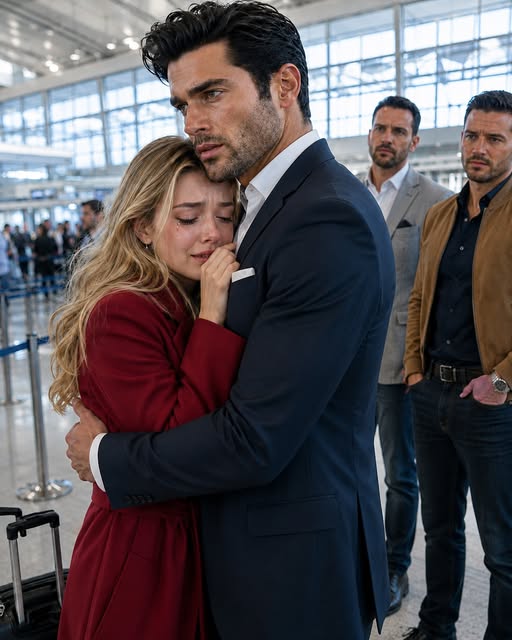
At JFK, his embrace had felt strange.
Not inappropriate.
Not romantic.
Just deeply familiar in a way I couldn’t explain.
Now I wondered if I had imagined that moment because I had been too upset to think clearly.
Rachel glanced between us.
“Should we continue with the interview?”
Adrian nodded.
“Yes.”
The presentation resumed.
I talked about Sterling Capital’s regional expansion strategy, its outdated client segmentation, and the opportunity I saw in smaller institutional investors who were being ignored by larger firms.
Adrian challenged nearly every assumption.
I pushed back on several of his objections.
At one point, Rachel actually smiled.
When I finished, Adrian closed the folder.
“You disagree with me often.”
“I disagree when I think you’re wrong.”
A silence followed.
Then he smiled.
“That’s useful.”
The meeting ended twenty minutes later.
Rachel walked me toward the elevators.
“You did well.”
“Thank you.”
She hesitated.
“You really didn’t know who he was at JFK?”
I laughed once.
“No.”
She shook her head.
“I’m not sure whether that makes you incredibly brave or completely unaware.”
“Probably the second one.”
The elevator doors opened.
Before I stepped inside, Rachel said, “If you get the job, you’ll report directly to him for the first six months.”
I stopped.
“I’m sorry?”
She gave me a sympathetic look.
“You heard me.”
The doors closed.
I stood alone in the elevator, staring at my reflection.
My mascara was no longer running.
My hair was neat.
My suit was pressed.
I looked like a professional woman who belonged in Boston’s financial district.
Not the woman who had grabbed a stranger by the lapel three days earlier and begged him to hold her.
My phone buzzed.
For half a second, I thought it was Preston.
It wasn’t.
It was an email from Sterling Capital.
Thank you for your time today.
Please return tomorrow at nine.
I read it twice.
Then I noticed the final line.
Mr. Sterling would like to speak with you privately.
I almost laughed.
Of course he did.
The next morning, I arrived ten minutes early.
His assistant led me to a smaller office overlooking the Charles River.
Adrian stood by the window.
He turned when I entered.
“Close the door.”
I did.
He pointed to the chair.
“Sit.”
I sat.
He remained standing.
“I owe you an apology.”
That was the last thing I expected.
“For what?”
“For asking about something personal during your interview.”
I shrugged.
“It’s fine.”
“No.”
He walked to his desk.
“It wasn’t.”
He picked up the red notebook.
My eyes went straight to it.
“You’ve had that since JFK.”
“Yes.”
“Why?”
He was silent for a moment.
Then he opened it.
Inside were pages of handwritten notes.
Names.
Dates.
Numbers.
At the top of one page was a sentence.
I need to stop pretending everything is fine.
I looked away.
“I shouldn’t be reading that.”
“You already saw it.”
“I saw the cover.”
He closed the notebook.
“My father died two months ago.”
I looked at him.
“I’m sorry.”
“He built this company.”
Adrian’s voice remained controlled.
“He expected me to take over everything.”
“And you didn’t want to?”
“I wanted to.”
He looked toward the window.
“I just didn’t know what it would cost.”
Something in his voice reminded me of the airport.
That desperate grip.
That strange moment when the billionaire in the perfect black suit had held me as if he needed the embrace as badly as I did.
“You were upset that morning too,” I said.
His eyes returned to mine.
“Yes.”
“Why?”
“My father’s memorial was that afternoon.”
I went still.
The airport hadn’t been random.
He had been on his way to something.
Something he hadn’t wanted to face.
“I’m sorry,” I said again.
He nodded.
“I knew I was supposed to be composed.”
“You were.”
“I wasn’t.”
“You were with me.”
A faint smile touched his mouth.
“You were crying on me.”
“That is true.”
“And you told me I was terrible at hugging.”
“You were.”
He actually laughed.
It was brief, but real.
Then the expression disappeared.
“I almost asked you to stay.”
My smile faded.
“At the airport?”
“Yes.”
“Why?”
“Because for the first time in months, someone touched me without wanting something from me.”
I didn’t know how to respond.
Adrian looked embarrassed by his own honesty.
“I’m not asking you to explain your breakup,” he said. “And I’m not asking you to forgive me for bringing it up.”
“Then why tell me?”
“Because if you take this job, I don’t want you wondering whether I hired you because of what happened at JFK.”
My answer came quickly.
“I wondered.”
He nodded.
“You earned the position before I knew your name.”
I stared at him.
“What?”
“Your proposal.”
He slid my presentation across the desk.
“I read it the night before the interview.”
“You already knew?”
“Yes.”
“And you still interviewed me?”
“I wanted to see whether the person who wrote it could defend it.”
I felt something loosen in my chest.
“So I got the job?”
“You did.”
I exhaled.
“Thank you.”
He stood.
“There is one condition.”
Of course there was.
“What condition?”
“No special treatment.”
“I wouldn’t want any.”
“And no pretending we’re strangers.”
I looked at him.
“That might be difficult.”
“Why?”
“Because three days ago, I cried all over your jacket.”
His mouth curved.
“I remember.”
I covered my face with one hand.
“I really hope you don’t.”
“I do.”
That was when my phone rang.
Preston.
I stared at the screen.
Adrian noticed.
“You don’t have to answer.”
“I know.”
The phone stopped.
A second later, a text appeared.
Can we talk?
I turned the screen face down.
“No.”
Adrian didn’t ask anything else.
I started working at Sterling Capital the following Monday.
The first two weeks were exhausting.
Adrian was demanding, but he was fair.
He corrected my work without humiliating me.
He disagreed without raising his voice.
He expected everyone in the room to be prepared, including himself.
And slowly, something strange happened.
I stopped seeing him as the billionaire whose shoulder I had cried on.
He became Adrian.
The man who drank black coffee and forgot to eat lunch when he was buried in numbers.
The man who kept his father’s old fountain pen in the top drawer of his desk.
The man who hated crowded restaurants but loved quiet diners.
The man who never talked about his mother.
The man who sometimes opened the red notebook and stared at one page for several minutes before closing it again.
I also stopped thinking about Preston as often.
Until one Thursday evening, he showed up outside the office.
I saw him through the glass doors.
My entire body went cold.
He was holding a small cardboard box.
When I walked outside, he stood.
“Eve.”
“What are you doing here?”
“I brought your things.”
“You could have mailed them.”
“I wanted to see you.”
“You already said goodbye.”
He looked tired.
“I made a mistake.”
“No.”
“I was angry.”
“You ended three years of our relationship in forty seconds.”
“I know.”
“You told me to have a good trip.”
His jaw tightened.
“I didn’t mean it like that.”
“You said exactly what you meant.”
He looked toward the building.
“Is this why?”
“Why what?”
“Why you got this job?”
I stared at him.
“What does that mean?”
“I heard about Sterling.”
I understood then.
Someone had told him.
Maybe a mutual friend.
Maybe LinkedIn.
Maybe he had searched my name.
“You think I got hired because I cried on the CEO?”
His expression shifted.
“I didn’t say that.”
“You didn’t have to.”
He stepped closer.
“Eve, I was wrong.”
I looked at the box in his hands.
“Then take responsibility for being wrong.”
“I’m trying.”
“No.”
I shook my head.
“You’re trying to make me feel better about your decision.”
His face fell.
For the first time, he looked like the man who had once loved me.
And that was exactly why I knew I had to leave.
“I hope you find what you want,” I said.
Then I walked back inside.
Adrian was standing near the reception desk.
I stopped.
He had seen everything.
“I’m fine,” I said.
“I didn’t ask.”
“I know.”
He nodded toward the elevators.
“Come on.”
We went upstairs without speaking.
That evening, I stayed late.
Around eight, Adrian appeared beside my desk.
“Still working?”
“I have a deadline.”
“So do I.”
He looked at my screen.
“You’ve been staring at the same spreadsheet for ten minutes.”
I sighed.
“Bad day.”
He pulled a chair over.
“Want coffee?”
I looked at him.
“Is this another terrible hug situation?”
His smile appeared.
“Coffee first.”
We went downstairs.
For the first time, we sat across from each other without discussing work.
The city lights reflected in the window.
“I used to think being successful meant never needing anyone,” he said.
“And now?”
“Now I think it means knowing who you can trust when you do.”
I looked down at my cup.
“Do you trust me?”
“Yes.”
The answer came without hesitation.
That scared me.
Not because I didn’t trust him.
Because I was beginning to realize how much I wanted him to trust me.
Months passed.
Nothing happened between us.
Not officially.
There were no secret meetings.
No stolen kisses.
No inappropriate messages.
There were simply small moments.
He remembered how I took my coffee.
I remembered his father’s birthday.
He asked whether I had eaten.
I asked whether he had slept.
We became friends before either of us admitted it.
Then one night, after a difficult board meeting, Adrian asked me to walk with him.
We left the office and crossed the quiet street.
“You know what I remember most about JFK?” he asked.
I laughed.
“My terrible crying?”
“No.”
“My mascara?”
“No.”
“My handkerchief?”
“You never returned it.”
I looked at him.
“What?”
He smiled.
“I kept it.”
I stared.
“You kept the handkerchief?”
“Yes.”
“That is deeply strange.”
“I know.”
“Why?”
He stopped walking.
“Because that was the first time in years I felt like someone saw me as a person.”
My smile disappeared.
He looked nervous.
For the first time since I had met him, Adrian Sterling looked genuinely unsure.
“I don’t want to make your life complicated,” he said.
“You’re my boss.”
“I know.”
“You’re also the man whose jacket I ruined.”
“I remember.”
“And I’m still recovering from a three-year relationship.”
“I know.”
“So what are you saying?”
He took a breath.
“I’m saying I would like to take you to dinner.”
I looked at him for a long moment.
“Not as my employee?”
“Not as my employee.”
I smiled.
“Then you should probably start with a restaurant where I’m not allowed to cry on your suit.”
He laughed.
“I’ll find one.”
Our first date was quiet.
Our second was easier.
By the third, I stopped wondering whether I was making a mistake.
But I never forgot Preston.
Not because I wanted him back.
Because he had taught me something I needed to understand.
Sometimes the person who leaves you creates the space for someone else to see you clearly.
A year after the airport, I returned to JFK.
I was traveling to Boston for a conference.
Adrian was coming with me.
At Terminal 4, we stopped near the same check-in area where I had once stood with tears on my face.
He looked around.
“This is where it happened?”
I nodded.
“Right there.”
“You grabbed me here.”
“Yes.”
“You cried here.”
“Yes.”
“You insulted my hugging.”
“You were terrible.”
He laughed.
Then he reached into his coat pocket.
I frowned.
“What?”
He pulled out a folded white handkerchief.
The same one from that morning.
I stared at it.
“You kept it all this time?”
“Yes.”
“Why?”
He stepped closer.
“Because I didn’t know your story that day.”
He held it out to me.
“But I knew I wanted to remember the moment.”
I took it carefully.
The fabric was still white, though the edges were worn.
I looked at him.
“I don’t think I ever thanked you properly.”
“You did.”
“No.”
I shook my head.
“You let me borrow your shoulder when I thought my life was over.”
He smiled.
“And now?”
I looked through the terminal windows at the planes waiting beyond the glass.
“Now I think it was just changing.”
His hand found mine.
No cameras.
No assistants.
No security team.
No conference room.
Just us.
I folded the handkerchief and slipped it into my bag.
Then I took his hand and walked toward the gate.
The first time I had left JFK, I believed I was flying away from the future I had planned.
I didn’t know that a stranger in a black suit would be waiting at the end of that heartbreak.
And I certainly didn’t know that one desperate request—just one second of being held—would become the beginning of a life I never could have planned for myself.