The Tiny Padlock Grandma Said Was Medical Was Never From The Clinic
PART 3 (FULL STORY)
The note had been written the same morning the chain mark appeared.
Dr. Mercer read it twice before setting the paper down. “This says the child reported that her brace was painful, and that an adult was present during the conversation.”
Dad looked at me. “Why didn’t you tell the nurse?”
I wanted to say I had. I wanted to say I had tried. But at ten, I had already learned that telling the truth and being believed were two different things.
“I did,” I said.
Grandma moved toward me.
Dr. Mercer raised one hand. “Please don’t.”
She stopped.
That was the first time I had ever seen an adult stop her.
Dad looked at the chain again. “Mom, where did this come from?”
Grandma folded her arms. “I bought it.”
The answer was so ordinary that for a moment nobody spoke.
“You bought it?” Dad asked.
“It was necessary.”
“Then why did you tell me the clinic gave it to you?”
She looked at him as though he had asked the wrong question.
“Because you wouldn’t have understood.”
Dad’s face tightened.
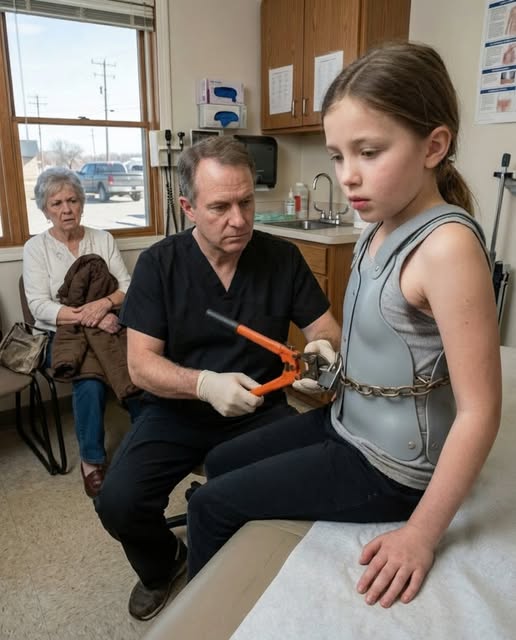
Dr. Mercer picked up the brace and examined the damaged plastic. “This brace may have been medically prescribed, but the lock was not part of the prescription.”
Grandma said nothing.
“And if you’ve been fastening a child into this for months,” he continued, “we need to know exactly why.”
“She wandered,” Grandma said.
“Once,” I whispered.
Grandma looked at me.
I immediately wished I had stayed quiet.
Dad heard me.
“Once?”
Grandma sighed. “You weren’t there.”
“I’m asking her.”
I looked at Dad.
“I went to the mailbox.”
“You ran?”
I shook my head.
“I walked.”
“Why?”
“The flag was up.”
Dad stared at me.
I could see the memory forming in his face, piece by piece, and I knew he was remembering all the evenings Grandma had called him after work.
She had told him I was becoming difficult.
She had told him I slipped away whenever she looked down.
She had told him I needed the brace because she could not risk another accident.
She had never told him about the mailbox.
Grandma reached for her purse.
Dad stepped between us.
“Don’t.”
Her hand stopped.
Dr. Mercer asked the receptionist to bring the school nurse into the room if she was still available.
She was.
When the nurse entered, she looked at me first, then at the chain sitting on the table.
Her expression became serious.
“I wrote this note because she told me the brace hurt,” she said.
Grandma immediately answered, “She told you it didn’t.”
The nurse shook her head. “She told me no when I asked if it hurt. But then I noticed the mark.”
Dad looked at me.
“Why would you say no?”
I stared at my hands.
“Because Grandma was there.”
The words were quiet.
They were also the clearest thing I had said all day.
Nobody corrected me.
The nurse continued. “I asked her to come back after lunch so I could look at the skin. She never came.”
Grandma said, “Because she had class.”
The nurse looked at her. “No. Because you came to the office and said you were taking her home.”
Dad closed his eyes.
I watched his hands.
They were still dusty from work.
The same pale sawdust remained caught in the cuff of his shirt.
He opened his eyes and turned toward his mother.
“Why?”
Grandma’s voice dropped.
“Because you were working all the time.”
Dad stared at her.
“You thought I was working too much, so you locked my daughter into a brace?”
“I thought you were ignoring what was happening.”
“What was happening?”
“She was becoming uncontrollable.”
I looked down.
Grandma continued.
“You weren’t home. I was the one who had to deal with her.”
Dad’s voice became quieter. “Deal with her?”
Grandma did not answer.
Dr. Mercer stepped in before the argument could become louder.
“This needs to stop being a family disagreement,” he said. “The child has an injury. The locking device was not medically prescribed. There are statements from the school nurse that raise additional concerns. I’m documenting everything.”
Grandma suddenly looked frightened.
Not guilty.
Frightened.
That distinction stayed with me.
Dad asked what would happen next.
Dr. Mercer said he would make the appropriate report and arrange for me to be examined properly.
Grandma shook her head.
“You don’t understand what she’s like at home.”
Dad looked at her.
“I think I understand enough.”
The examination took nearly an hour.
The brace had irritated the skin beneath my arm, and Dr. Mercer said I would need time without it so the injury could heal.
He also asked me questions Grandma could not answer for me.
Could I walk?
Yes.
Could I run?
Yes.
Had I ever fallen because of my legs?
No.
Had anyone told me I needed to be restrained?
No.
When he asked what I was most afraid of, I looked toward the open window.
The fly was still there.
It tapped against the screen.
“I’m afraid of getting in trouble.”
Dr. Mercer did not write immediately.
“What kind of trouble?”
I swallowed.
“When I tell Dad something Grandma doesn’t like, she says he’ll be angry with me.”
Dad looked away.
That hurt more than I expected.
Not because he was angry.
Because he wasn’t.
He looked ashamed.
After the clinic contacted the appropriate authorities, Grandma was not allowed to take me home alone.
The next weeks were messy.
There were interviews.
There were questions I had to answer more than once.
There were adults who spoke gently and adults who spoke too carefully.
There were forms.
There were meetings.
There were nights when Dad sat outside my bedroom because he was afraid to leave me alone, even though nobody had asked him to.
One evening, I found him sitting on the floor with his back against the hallway wall.
“You can go to bed,” I told him.
“I know.”
He didn’t move.
“Why are you sitting there?”
He rubbed his hands together.
“I keep thinking about every time you asked me something and I was too tired to listen.”
I didn’t know what to say.
So I sat beside him.
After a while, he said, “I believed my mother because I thought she knew how to take care of you.”
I looked at the carpet.
“She said you were difficult.”
Dad nodded.
“I know.”
“I wasn’t.”
“No.”
His answer came quickly.
“You weren’t.”
That mattered.
Not enough to erase anything.
But it mattered.
Grandma eventually moved out of the house while the investigation continued.
I did not see her for several months.
When I finally did, it was in a room with another adult present.
She looked smaller than I remembered.
She asked whether I was still wearing the brace.
“No.”
“Does your back hurt?”
“Sometimes.”
She nodded.
Then she asked whether I missed her.
I thought about the folded coat in the clinic.
The crackers.
The chain.
The little padlock.
“No,” I said.
She looked down.
For once, she didn’t argue.
Years later, I would understand that was probably the closest thing to an apology she was capable of giving.
The investigation found no medical reason for the lock.
The clinic confirmed that nobody there had ever supplied one.
Dad kept the medical records.
I never kept the chain.
Dr. Mercer threw it away after documenting it, and I was glad.
I didn’t want a souvenir.
I wanted the thing it represented to disappear.
But one detail from that morning stayed with me.
The crackers.
Grandma had handed me four small crackers while we waited for Dad.
At the time, I thought she was being kind.
Later, I understood how strange that moment was.
She had spent months telling everyone I couldn’t be trusted.
She had called me difficult.
She had told Dad I wandered.
She had locked a brace around my body and then acted as though the lock itself were protecting me.
And still, when the truth began to come apart, she handed me food.
Maybe she wanted to feel like the good grandmother.
Maybe she simply didn’t know what else to do.
I never asked.
Some questions don’t need answers to become clear.
Years after the clinic, I found myself standing beside a rural mailbox with a red flag still raised.
I was older then.
Old enough to drive.
Old enough to leave.
Old enough to understand that the road had never been the thing I was afraid of.
I reached out and lifted the flag.
It clicked softly against the metal box.
For a second, I thought about the little padlock.
Then I let the flag fall.
The sound was small.
Ordinary.
And this time, nobody came running after me.