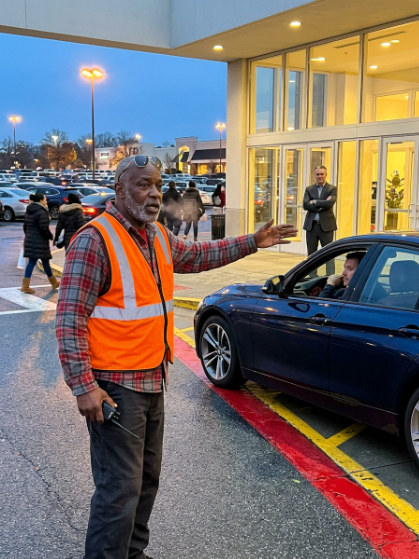
Trent’s face went through four colors in three seconds. Red to white to gray to something I don’t have a name for — the color a man turns when he realizes he’s been building a house of cards inside someone else’s building.
“You — you can’t—” he sputtered.
“I can,” I said. “I own the building you’re standing in front of. I own the parking lot under your feet. I own the tow company that just removed a board member’s vehicle from a fire lane. And I own every document that proves you’ve been skimming revenue from the valet operation for twenty-three months.”
I reached into the pocket of my flannel shirt — the one under the orange vest — and pulled out a folded sheet of paper. Handed it to him.
“That’s a summary,” I said. “Dates. Amounts. The name of the valet supervisor who’s been splitting the take with you. My attorney has the full file — six months of documentation, surveillance footage from three cameras I had installed in the valet booth area, and bank records obtained through a court order two weeks ago.”
Trent didn’t unfold the paper. He just held it. His hand was shaking.
“This isn’t — I don’t—” He looked around. Early shoppers were streaming past us. A few had stopped to watch. A woman with a stroller was recording on her phone. “You’re a parking attendant,” Trent said. Like saying it out loud would make it true again.
“I’m a lot of things,” I said. “Parking attendant is one of them. I like directing traffic. I like being outside. I like watching how people behave when they think nobody important is looking.” I zipped up my vest. “But I’ve been Jerome Pitts — sole owner of Pitts Properties LLC, which holds the deed to Lakewood Galleria and six other commercial properties in the Charlotte metro area — for the past nineteen years.”
I’d bought this mall in 2005. It was failing then — anchor store had pulled out, vacancy rate was sixty percent, parking lot full of potholes. I poured four million into renovations. Brought in new tenants. Fixed the infrastructure. Turned it into the highest-traffic retail center on Independence Boulevard.
Then I hired a management company to run the day-to-day operations. Stepped back. Let other people handle the spreadsheets and the staffing and the holiday promotions.
The first GM was fine. Competent. Honest. He retired in 2020.
Trent Huxley was his replacement.
And from the first month, something felt wrong.
The numbers were slightly off. Not enough to trigger an audit — just enough to make me pay attention. Valet revenue was down twelve percent year-over-year despite increased foot traffic. Vendor pop-up fees weren’t matching the contracts I’d signed. And the maintenance budget was being redirected to “consultants” who didn’t seem to exist.
I could have sent in auditors. Could have hired investigators. Could have fired Trent from a boardroom and never set foot on the property.
But that’s not how I work.
I’ve always believed you learn more about a building by standing in its parking lot than by reading its balance sheet. You learn who cuts corners. Who treats staff well. Who takes shortcuts. Who thinks the rules don’t apply to them.
So three years ago, I put on an orange vest and started directing traffic.
Nobody recognized me. Why would they? The deed was held through an LLC. My name wasn’t on any public signage. The last photo of me in any business publication was from 2009, when I had a full head of black hair and weighed thirty pounds less.
I showed up every Saturday. Then every Friday and Saturday. Then every major shopping event — Black Friday, back-to-school, holiday weekends. I directed traffic, I observed, and I documented.
I watched Trent accept envelopes from the valet supervisor. I watched him reassign security staff away from the valet area during peak hours — creating gaps in coverage that allowed the skim to happen undetected. I watched him fire the head of security for asking questions.
I watched him watch me through the glass doors. Laughing.
“Just let Jerome wave his arms.”
Six months of documentation. Every interaction logged. Every amount estimated based on envelope thickness, frequency, and cross-referenced with the revenue shortfalls in the quarterly reports.
And now it was done.
“You’re terminated,” I said to Trent. “Effective immediately. Security will escort you to your office to collect personal items. Your final paycheck will reflect salary through today. No severance.”
Trent’s jaw clenched. He looked at the paper in his hand. At the tow truck driving away with the BMW. At the shoppers watching. At me.
“This is insane,” he said. “You can’t prove—”
“The court order already confirmed the bank records, Trent. The footage is timestamped. The valet supervisor has agreed to cooperate in exchange for a reduced civil penalty.” I paused. “You can call your attorney. I recommend you do.”
He turned. Walked toward the mall entrance. Pushed through the glass doors without looking back.
I watched him go.
Then I picked up my radio.
“All stations,” I said. “This is base. Normal operations. Pitts out.”
The morning continued. Cars arrived. Shoppers streamed past. The sun came up over the roof of the Galleria and the frost melted off the fire lane curb where the BMW had been parked.
I directed traffic until noon. Then I walked inside, bought a coffee from the food court, and sat on a bench near the fountain.
A woman approached me — one of the shoppers who’d been watching.
“Excuse me,” she said. “Are you — did you really—”
“I’m just the parking guy,” I said. Smiled. Sipped my coffee.
She laughed. “Right,” she said. “Sure.”
The following Monday I met with the new GM candidate — a woman named Sharon Oaks, forty-six, formerly the operations director at SouthPark Mall. Smart. Thorough. The kind of person who checks every line item and treats custodial staff the same as executives.
I also implemented three changes effective immediately: full reimbursement to every shopper who’d been wrongly ticketed in the past two years, a new traffic management system designed by a civil engineer I’d consulted over the summer, and a complete restructure of the valet operation with transparent revenue reporting.
Total cost of Trent’s theft over twenty-three months: approximately three hundred and forty thousand dollars. Total cost of my three years in an orange vest: zero dollars and four hundred Saturday mornings.
Worth every one.
The following Saturday, I was back in the parking lot. Six AM. Orange vest. Flannel shirt. Silver beard catching the cold.
A woman in a minivan rolled down her window.
“Good morning,” she said. First person in three years.
“Good morning,” I said. “Row D has open spots near the entrance. Have a good one.”
She smiled and drove on.
I raised my arm. Directed the next car.
Same as always. Because that’s where I belong — on the ground, in the cold, watching the building I built do what it was always supposed to do.
Serve people. All of them. Even the ones in orange vests.
Especially the ones in orange vests.