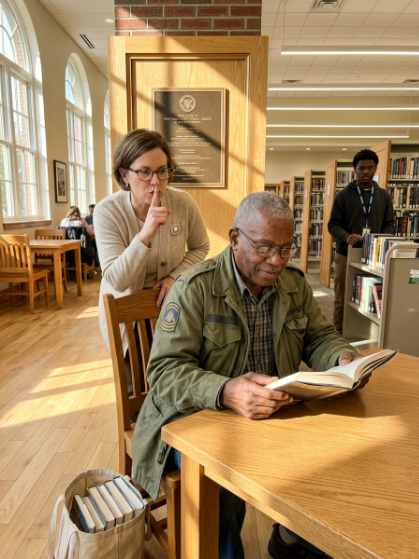
The gala was in the reading wing itself. The same room where Patricia Voss had shushed me a hundred times. The same oak tables where I’d sat with my mother’s memory every afternoon for three months. The same tall arched windows that let in the autumn light I loved most — except tonight they were dark, and the room was lit by string lights and candles and the warm amber glow of a sound system someone had set up near the circulation desk.
Sixty people. Folding chairs arranged in rows. A podium with a microphone. A banner that read WHITFIELD COUNTY LIBRARY — DONOR APPRECIATION GALA 2024.
I arrived in my army jacket. Same patched olive jacket I always wear. Canvas tote over my shoulder — empty tonight, no books. I’d considered wearing something else. A suit, maybe. Something that would make me look like the kind of person who donates four-point-two million dollars to a public library.
But that’s not who I am. That’s never who I’ve been.
I’m the man in the patched jacket with the tote bag. I’m the man who sits at the third table from the window. I’m Clarence Moody — Dorothy Moody’s son.
And tonight, everyone was going to know that.
I sat in the back row. Patricia was near the front — horn-rimmed glasses, cardigan, pearl brooch at her collar, the whole uniform of authority she wears like armor. She was chatting with the county commissioner and a woman from the Friends of the Library board. Laughing. Comfortable. Confident.
She had no idea.
Deshawn was there too. Standing along the wall near the book cart he usually pushes. Still in his aide lanyard. He caught my eye when I sat down. Gave me a small nod. That kid — seventeen years old and he notices everything. He’s the only one in this building who ever watched me touch that plaque and wondered why.
The board chair — a man named Harold Vickers, sixty-three, bowtie, reading glasses on a chain much fancier than mine — took the podium at seven-fifteen.
“Good evening,” he said. “Thank you all for being here. Tonight we celebrate the generous donors who make this library possible — and in particular, we honor the anonymous benefactor whose extraordinary gift made the reading wing we’re sitting in tonight a reality.”
Polite applause. Patricia clapped loudest. She always does when the library gets praise — as if the praise belongs to her.
“For two years,” Harold continued, “this donor has remained anonymous. They asked for no recognition. No naming rights. No plaque with their name — only the small dedication in the foyer that reads: ‘This wing made possible by an anonymous gift from a grateful reader.'”
I felt my chest tighten. I thought of my mother. Dorothy Moody. Thirty years as a librarian in this building. Shelving books. Running story hour. Staying late to help high school students with their research papers. Making minimum wage and never complaining because she believed — truly believed — that a library was the most important building in any town.
She retired in 2008. Died in 2016. Alzheimer’s. Slow and cruel. By the end she didn’t recognize me. But she recognized books. She’d hold them in her hands — any book, it didn’t matter — and turn the pages with this expression of peace that nothing else in the world could give her.
I bought this wing for her. With money I made in forty years in the technology industry — starting as a cable technician in Dalton, Georgia in 1978, working my way through night school, eventually founding a networking company that I sold in 2011 for more than I ever imagined a kid from this town could make.
Nobody here knows that. Nobody here has ever looked at the man in the patched jacket and thought: he could have built this room.
That’s the point.
“Tonight,” Harold said, “our anonymous donor has agreed — for the first time — to identify themselves publicly. And I’m told they are in this room.”
The audience murmured. Heads turned. Eyes scanned the front rows — looking for someone in an expensive suit, someone with a foundation name badge, someone who looked like four-point-two million dollars.
They didn’t look at the back row.
Harold glanced at a note card in his hand. “When you’re ready,” he said to the room.
I stood up.
Sixty heads turned.
Patricia’s face — I’ll remember it for the rest of my life. The confusion first. Then the recognition. Then the slow, dawning understanding that the man she’d shushed, the man she’d called security on, the man she’d treated like a vagrant trespassing in his own building — was the reason the building existed.
I walked to the podium. My boots made no sound on the hardwood floor. The string lights caught the patches on my jacket. My canvas tote hung empty at my side.
I adjusted the microphone. Cleared my throat.
“My name is Clarence Moody,” I said. “I grew up six blocks from here. My mother, Dorothy Moody, was a librarian in this building for thirty years.”
The room was absolutely silent.
“When I was twelve years old, I couldn’t read. Not well. Not the way other kids could. I was slow. I was embarrassed. I sat in the back of every classroom and hoped nobody would call on me.” I paused. “One afternoon, my mother brought me here after her shift. She sat me down at a table — this table—” I pointed to the third one from the window. My table. “—and she put a book in my hands. A real book. Not a textbook. Not a worksheet. A novel. She said: ‘You’re not broken, Clarence. You just haven’t found the right story yet.'”
My voice caught. Just for a moment.
“She was right. I found the right story that day. And then another. And another. And by the time I was sixteen, I’d read every book in this building’s collection. Twice.”
I looked at Patricia. She was gripping the armrests of her folding chair.
“I built this wing because my mother believed that a library should welcome everyone. Not just the people who look like they belong. Not just the people with clean jackets and new shoes and the right kind of face.” I paused. “Everyone.”
I let that settle.
“I come here every day because this is where she worked. This is where she sat. This is where she changed my life. I wear this jacket because it was the last gift she recognized before the Alzheimer’s took everything else. And I carry this tote bag because she always said a person should never leave a library empty-handed.”
Deshawn was standing at the wall with tears running down his face. He didn’t wipe them.
“I’d like to acknowledge one person tonight,” I said. “Deshawn Carter. Seventeen years old. Library aide. The only person in this building who ever noticed me. Who ever watched me touch that plaque and wondered. Who ever treated me with simple, quiet kindness.”
I looked at Deshawn. “Son, come here.”
He walked forward. Slowly. The whole room watching.
“My education trust is establishing a full scholarship in Dorothy Moody’s name. Four-year university. Any field you choose. It’s yours if you want it.”
Deshawn’s hands were shaking. He nodded. Couldn’t speak. I put my hand on his shoulder.
Then I turned back to the room.
“That’s all I have to say. Thank you for listening. This wing belongs to everyone in Dalton. Just like my mother always wanted.”
I stepped away from the podium. The room erupted — applause, standing ovation, people rushing forward. Harold was shaking my hand. The county commissioner was saying something about a ceremony.
But I was watching Patricia.
She hadn’t stood. Hadn’t clapped. She was still sitting in her folding chair, hands in her lap, face completely blank.
Two days later, she was reassigned to the reference desk at the downtown branch. The board cited “leadership realignment.” They didn’t mention me. They didn’t have to.
The new head librarian started the following Monday. A woman named Maria Santos — forty-one, warm, spent ten years at the Atlanta Public Library. Her first act was to post a new sign at the entrance:
ALL ARE WELCOME. NO EXCEPTIONS.
I come every afternoon still. 2:30. Same table. Same jacket. Same tote bag full of books.
But now when I touch the plaque in the foyer, I don’t do it alone.
Deshawn touches it too. Every shift. Fingertips to the glass.
He doesn’t know why I started doing it. I never told him.
But he does it anyway.
That’s enough.