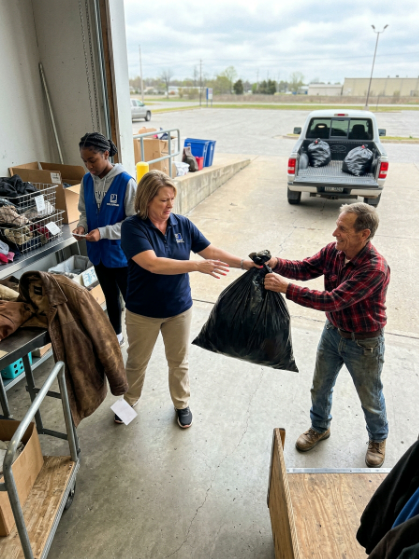
Walter Gaines walked toward the dock with his usual slow step. Same dented silver Ford Ranger in the lot behind him. Same black garbage bags. Same flannel shirt and work boots.
But this time he wasn’t heading for Brenda.
He was heading for me.
I stood up from the sorting table so fast I knocked a stack of folded jeans onto the concrete floor. My hands were shaking — the same way they’d been shaking since last Saturday when I found that appraisal certificate stitched into the lining of a leather jacket worth more than my grandmother’s house.
Walter stopped at the edge of the dock. Looked up at me. Smiled.
Not a polite smile. Not a sad smile. A knowing one. The kind that says I’ve been waiting for this exact moment and here it is.
“You found it,” he said.
It wasn’t a question.
“Yes, sir.” My voice came out smaller than I wanted. “The jacket. The certificate. Christie’s.”
He nodded. Set down the garbage bag he was carrying — gently, like it contained something precious, which I was now certain it did. He climbed the three concrete steps to the dock and stood in front of me. Up close, the sun-weathered lines in his face looked even deeper. His eyes were hazel, clear, sharp — not the eyes of a confused old man dropping off junk.
“Sit with me a minute,” he said.
We sat on the edge of the loading dock. Feet dangling. The parking lot stretched out in front of us — Brenda’s car in the staff spot, the dumpster where she’d thrown three of his coats two weeks ago, his truck with the tailgate still down.
“My name is Walter Gaines,” he said. “I was a fashion archivist for forty-one years. Started at the Met Costume Institute in 1978. Moved to a private collection in Dallas in ’92. Built my own archive by 2004 — twelve hundred pieces, spanning 1920 to 1985. Authenticated. Insured. Climate-controlled in a facility outside Tulsa that you’ve probably driven past a hundred times without knowing it was there.”
I stared at him. This wiry man in his flannel shirt and work boots. This man Brenda called “the sad old man.” This man whose donations she held at arm’s length like they were contaminated.
“The collection is worth — conservatively — fourteen million dollars,” he said. Matter-of-fact. Like he was telling me the weather.
I couldn’t speak.
“My wife Elaine passed in 2019,” he continued. “She was the only other person who understood what we’d built. After she died, I had a decision to make. What happens to the collection when I’m gone?”
He looked at me.
“I have no children. No family who cares about fashion history. No protege. Nobody trained to manage a collection this size, this specific, this important.” He paused. “So I designed a test.”
The certificate. The coats. The garbage bags.
“You’ve been testing people,” I said.
“For six months,” he confirmed. “Eleven donation centers across Oklahoma. Same protocol. Bags of coats from my collection — not the most valuable pieces, but significant ones. Each with an appraisal document sewn into the lining. Carefully stitched. Findable — but only if someone actually looks.”
“And nobody found them.”
“Eleven centers. Forty-three bags. Seventy-eight coats with certificates.” He smiled again. “You’re the first person who found one. The only person.”
My chest was tight. I thought about all the Saturday mornings. All the bags Brenda took at arm’s length and tossed onto the sorting pile without a second glance. The coats she threw directly into the dumpster because they “smelled old.” The ones she sent to the rag bin without checking a single pocket.
“Brenda threw three of your coats away,” I said. “Two Saturdays ago. I saw her do it.”
Walter nodded. “I know. I checked the dumpster that evening. Two of them had certificates inside. One was a 1958 Balenciaga evening coat — appraised at two hundred and twenty thousand.” His expression didn’t change. “She threw it in the trash.”
I felt sick.
“That’s why she fails the test,” Walter said simply. “Not because she missed the value. Because she didn’t care enough to look. She assumed that something old and worn had nothing left to offer.” He turned to face me fully. “You didn’t assume that.”
“My grandmother taught me,” I said. The words came out before I could stop them. “She always said — check every pocket. You never know what someone left behind in a coat they loved.”
Walter’s eyes softened. “Your grandmother sounds like she understood something most people don’t.”
We sat in silence for a moment. The morning traffic hummed on Riverside Drive. A bird landed on the sorting table behind us and pecked at a button that had fallen off a donated shirt.
“I’d like to offer you something,” Walter said. “Not charity. Not pity. A job.”
He reached into the breast pocket of his flannel shirt and pulled out a business card. Thick stock. Embossed. GAINES ARCHIVE — PRIVATE COLLECTION. An address in Broken Arrow. A phone number. And at the bottom: CURATOR APPRENTICE — POSITION OPEN.
“Full scholarship to the Fashion Institute of Technology in New York,” he said. “Four years. Tuition, housing, books, living expenses — all covered by my foundation. While you’re in school, you’ll work with my current archivist remotely. When you graduate, the apprenticeship begins in person. Three years. And at the end of those three years —” He paused. Looked out at the parking lot. At his dented truck. At the life he’d built that looked like nothing from the outside.
“At the end of those three years, you become the collection’s steward. Full curatorial authority. The Gaines Archive will be yours to manage, to grow, to protect.”
I was crying. I didn’t realize it until I felt the tears hit my volunteer vest.
“Mr. Gaines — I’m nineteen. I work at Goodwill. I’m a sophomore at community college. I can’t—”
“You can,” he said. “You already proved it. You paid attention when no one else did. You treated old things with respect. You found what was hidden because you took the time to look.” He set the business card in my hand. Closed my fingers around it gently. “That’s all curation is, Amara. Paying attention. Treating things with care. Finding what’s hidden.”
I looked at the card. Then at him. Then at the dock where Brenda was walking out of the back office, phone in hand, acrylic nails tapping the screen.
“What about her?” I asked.
Walter glanced at Brenda. Shrugged.
“She threw away a quarter-million-dollar coat without checking the pockets,” he said. “She failed the test. Not because she’s a bad person — but because she never once considered that something might be more than it appeared.”
He stood up. Dusted off his jeans.
“I’ll need to know your answer by next Saturday,” he said. “Take the week. Think about it. Talk to your grandmother — or to whoever you talk to when things feel too big.”
“My grandmother passed,” I said. “Two years ago.”
Walter stopped. Turned back. His face was different now — not sharp, not testing, just open. Sad. Understanding.
“Then talk to her anyway,” he said. “She’ll hear you.”
He walked back to his truck. Climbed in. Started the engine — it coughed twice before catching. Backed out of the spot with the tailgate still down, same as always.
I sat on the dock for another twenty minutes. The business card in my hand. The morning light warming the concrete.
I didn’t need a week.
I called the number on Monday.
Walter answered on the first ring.
“I’m in,” I said.
“I know,” he said. “I knew the moment you set that jacket aside instead of putting it in the bin.”
And that’s how it started. A garbage bag. A stitched envelope. A certificate hidden in a lining.
My grandmother was right. You never know what someone left behind in a coat they loved.
Sometimes it’s everything.