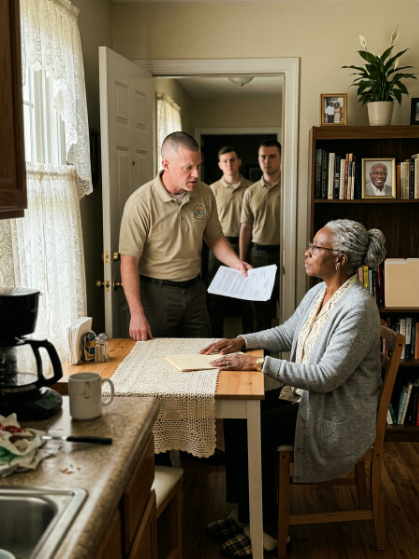
Derek’s hand was still holding the eviction papers when I opened the folder.
I didn’t rush. I didn’t fumble. I placed both hands flat on the manila cover, adjusted my reading glasses, and slid it open like I was reviewing a contract at my old firm — which, in a sense, I was.
“Have a seat, Mr. Platt,” I said again.
He was still standing in my doorway. The two men behind him — younger, same khaki polo uniform, same company logo embroidered on the chest — had gone quiet. One of them was holding a clipboard against his thigh like he’d forgotten it was there.
Derek laughed. Short. Nervous. The kind of laugh people use when they’re trying to reassert control of a situation that’s already slipping.
“Mrs. Okafor, I don’t have time to sit and look at—”
“Ms.,” I corrected. “And you’ll want to sit for this.”
Something in my voice — the voice I used in depositions for thirty-one years, the voice that made opposing counsel shift in their chairs — made Derek take one step forward. Then another. He pulled out the chair across from me at the kitchen table. Sat down. Set the eviction papers on my crocheted runner like they were a winning hand.
I turned the folder toward him.
“This is a note purchase agreement,” I said. “Executed six months ago between River Bend Capital LLC and First Tennessee Savings Bank.” I paused. Let him read the header. Let his eyes scan the document even though I knew he wouldn’t understand half of it. “First Tennessee held the mortgage note on this property — Cedar Hill Apartments, all sixty-four units — since 2019. Stonewall Holdings has been making monthly payments to that bank for four years.”
Derek’s jaw tightened. “Okay. And?”
“Six months ago, First Tennessee sold that note. The full principal balance. Two-point-three million dollars.” I tapped the signature line at the bottom of the page. “Purchased by River Bend Capital LLC.”
He stared at the signature. Then at me.
“I am the sole managing member of River Bend Capital,” I said. “I purchased the mortgage note on this building with funds from my retirement account and a portfolio I managed during my thirty-one years as a corporate attorney specializing in commercial real estate.”
The room went still.
Derek’s mouth opened. Closed. His hand moved toward the eviction papers on the table — reflexive, like he was going to grab them back.
“Let me make this plain,” I said. “You don’t own this building, Mr. Platt. Stonewall Holdings doesn’t own this building. You make payments on a note — and that note belongs to me. You owe me two-point-three million dollars in principal. Not the other way around.”
Behind him, one of the younger men whispered something. Derek didn’t turn around.
“That’s — that’s not—” He swallowed. “That’s not how it works. We’re the management company. We operate the property. The bank—”
“The bank sold the note,” I said calmly. “As is their right under Article 9 of the UCC. River Bend Capital is now the holder in due course. Your management agreement is with the note holder — which is me.” I folded my hands. “And as of this morning, I’m calling the note due.”
Derek’s face went gray.
“Due,” he repeated.
“Immediately. Full principal balance. Two-point-three million.”
He stood up. The chair scraped against my linoleum. “You can’t just — we have a payment schedule — there are protections—”
“Your payment schedule contains an acceleration clause,” I said. I’d written the clause myself — or rather, I’d ensured it remained in the original note when I purchased it. “Triggered by material breach of the management obligations outlined in Section 4.2. Specifically: failure to maintain habitable conditions in tenant units.”
I opened the second section of the folder. Photographs. Dated and timestamped. Fourteen units with mold damage. Seven with broken heating systems. Three with exposed wiring that violated county code. All documented over six months by a building inspector I’d hired privately.
“You’ve been collecting rent from sixty-four families,” I said, “while allowing this building to deteriorate. You’ve evicted fourteen tenants in eighteen months — most for amounts under two thousand dollars — while deferring maintenance that would have cost less than what you spent on your company’s holiday party.”
I set the inspection report on top of the photographs. Then the acceleration notice. Then the formal demand letter, already signed and notarized.
“This is your demand,” I said. “Two-point-three million. Thirty days. If you cannot pay — and we both know you cannot — I will foreclose on the note and take possession of the property.”
Derek’s hands were shaking. He looked at the stack of papers. Looked at me. Looked at the framed photo of my late husband Emeka on the bookshelf — the man who first told me about this building, who said it had good bones and bad management and that one day someone ought to do something about it.
I am doing something about it.
“However,” I said. I let the word hang. Derek’s eyes snapped back to mine. “I’m prepared to offer an alternative.”
He waited.
“A payment plan. Extended. Manageable for a company of your size.” I removed my glasses. Set them on the table. “On three conditions.”
He didn’t speak. Just stood there with his clipboard man and his measuring-tape man behind him, all three of them looking at a sixty-four-year-old woman in a gray cardigan and house slippers who had just dismantled their entire operation from a kitchen chair.
“One: every pending eviction at Cedar Hill is dropped immediately. All fourteen families who were removed in the past eighteen months will be offered their units back at the original rate — with a formal apology from your office.”
Derek’s mouth moved but no sound came out.
“Two: a maintenance schedule will be implemented within thirty days. Every code violation in this report will be corrected at Stonewall’s expense. I will have my inspector verify compliance monthly.”
He nodded. Barely.
“Three: you, personally, Mr. Platt, will no longer manage this property. I want a different representative assigned — someone who does not snap their fingers at tenants or serve eviction papers for twelve hundred dollars while their company defers forty thousand dollars in basic repairs.”
The sunlight through my lace curtains moved one more inch across the table. The peace lily on the bookshelf caught the light and seemed to glow.
Derek reached for the eviction papers he’d set on my table. Picked them up. Folded them in half. Put them in his back pocket.
“I’ll — I’ll need to call our attorney,” he said.
“You do that,” I said. “My number is on the demand letter. Your attorney can reach me anytime. I’ll be here.” I smiled. “I live here.”
He turned. Walked to the door. The two men in the hallway parted to let him through. One of them looked back at me — young, maybe twenty-five, wide-eyed — and mouthed something that looked like sorry.
I nodded to him. Closed the door gently.
Then I sat back down at my kitchen table. Poured myself a fresh cup of tea from the pot I’d brewed before they arrived. Chamomile. Emeka’s favorite.
I lifted the cup.
“We did it, baby,” I said to the photo on the shelf.
The peace lily swayed in the draft from the closed door. Just slightly. Just enough.
Three weeks later, the eviction notices came down. The repair crews arrived. A new property manager — a woman named Keisha, twenty-nine, respectful, looked me in the eye — introduced herself at the tenant meeting.
And on the first of the month, I paid my rent.
Twelve hundred dollars. On time. To myself.
Because that’s what you do when you own the building. You keep the lights on. You keep the people safe. And you pay what you owe — even when it’s to yourself.
Emeka would have laughed at that.
I laughed too.