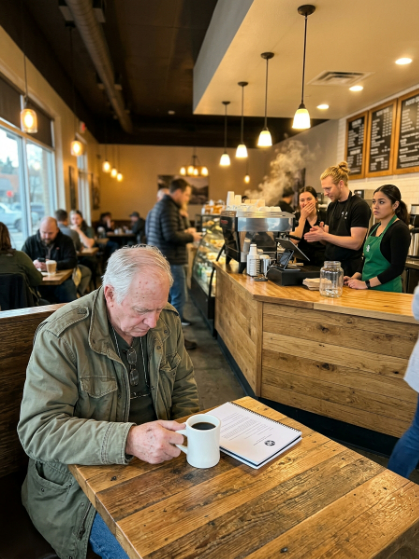
The man in the suit knelt beside booth three and said five words that made every sound in the café disappear.
“Mr. Dawson, the board approved your renovation plan.”
I was standing behind the register with a rag in my hand. Kyle was mid-sentence — something about the freeloader, something about dead weight, something cruel and careless that he’d said a hundred times before. But this time his voice just — stopped.
Everyone’s did.
Earl Dawson looked up from his untouched coffee. His reading glasses still hung on the chain around his neck. His liver-spotted hands rested on either side of the bound document he’d been reading — the one with our logo on the cover. The one I’d noticed three weeks ago and couldn’t stop thinking about.
The man kneeling beside the booth was wearing a navy suit and a tie that probably cost more than my entire closet. He had a leather briefcase on the floor and a tablet in his hand, and he was looking at Earl like Earl was the most important person in the state of Idaho.
“Thank you, David,” Earl said. His voice was quiet. Unhurried. The same voice he used to say “Thank you, young lady” to me every morning when I refilled his cup. “We’ll review the timeline this afternoon.”
David — whoever David was — stood, straightened his jacket, and walked out of the café without ordering anything. The bell above the door chimed. The morning traffic hummed outside.
And then it was just Earl in booth three with his black coffee and his document and the silence of eighteen people who had no idea what they’d just witnessed.
Kyle was the one who broke it.
“What the—” he started. But he didn’t finish. Because Earl was looking at him.
Not angrily. Not triumphantly. Just — looking. With those pale blue eyes that I’d described to my roommate as tired and sharp at the same time.
Earl stood up. Slowly. The way an old man stands — except there was nothing weak about it. He picked up the bound document from the table and held it against his chest.
“I’d like to speak to the shift lead,” he said. To the room. To no one in particular.
Kyle swallowed. His hand was still holding the rag he’d been using to mimic Earl’s trembling fingers thirty seconds ago.
“That’s — that’s me,” Kyle said.
Earl nodded. Walked to the counter. Set the document down face-up.
The cover was a financial prospectus. Glossy. Professional. And printed across the top in clean corporate type was: BREWED AWAKENING INC. — ACQUISITION REPORT. PREPARED FOR: EARL R. DAWSON, SOLE PROPRIETOR.
Kyle’s face went white.
“You bought —” he started.
“Forty-seven locations,” Earl said. “Fourteen months ago. Quiet acquisition through a holding company my wife and I established in 1982.” He paused. “Her name was Margaret. She passed six years ago. Pancreatic cancer.”
Nobody moved.
“We used to own a diner together,” Earl continued. “Small place. Twelve seats. Boise, over on State Street. It closed in 2004 when the strip mall went in. Margaret loved two things about that diner — the coffee and the people.”
He looked around the café. At the pendant lights and the reclaimed-wood tables and the espresso machine hissing in the background.
“When this chain came up for sale, I bought it because it reminded me of what she built. Same warmth. Same potential.” His eyes landed on Kyle. “But the people — that’s what I needed to evaluate.”
Kyle’s mouth opened and closed. Opened again.
“Mr. Dawson, I—”
“You posted a video of me online,” Earl said. Not a question. “You called me a freeloader in front of your staff. You encouraged others to laugh at an old man sitting quietly in a booth drinking coffee.” He paused. “My coffee. In my building. At my table.”
Kyle’s phone was in his apron pocket. You could see the shape of it. I wondered if he was thinking about the TikTok — 23,000 views, the one where he titled it “FREELOADER WON’T LEAVE BOOTH 3.”
“Your employment is terminated,” Earl said. “Effective now. Your final check will be mailed.”
Kyle didn’t argue. He untied his apron. Set it on the counter. Walked to the back to get his things. Nobody said a word to him.
Then Earl looked at me.
My heart was hammering so hard I could feel it in my fingertips. I was still holding the rag. Still standing behind the register in my green apron with my dark ponytail and my eleven-dollar-an-hour name tag.
“Jessa,” he said. My name. He knew my name.
“Yes, sir?”
“You refilled my cup every morning without being asked.”
“Yes, sir.”
“You never laughed.”
“No, sir.”
He nodded. Something shifted in his face — the sharpness softened, and what was underneath it was something old and sad and grateful all at once.
“Your grandmother’s name was Rosa Martinez. She worked at a diner on State Street in 1979. Small place. Twelve seats. She served my wife coffee every morning for three years.”
I felt the floor tilt.
“She used to bring my Margaret extra cream because she knew she wouldn’t ask for it.” Earl’s voice was steady but his eyes were wet. “When Margaret got sick, Rosa sent flowers to the hospital every week. She never told us her last name. But Margaret remembered her face until the very end.”
I couldn’t breathe.
My grandmother. Rosa. The woman who raised me after my mother left. The woman who taught me to refill a cup without being asked, to check on the quiet ones, to never assume that someone sitting alone wants to be alone.
She’d passed two years ago. Eighty-seven. In her sleep. Peaceful.
And this man — this man who sat in booth three every morning for God knows how long, who never tipped, who endured mockery in silence day after day — he remembered her.
“I bought this chain for Margaret,” Earl said. “But I kept coming here for Rosa.” He paused. “And for you.”
He reached into the inside pocket of his field jacket. Pulled out an envelope. Set it on the counter beside the prospectus.
“You’re the new assistant manager of this location,” he said. “Effective today. There’s a raise and a benefits package outlined in there.” He tapped the envelope with one finger. “And a tuition reimbursement program I’m launching for employees at all forty-seven stores. Your application is already approved.”
I picked up the envelope. My hands were shaking.
“Mr. Dawson,” I said. “Why didn’t you ever say anything? All those mornings — all that time — why did you just sit there and let them—”
“Because I needed to know,” he said simply. “Who would be kind without a reason.” He looked toward the back where Kyle had disappeared. “And who wouldn’t.”
He sat back down in booth three. Picked up his coffee — cold by now, untouched for twenty minutes. Took a sip.
“I’ll take a refill,” he said. “When you get a chance.”
I poured it myself. Fresh pot. Walked it to the booth. Set it down.
And for the first time in three weeks of morning shifts at Brewed Awakening café number twelve, corner booth three — I sat down across from him.
He smiled. The sharpness was gone. Just a seventy-one-year-old widower with thinning silver hair and liver-spotted hands and a fortune nobody knew about, sitting in a booth that belonged to him, in a chain that belonged to him, drinking coffee that was made by the granddaughter of a woman his wife never forgot.
“Tell me about Rosa,” he said.
So I did.