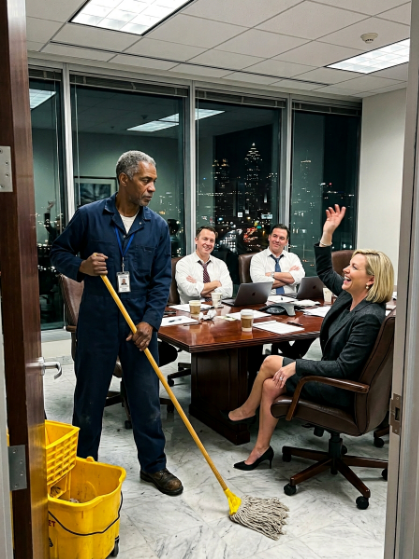
The board call happened at 6 AM Monday morning. Before the sun hit the glass. Before a single executive badge scanned through the lobby turnstile.
My attorney, Diane Cho, conferenced in the three independent directors first. They’d known about my ownership stake from the beginning — I’d disclosed it when I initiated the blind trust five years ago. What they hadn’t known was that I’d been inside the building. That I’d been mopping their floors. That I’d watched, for three years, exactly how this company treated the people who keep its lights on.
“Marcus,” Diane said, her voice crisp through the speaker, “the board is prepared to act on your recommendations. Do you want to walk them through the memo?”
I did.
I’d written it at my kitchen table at 2 AM — still in my coveralls, still smelling like floor cleaner and the lemon disinfectant I use on the bathroom tiles. The memo was four pages. Single-spaced. Everything I’d documented since I started the night shift at Calloway-Briggs Financial in January three years ago.
Page one: the culture audit. Every comment made in my presence that assumed I couldn’t hear, couldn’t understand, or didn’t matter. Danielle’s “add him to the list” was on there, but it wasn’t the worst. Not even close. There were comments about the mailroom staff. About the security guards. About the cleaning crew’s immigration status — speculative, cruel, said while laughing over eleven-dollar coffees.
Page two: the layoff methodology. I’d listened to six midnight sessions over three years. The pattern was clear — they cut from the bottom first, always. Not by performance. By proximity to power. The people farthest from the C-suite were the first to go. Every time.
Page three: the financial mismanagement. The crumpled spreadsheet Danielle tossed at my bucket wasn’t just a layoff projection. It was a document showing she’d approved severance packages for executives who “voluntarily resigned” — packages that were three times the contractual amount. The money was coming from operational budgets meant for equipment upgrades and employee training.
Page four: my recommendations.
The board voted unanimously.
At 8:47 AM, I walked into the lobby of Calloway-Briggs Financial wearing a charcoal suit I hadn’t touched in three years. No coveralls. No mop bucket. No lanyard badge that said CUSTODIAL STAFF.
The badge I wore said WEBB CAPITAL HOLDINGS — MANAGING DIRECTOR.
The security guard at the desk did a double-take. Then he smiled. James Ogden — sixty-one, retired Marine like me, works the overnight shift. He’d watched me mop these floors for a thousand nights and never once asked why I was always here so late. Maybe he knew. Maybe he’s just the kind of man who doesn’t ask questions that aren’t his to ask.
“Morning, Mr. Webb,” he said. First time he’d ever used my last name.
I nodded. “Morning, James. You’re getting a raise.”
The elevator ride to fourteen took forty-three seconds. I counted them.
When the doors opened, the boardroom was already full. All five executives from Tuesday night. Danielle Hargrove at the head of the table in her charcoal blazer and pearl earrings, laptop open, coffee cup positioned exactly where it always is — two inches from the edge, handle pointed left.
She didn’t look up when I walked in.
Nobody did.
Not until Diane Cho walked in behind me and said, “Good morning. Mr. Webb will be chairing this meeting.”
Danielle’s head snapped up.
I watched her eyes travel from my face to my suit to the badge on my chest. I watched the blood leave her cheeks. I watched her mouth form a word that never made it out.
“Sit down, Danielle,” I said. I didn’t raise my voice. I never raise my voice.
She sat.
I took the seat at the opposite end of the table. The seat nobody ever uses because it’s closest to the door — closest to where the janitor’s cart usually parks.
“Three things are happening today,” I said. “First: the layoffs you approved on Tuesday are cancelled. All forty-seven positions will be retained. The budget shortfall will be covered by eliminating the executive severance packages you’ve been overpaying by two hundred percent.”
Stephen Miller — VP of Operations — opened his mouth.
“Don’t,” I said. He closed it.
“Second: Ms. Hargrove’s position as CFO is dissolved, effective immediately. Her severance will be calculated at the contractual rate — not the inflated rate she’s been approving for her colleagues.”
Danielle stood up. Chair scraped against the marble.
“You can’t — who — this is—”
“Sit. Down.”
She didn’t sit. But she stopped talking.
“Third,” I said. I pulled a file folder from the inside pocket of my jacket. “Tamara Reid. Mailroom supervisor. Three years of performance reviews in the top two percent. Three years of applications to the analyst development program — all rejected by your office, Danielle. Rejected without review. I have the email records.”
Danielle’s jaw tightened.
“Tamara is being promoted to Vice President of Employee Relations, effective today. Her first task will be implementing the culture audit recommendations I’ve outlined in this memo.” I set the folder on the table. “You’re welcome to read it on your way out.”
The room was silent.
I stood up.
“One more thing,” I said. I reached into my other pocket and pulled out a crumpled piece of paper — water-stained, wrinkled, still smelling faintly of mop water.
The spreadsheet. The one Danielle had thrown at my bucket six days ago.
I smoothed it flat on the conference table. Pushed it toward her.
“Two points,” I said.
Then I walked out.
I took the elevator back down to the lobby. James was still at the desk. He looked at me with something between awe and amusement.
“You heading out, Mr. Webb?”
“Not yet,” I said. I reached into my briefcase and pulled out my lanyard. The old one. CUSTODIAL STAFF.
“I’ve got to finish the fourteenth floor,” I said. “Left the west hallway half done on Tuesday.”
James laughed. Deep, rolling, the kind of laugh that fills a marble lobby.
“You’re something else, Marcus.”
Maybe I am. But here’s what I know: you learn more about a company from the nightshift than you ever will from a boardroom. You learn who leaves their cups for someone else to clean. Who holds the door for the guy with the mop. Who looks you in the eye and who looks through you.
I spent three years mopping floors I already owned.
And I’d do it again.
Because the forty-seven people who kept their jobs this morning? They’ll never know what happened in that boardroom. They’ll just know their names weren’t on the list.
And Tamara Reid — the woman Danielle blocked for three years — she sat down at her new desk at 10 AM with a nameplate that said VICE PRESIDENT and a view of the Atlanta skyline through floor-to-ceiling glass.
The same glass I used to clean every Tuesday night.
She deserved that view. They all did.
The building didn’t change. The people inside it did.
And me? I still have the coveralls in my closet. Still have the steel-toe boots by the door. Still have the mop bucket badge in my wallet behind my driver’s license.
Because one day I might need to remind myself where I learned the most important lesson of my career: that power isn’t what you hold over people. It’s what you do when they think you have none.