Staff Sergeant Marcus Clark had stopped keeping count of the days somewhere around month eleven of his third deployment. The forward operating base in the Helmand Province dust bowl had a way of making time feel both endless and meaningless. Mail call came twice a week if the supply convoy made it through. Marcus never expected letters. His parents had passed while he was in basic. No wife. No kids. The only thing waiting for him stateside was an empty apartment and a storage unit full of furniture he never unpacked between tours.
What he did have was money.
Combat pay stacked up when you had no one to spend it on. So every month, after the chaplain’s service and before the nightly mortar watch, Marcus sat at the plywood desk in his hooch and logged into the hospital’s anonymous donation portal. He sent half his paycheck. Sometimes more. The portal let you pick categories—pediatric oncology, neonatal ICU, families in need. He always chose the kids.
He told himself it was because of his little sister, Emily, who had died of leukemia when he was twelve. The memory of her bald head and brave smile had never left him. He couldn’t save Emily. But maybe he could save someone else’s Emily.
He never put his name on the donations. Never checked the “notify recipient” box. He just sent the money and closed the laptop and went back to the war.
On the day his DEROS orders came through, Marcus packed his duffel with the same mechanical efficiency he’d used for three tours. He said goodbye to the guys in his squad, accepted their crude jokes about “finally getting laid stateside,” and boarded the C-17 with nothing but the uniform on his back and the weight of fourteen months in his chest.
He expected the usual arrival scene. Maybe a few families holding signs for other soldiers. A taxi line. The long shuttle to the parking garage where his truck had been sitting under a cover for over a year.
He did not expect the line.
The nurse—her name was Patricia, though he wouldn’t learn it until later—had been coordinating with the hospital’s family services department for three weeks. When Marcus’s flight manifest hit the system, she had called every family who had received anonymous funding in the past fourteen months. Some couldn’t come. Some didn’t want to. But twenty-three people had shown up at Terminal 4 with handmade signs, best clothes, and eyes full of the kind of gratitude that makes a grown man forget how to breathe.
The little girl was named Sofia. Seven years old. Acute lymphoblastic leukemia. Her mother had been working two jobs and still couldn’t cover the experimental treatment the doctors said might give her a fighting chance. The anonymous donations had covered the gap. Sofia had gone into remission four months earlier. Her mother had told her every night before bed that a soldier somewhere was helping her get better.
When Sofia saw Marcus step through the doors in his dusty uniform, she didn’t wait for permission. She ran.
Marcus felt her small body hit his leg like a mortar round made of hope. He went down on one knee without thinking, the same way he dropped when incoming fire started. But this time there was no danger. Only a child who smelled like strawberry shampoo and clean laundry and the future.
He held her while the applause rose around them. He felt every pair of eyes on his back, but for the first time in years he didn’t mind being seen. The war had taught him how to disappear. This moment was teaching him how to come home.
Patricia the nurse stepped closer. “We didn’t know how to thank you,” she said. “You never left a name. But the portal keeps records. When we saw your flight coming in, we called the families. Sofia’s mom drove from two counties over.”
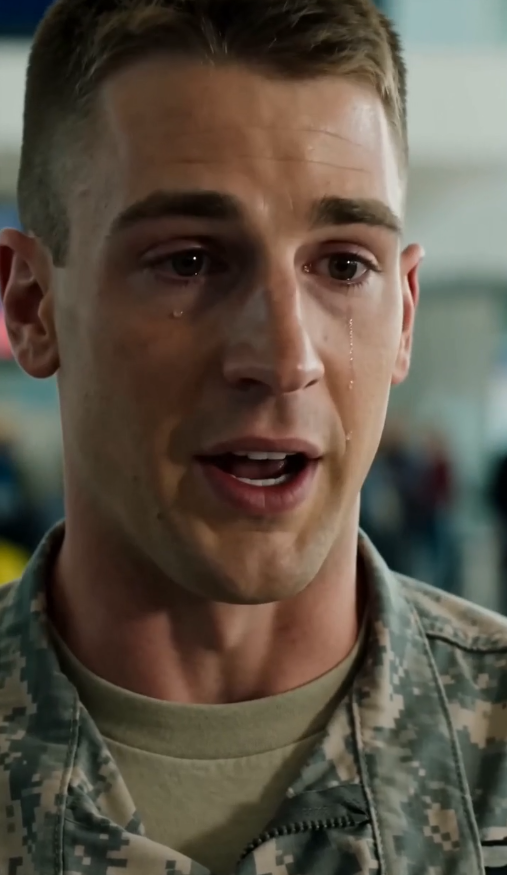
Marcus’s voice came out hoarse. “I didn’t want… I just couldn’t let another kid…”
He couldn’t finish. Sofia had pulled back enough to look at his face. She reached up with one small hand and wiped a tear from his cheek with the solemn concentration of a child who had seen too much of hospitals and not enough of normal.
“Mom said you saved me,” she repeated, like it was the most important fact in the world.
Marcus looked past her at the line. He saw the boy in the wheelchair—leukemia survivor, now in remission, holding a sign that said THANK YOU SOLDIER. He saw the mother whose daughter had needed a bone marrow transplant the insurance wouldn’t fully cover. He saw the old Vietnam vet who had simply come to stand in solidarity with another soldier who had found his own way to fight.
For fourteen months Marcus had told himself the donations were just numbers on a screen. A way to make the war feel less pointless. He had never allowed himself to picture the faces on the other end.
Now the faces had names. And one of them was in his arms.
He stood slowly, still holding Sofia. Her legs wrapped around his waist like she had no intention of letting go. The crowd was still clapping. Someone was crying openly. Marcus didn’t care.
He looked at Patricia. “Can I… can I meet them? All of them?”
She smiled through her own tears. “That’s why we’re here, Sergeant.”
The next hour passed in a blur of handshakes and stories and photographs Marcus knew he would keep for the rest of his life. He learned names. He heard about treatments and setbacks and victories. He accepted hugs from mothers who had stayed up nights praying for a miracle and found it in the form of an anonymous wire transfer from a war zone.
When the crowd finally thinned and it was just Marcus, Sofia, and her mother left in the now-quiet corner of the terminal, Sofia’s mother took his hand.
“I don’t know how to thank you,” she said. “But I want you to know… Sofia asks about you every night. Not ‘the soldier.’ She calls you ‘my soldier.'”
Marcus swallowed hard. “Tell her she saved me too.”
He meant it. The war had taken pieces of him he wasn’t sure he’d ever get back. But this child, this line of people, this moment—they had given something back. Not redemption. Something quieter. Something like belonging.
He walked out of the airport that day with Sofia’s hand in his and her mother on his other side. His duffel was still heavy, but the weight inside his chest had shifted. For the first time since Emily died, Marcus Clark didn’t feel like the only survivor.
Some soldiers come home to parades.
Some come home to silence.
Marcus came home to a line of people he had saved without ever meeting—and who had saved him right back.