Officer Daniel Ruiz had been working the night desk for eight months when the old man walked in with the lilies. The station on 47th and Mercer was quiet that Tuesday, the kind of quiet that made the fluorescent buzz feel loud. Daniel was twenty-three, two years out of the academy, still learning how to hold the weight of the badge without letting it show in his shoulders.
He was sorting incident reports when the automatic doors hissed open. An old man in a jacket that had seen better decades stepped inside. He carried the lilies like they were both fragile and heavy, the way a man carries something he can’t afford to drop.
Daniel looked up. “Visitors wait outside after eight, sir.”
The old man didn’t answer right away. He crossed the lobby in measured steps, boots soft on the tile. When he reached the counter he set the vase down with both hands, centering it exactly between the two computer monitors. The water inside the glass caught the light and threw small rainbows across the form Daniel had been filling out.
“They’re for officer Ruiz,” the old man said. “You can leave them.”
Daniel felt the words before he understood them. Something in the timbre, the way the man said “Ruiz” like it was a name he’d practiced. He looked at the name tag on his own chest. RUIZ. Black letters on silver. Issued six months ago.
Behind him, Shift Commander Morales leaned over the partition. “Chief, that’s him.”
Daniel turned. Morales was staring at the old man the way a man stares at a ghost he half-expected.
The old man met Daniel’s eyes. His face was a map of weather and time—deep lines around the mouth, a scar above the left eyebrow, skin the color of old saddle leather. But the eyes were clear. Waiting.
“The man who wrapped you in my jacket the night your mother ran,” he said.
The sentence didn’t ask a question. It simply arrived, like a letter twenty years late.
Daniel’s throat closed. The station sounds—phones, distant radio chatter, the hum of the vending machine—fell away. He was six years old again. The porch light was out because the bulb had burned out three weeks earlier and his mother kept forgetting to replace it. The rain had started at dusk, thin at first, then harder. She had been packing a duffel bag in the kitchen, moving fast, not looking at him.
“Don’t follow me, Danny,” she had said. “You’ll be better off.”
He had stood on the porch in his thin pajamas, watching her taillights disappear into the wet dark. The rain soaked through to his skin in minutes. He didn’t cry. He just sat on the top step and waited for something he couldn’t name.
That was when the stranger appeared.
An old man—younger then, but still old to a six-year-old—had come up the walkway carrying a paper bag of groceries. He saw the boy, saw the empty house, saw the rain. Without a word he took off his jacket, the only one he owned, and wrapped it around Daniel’s shoulders. The lining was warm from the man’s body. It smelled of tobacco and soap and something like pine.
They sat together on the step for what felt like hours. The man didn’t ask questions. He just kept one arm around the boy’s small frame and hummed a song Daniel didn’t know. When the police cruiser finally pulled up—someone had called from the corner store—the man stood, nodded once to the officers, and walked away into the rain. He never gave his name.
Daniel had asked about him for years. The social worker who took him in said they never found the man. The jacket had been logged as evidence and eventually lost in the system. Daniel grew up in three foster homes before aging out. He joined the department because he wanted to be the person who showed up when a kid was left in the rain.
Now that person was standing in front of him, older, thinner, but the same clear eyes.
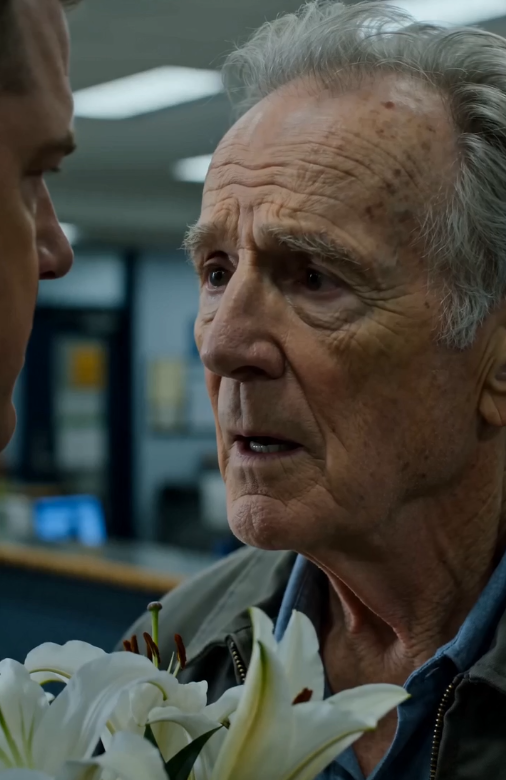
Daniel’s voice came out rough. “How did you find me?”
The old man—Harlan was his name, though Daniel wouldn’t learn it until later—shifted his weight. “Saw your picture in the paper last year. The academy graduation. Knew those eyes. Knew that jaw. A man doesn’t forget the face of the child he sat with in the rain.”
Morales had gone quiet behind them. The desk sergeant at the other end of the counter was pretending not to listen.
Daniel looked at the lilies. “Why now?”
Harlan’s hands tightened on the edge of the counter. “Because I got a letter from the VA last month. Stage four. They gave me six months, maybe eight if I’m lucky. I don’t have family. Never did. But I had that one night. And I wanted to see what kind of man that boy became before I go.”
The words landed heavy and clean. No self-pity. Just fact.
Daniel walked around the end of the counter. He didn’t know what he was going to do until he was doing it. He stopped in front of the old man, close enough to smell the same faint pine-and-tobacco scent that had lived in his memory for seventeen years.
He reached out and took Harlan’s hand. It was calloused, the knuckles swollen with age and work.
“You saved my life that night,” Daniel said. “Not just from the rain. From what comes after when a kid thinks no one is coming.”
Harlan’s eyes glistened but didn’t spill. “You were worth sitting in the rain for, son.”
They stood there in the middle of the police station lobby, the white lilies between them like a third witness. Morales cleared his throat once, then turned away to give them the moment. The desk sergeant suddenly found urgent work at the other end of the counter.
Daniel didn’t let go of the old man’s hand for a long time.
Later, after Harlan had gone—Daniel made him promise to come back the next day so they could talk properly—he sat at his desk with the vase of lilies. The petals were beginning to open wider under the warm air. He picked up the phone and called the only person who might understand.
His foster mother answered on the third ring.
“Mama,” he said. “I found him. The man from the rain.”
She was quiet for a moment. Then she said, “Bring him to Sunday dinner. Tell him I still have his jacket.”
Daniel smiled for the first time in what felt like hours. “He doesn’t need it anymore. He gave it to me a long time ago.”
He hung up and looked at the lilies again. White. Pure. The kind of flower you bring when words aren’t enough.
Outside, the city kept moving. Sirens in the distance. Someone laughing too loud on the sidewalk. But inside the station, for a few minutes, time had bent. A debt older than Daniel’s badge had been acknowledged, not with money or medals, but with the simple act of a man walking through a door with flowers and a name.
Some nights never end.
They just wait for the right face to walk back through the door—and for the courage to say the words that were left unsaid in the rain.